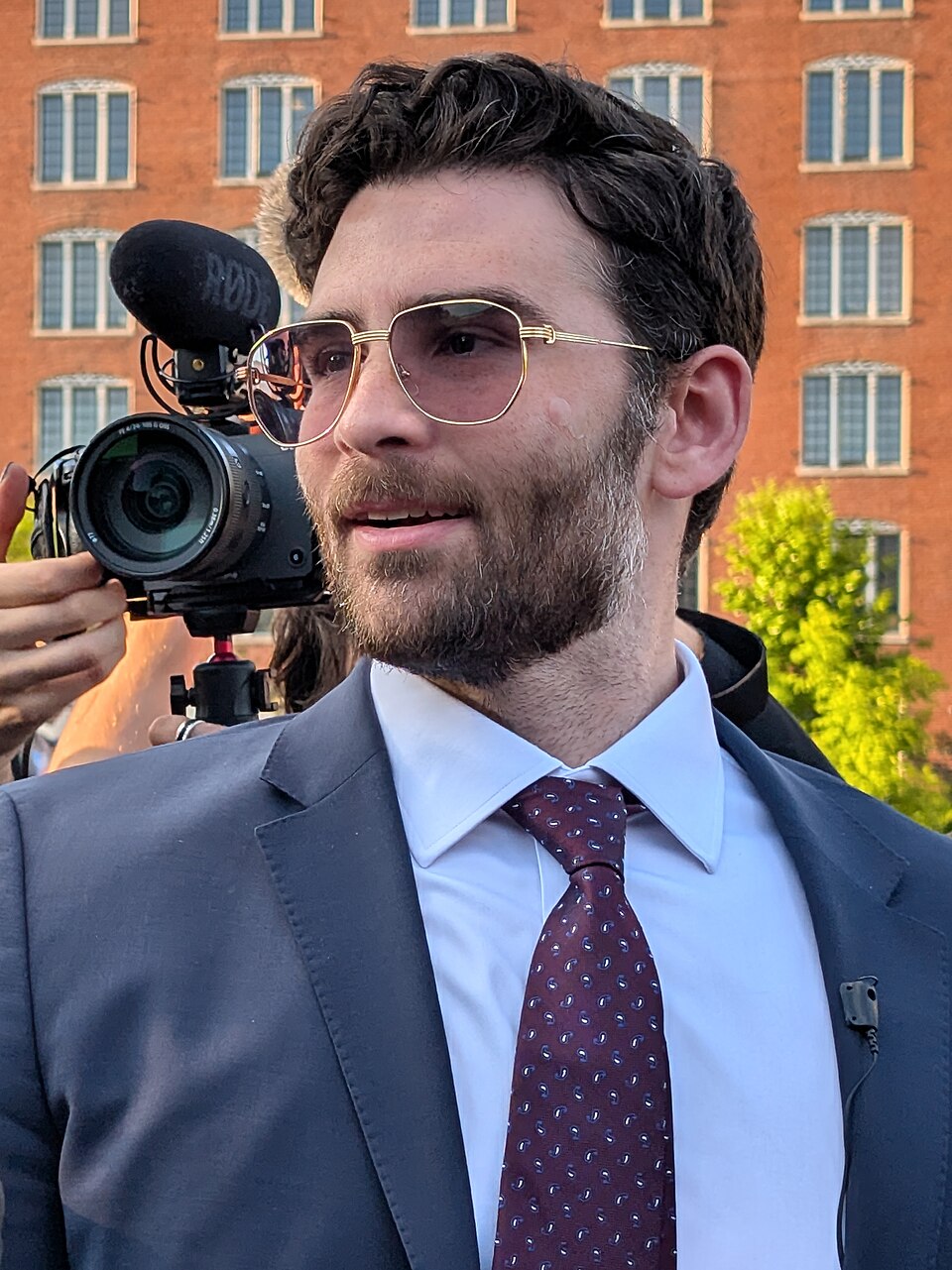
PoisonwithahawkseyeSourceCC BY 4.0Existing Commons crop retained; downloaded at Commons display resolution. No additional edits.
Hasan Piker, also known as HasanAbi, is a political commentator and livestream host. He broadcasts on Twitch and publishes videos on YouTube, discussing current events and politics. Piker previously made programs for The Young Turks, including Agitprop with Hasan Piker and The Breakdown. He graduated from Rutgers University with degrees in political science and communications.
DI has documented statements by Hasan Piker on 2026 Midterm Elections, Antisemitism, and Artificial Intelligence, among other topics. Read the quotations, original sources and related cases below.
Role at the time: Streamer and political commentator
Defended or excused
Statement summary
Asked about his statement that he would never criticise Mao Zedong, Piker called Mao "a great man of history" and, asked to define the "excesses" he acknowledged, described deaths arising from mismanagement and famine.
“I'll never make fun of Mao Zedong. He's a great man of history. Of course, there were a lot of excesses. -- What do you mean by excesses? -- Deaths. They're born out of mismanagement and famine. It was a huge crisis.”
Open the original interview (opens in a new tab)"Hasan Piker on political violence, Israel and why he praises China" -- full Axios Show episode (YouTube)08:57-09:24 Israel as ally; 32:09-32:38 Zionism and fascism; 33:42-34:07 whether his rhetoric could incite violence; 34:34-34:49 Gaza and the Holocaust; 36:36-36:55 China trajectory; 41:33-42:27 and 44:48-46:06 Mao Zedong; 52:33-54:14 Tibet
Why we used this label
The claim at issue here is Piker's assessment of Mao Zedong. Piker defends it, reaffirming that Mao is "a great man of history" and characterising the mass deaths under his rule as "excesses" born of mismanagement and famine rather than as deliberate policy. He frames the original remark as partly a joke but does not withdraw the assessment.
Role at the time: Streamer and political commentator
Defended or excused
Statement summary
In a response video, Piker said it would have been better not to do the Axios interview and better not to have used the phrase "pound for pound," while maintaining that the underlying analysis was true and that he is too stubborn to avoid saying it.
“[It] would have been probably better if I just didn't do the interview at all. Having said that, it certainly would have been better if I didn't say pound for pound. ... Perhaps someone with a name like Hasan, who is being aggressively slammed into the campaign of a guy who's named Abdul, should not be saying those things. Regardless, I'm too hardheaded and too stubborn to a fault, especially when it comes to analysis and perspective.”
Watch the original video (opens in a new tab)Hasan Piker, "AXIOS INTERVIEWER TRIED TO GET ME CANCELLED" (YouTube)01:36-02:15 (partial regret); 04:30-04:51 (maintains the claim is truthful); 22:24-22:46 (reads a viewer comment defending the phrasing)
Why we used this label
Relative to the claim at issue -- that America commits more terrorism than al-Qaeda -- Piker continues to defend it, saying elsewhere in the same video that the quote is "truthful, but it doesn't matter because being truthful is utterly irrelevant." His regret is confined to the wording ("pound for pound") and to the tactical decision to give the interview while tied to a Senate campaign; he does not withdraw the underlying comparison. This is recorded as a partial regret about expression, not a retraction.
Role at the time: Political commentator and streamer, interviewed on MS NOW’s “Clock It” by Eugene Daniels and Symone D. Sanders Townsend
Defended or excused
Statement summary
Asked on MS NOW whether his formulation was provocation or genuine belief, Piker reaffirmed it — “I do believe that” — describing it as intentionally provocative and as one of his standard examples, while acknowledging Hamas is a religious fundamentalist organisation that has engaged in violent actions and attributing that violence to the occupation.
“Is Hamas a religious fundamentalist operation that have engaged in violent actions? Of course they have, absolutely. But that violence is directly born out of, and even that repression is directly born out of, the conditions brought about by the occupation that’s been going on for 80 plus years.”
Watch the original video (opens in a new tab)MS NOW: “Hasan Piker PRESSED by MS NOW in FIERY interview” (full episode)22:37–23:10 (the comparison and Piker’s affirmation); 25:45–26:20 (Sanders Townsend’s rejection of the analogy).
Why we used this label
On Piker’s Hamas-over-Israel comparison and whether it whitewashes or excuses Hamas, he defends the comparison directly, affirming that he believes it and citing it as an example he uses “fairly frequently,” expressly linking it back to the Pod Save America exchange that anchors this case. His concession that Hamas is “a religious fundamentalist operation that have engaged in violent actions” does not make the position mixed: it is the same lesser-evil structure already recorded here, in which the acknowledgement is followed immediately by attribution of that violence to the occupation. “Minimized” understates a speaker who is affirmatively restating and justifying the comparison rather than downplaying a concern about it.
Role at the time: Twitch streamer and political commentator, interviewed for "The Axios Show"
Defended or excused
Statement summary
In a further excerpt from the same Axios interview, given first to CNN, Alex Thompson asked Piker whether Iran should be free to build a nuclear weapon. Piker said Iran has a right to defend itself like any sovereign nation and, citing political scientist John Mearsheimer, argued that in an age of proliferation only nuclear-armed states can generate true sovereignty, applying the same reasoning to Ukraine. Asked directly whether the Middle East would be more stable if Iran had a nuclear weapon, he answered that he believes it would. He twice qualified the answer, saying he does not want Iran, the United States, Russia or China to hold nuclear arms and that he was not advocating Iranian armament, and added that he regards the nuclear conversation as a distraction that Tehran uses as leverage for sanctions relief. His deterrence reasoning and his characterisation of Iranian conduct are his own.
“I think Iran, much like any other sovereign nation, has a right to defend itself, regardless of its domestic policies. … countries that would have nuclear arms in an age of nuclear proliferation are the only countries that can generate true sovereignty. Now, having said that, do I want Iran to have nuclear arms? No. But I also don't want America or Russia or China to have nuclear arms either. … Do you think the Middle East would be more stable if Iran had a nuclear weapon? I believe yes. I think that the Middle East would be more stable. Having said that, once again, I'm not advocating.”
Read the original post (opens in a new tab)Alex Thompson posts Piker's full answer on Iran and nuclear weapons1:40 clip posted by the interviewer, described as Piker's full answer.
Why we used this label
As the author of the claim, Piker asserts and defends it: asked directly, he answers that he believes it, and supplies a deterrence rationale attributed to Mearsheimer. The closest competing label is “Mixed or conditional”, given his repeated qualifiers that he does not want any state to hold nuclear arms and is "not advocating"; it loses because those qualifiers address what he would prefer and what he is urging, not whether the stability claim is true, and he does not withdraw or condition the claim itself. Note that the widely circulated headline carries only the stability answer without the qualifiers.
Role at the time: Twitch streamer and political commentator, posting on his verified X account
Defended or excused
Statement summary
In further posts the same day, beyond the one accusing Axios of clickbaiting his answer, Piker expanded the argument behind his comparison. He said American elites terrorise the world while ordinary Americans pay for it, that trillions were spent fighting terror the United States had itself created in order to cover resource extraction, and that the result was death abroad and poverty at home alongside a growing military-industrial complex. The Washington Examiner reported he also wrote that Trump and the Republican Party are "Epstein-class terrorists" and cited strikes on fishermen off South America, arms to Israel and sanctions on Cuba. These are his characterisations and are not established here.
“our elites terrorize the entire world while ordinary americans continue to foot the bill. we spent trillions 'fighting' the terror we created to provide cover for our oil barons stealing 3rd world resources … it only amounted to more death overseas, more poverty at home. all while the MIC ballooned. no houses, no hospitals, no schools-just a growing crisis of homelessness, underemployment and diseases of despair in the wealthiest country on earth”
Here he neither withdraws nor qualifies it but supplies the underlying argument, framing U.S. conduct as elite-driven terror paid for by ordinary Americans. That is a continued defence of the claim under scrutiny, consistent with his interview answer (955) and his response to the Axios framing (967), and it is recorded separately because it is a distinct statement making a distinct argument rather than a restatement. The closest competing label is “Mixed or conditional”; it loses because he attaches no condition and combines no opposing position.
Role at the time: Twitch streamer and political commentator, posting on his verified X account
Defended or excused
Statement summary
Responding on X the same day to the teaser clip Axios published from his interview, Hasan Piker accused the outlet of "farming the interview" and turning what he called a nuanced answer about acts of terror into clickbait. He did not withdraw the comparison: he restated the substance by citing United States arming of al-Qaeda since the September 11 attacks and saying a former al-Qaeda commander became president of Syria. Those historical characterisations are his own and are not established here.
“oh this is why they were farming the interview. i give a nuanced answer about acts of terror this admin has caused and they clickbait it. he asked, i gave a nuanced answer. we've armed al qaeda since 9/11, we made its former commander the president of syria.”
The post's opening move is a complaint about Axios's framing, which would point to “Challenged the characterization”, and that is the closest competing label. It loses because the passage goes on to express a clearer substantive endorsement of the claim itself: rather than qualifying or withdrawing the comparison, he supplies further argument for it. Under the tie-break between condemnation and characterisation, a substantive evaluation that follows a framing dispute governs the label. He therefore continues to defend the claim under scrutiny, consistent with his interview answer (955).
Role at the time: Twitch streamer and political commentator, interviewed for "The Axios Show"
Defended or excused
Statement summary
Asked in an interview for "The Axios Show" whether America commits more terrorism than the organization behind the September 11 attacks, Hasan Piker answered "Pound for pound as far as the number of deaths, yes," and said the United States has "caused tremendous terror all around the world." He grounded the claim in a U.S. missile strike that hit an elementary school in Minab, Iran, saying that killing 140 schoolgirls is an act of terror, while adding that this does not make all Americans terrorists and calling for accountability so that such strikes do not recur. Piker's casualty figure and his characterisation of U.S. conduct as terrorism are his own; the Associated Press found evidence at least one U.S. missile struck the school, but the death toll is not established.
“Pound for pound as far as the number of deaths, yes. … We have caused tremendous terror all around the world. … If you're killing 140 schoolgirls, that is an act of terror. This doesn't mean that all Americans are terrorists, but the reality of the matter is we have to create an environment of accountability to ensure things like that never happen again.”
As the speaker of the claim under scrutiny, Piker asserts and defends it: he affirms the comparison directly in answer to the question, supplies a specific factual basis for it, and frames it as an argument for accountability rather than withdrawing or softening it. That matches how his own statements are classified in his other cases, such as 178 in the "Hamas over Israel" case. The closest competing label is “Mixed or conditional”, which loses because his qualification — that this does not mean all Americans are terrorists — limits the claim's scope without conditioning the comparison itself.
Role at the time: Political livestreamer and commentator
Mixed or conditional
Statement summary
Hasan Piker said the arrangement could be good for middle powers but is likely purely symbolic, while also expressing personal distaste for the European Union.
“I mean on the one hand I think this is good for middle powers, on the other hand I feel like this is purely symbolic and I also despise the European Union.”
Piker holds two competing views simultaneously -- that the arrangement is good for middle powers, but also purely symbolic -- without landing on a clear yes or no, matching the case's convention for genuinely torn reactions (cf. Poilievre).
Hasan Piker told Axios the US has caused more terrorism than al-Qaeda "pound for pound." The full episode added more contested claims -- on Iran's nuclear programme, Mao Zedong, China and Zionism -- and drew condemnation from both parties.
Cornell says its investigation led to expulsions and suspensions. Critics say its response to the Chi Phi allegations was inadequate and opaque. The civil complaint mentions essays as a way to mitigate conduct, not as the only sanction.
The European Commission president offered to open the door for Canada to become the European Union's first associate member. Mark Carney welcomed the ambition, Pierre Poilievre set red lines, and Donald Trump threatened tariffs. Nobody has defined what the status would mean.
The Front Line Action's AI-generated ad opposing Abdul El-Sayed drew criticism from a political scientist who says its terrorism-related framing evokes anti-Muslim stereotypes. The sponsor's leader asked which imagery was Islamophobic.
Mike Rogers accused Abdul El-Sayed of funding his Senate campaign with terrorist-group money. The case examines the allegation, FEC records documenting outside-support transfers, related public responses, and whether any record establishes a direct payment from a designated organization.
Read Macklemore's 'Free Palestine' speech excerpts and the full transcript source. Compare the promoter's venue statement with his account of leaving Ed Sheeran's U.S. tour.
Trump backs company controls and outside audits for frontier AI. Critics want enforceable federal safeguards, and the White House now calls incident reporting mandatory without identifying enforcement mechanisms or penalties.
At the August 30, 2026 Jewish American Summit, Mosab Hassan Yousef said he did not want Muslims in America and told them to leave and reform their countries of origin. Critics called the remarks and audience applause anti-Muslim bigotry.
Read twelve distinct appeals by Mike Rogers and his campaign for Abdul El-Sayed to disavow Hasan Piker, documented as of September 21, 2026. The timeline counts dated requests and excludes repeated coverage.
JD Vance and conservative commentators challenged Abdul El-Sayed’s opposition to Sharia bans. El-Sayed defended religious freedom and rejected imposing his faith, while critics disputed his comparison between Sharia and Christian canon law.
Larry Klayman sued Hasan Piker over his August 20 remarks about American Jews, seeking more than $150 million. Piker had earlier disputed the threatening interpretation.
Mike Rogers attributed a belief about 9/11 to Abdul El-Sayed based on his association with Hasan Piker. El-Sayed rejected that belief and challenged the premise that campaigning together establishes agreement.