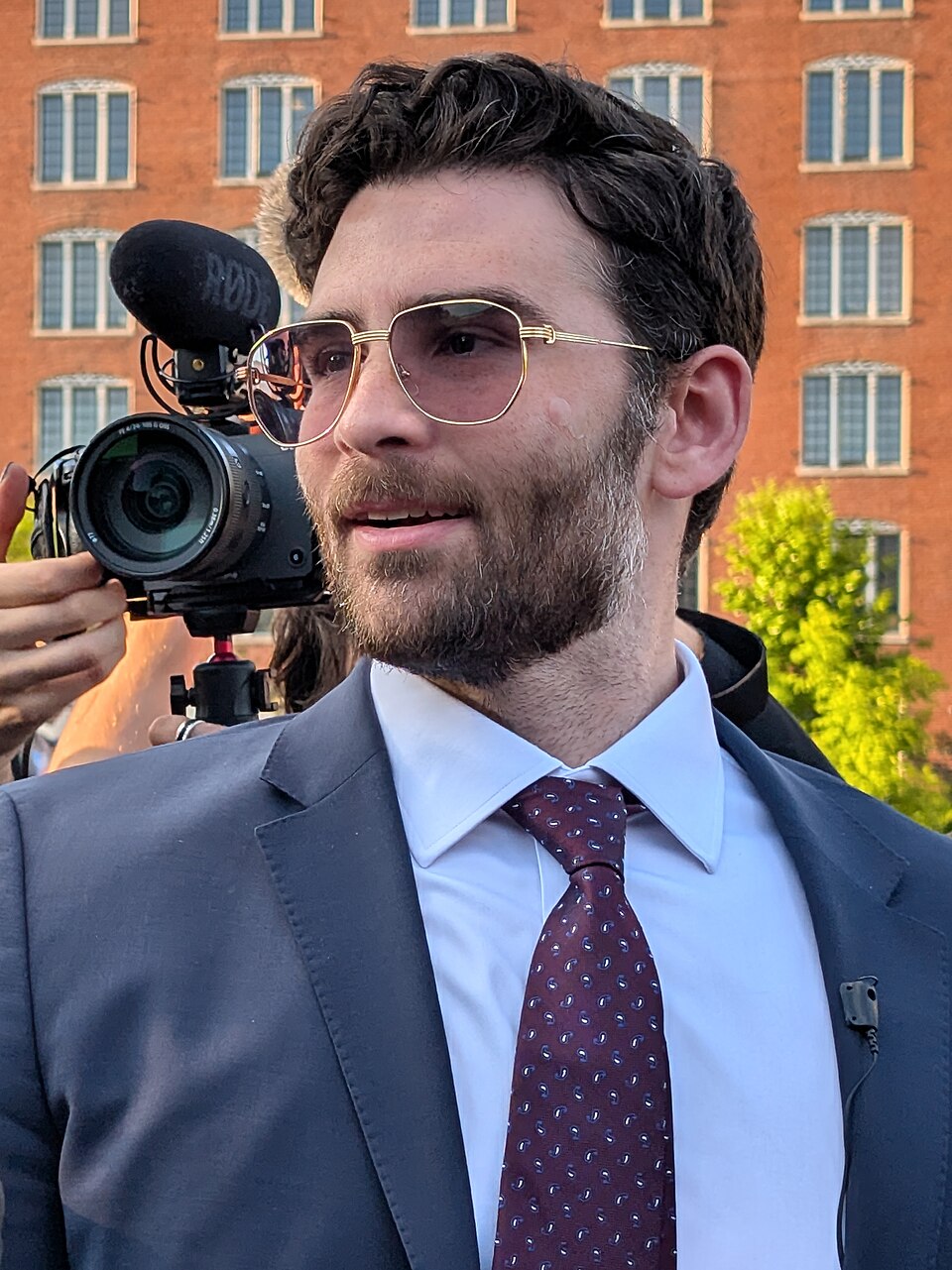
PoisonwithahawkseyeSourceCC BY 4.0Existing Commons crop retained; downloaded at Commons display resolution. No additional edits.
Hasan Piker, also known as HasanAbi, is a political commentator and livestream host. He broadcasts on Twitch and publishes videos on YouTube, discussing current events and politics. Piker previously made programs for The Young Turks, including Agitprop with Hasan Piker and The Breakdown. He graduated from Rutgers University with degrees in political science and communications.
DI has documented statements by Hasan Piker on 2026 Midterm Elections, Antisemitism, and Artificial Intelligence, among other topics. Read the quotations, original sources and related cases below.
Role at the time: Political commentator and Twitch streamer, on his livestream
Challenged the characterization
Statement summary
Reacting to the Meet the Press exchange on his stream, Piker called the accusations against El-Sayed and his family heinous and slanderous, and said a competent news organization should not raise their salience by putting them to him.
“But if you are a competent media organization, you don't raise the salience of heinous and slanderous accusations. Because when you present them as a serious media organization, you're offering legitimacy to the claim.”
Watch the original video (opens in a new tab)Hasan Piker's October 11 Twitch stream on El-Sayed's Meet the Press interview3:52:40-3:53:45, reaction to the Meet the Press question about Rogers's attacks
Why we used this label
Relative to the allegations that El-Sayed and his family have terrorist ties, Piker calls them slanderous and objects to NBC putting them to El-Sayed. He disputes their legitimacy rather than answering a specific factual claim, so challenging the characterization fits better than a denial.
Role at the time: Political commentator and livestream host
Defended or excused
Statement summary
In an Axios interview, Hasan Piker said his comparison of Israel to Hamas was intentionally provocative and personally held. He also said he was not advocating Hamas governing Palestine or defending the October 7 atrocities. The statement reiterates and explains Piker’s comparison while limiting what he said it did not mean.
“This is intentionally a provocative statement, but it’s also something that I personally believe as well. I’m not being insincere when I say this.”
Piker explicitly reaffirmed the contested comparison as a view he personally holds. His accompanying disclaimer about Hamas governance and the October 7 atrocities is preserved as relevant qualification.
Role at the time: Political streamer and commentator
Challenged the characterization
Statement summary
In an Axios interview published September 18, Hasan Piker said Abdul El-Sayed was making a mistake by taking ownership of an insincere characterization while distancing himself from Piker.
“I think he is making a mistake with taking ownership over something that I think most voters understand is insincere.”
Role at the time: Political commentator and streamer, interviewed on Lovett or Leave It
Defended or excused
Statement summary
Piker accepted Lovett’s criticism of his framing, agreeing there was truth in it and that he had at times become a problem for candidates such as Abdul El-Sayed, while maintaining that the difficulty lay in his becoming a distraction rather than in the substance of what he had said.
“No, I think you’re — I think there’s truth to what you’re saying. Absolutely. … And clearly that’s, there are times in which you’ve become a problem for people like Abdul. And the problem isn’t necessarily what I’m saying. The problem is that I become a distraction, because you have a finite amount of time where you are supposed to make your case to the people.”
Watch the original video (opens in a new tab)Lovett or Leave It: “Jon Lovett & Hasan Piker on Macklemore, Trump’s Economy & Republican Media”08:35–11:39 (Macklemore and Ed Sheeran monologue); 14:28–34:44 (interview with Hasan Piker), with the exchange on the Axios interview at approximately 27:00–29:00.
Why we used this label
On Piker continues to defend the substance of his claims while conceding their tactical cost, which is the same structure as his earlier statement that he regretted the phrase “pound for pound” while maintaining the claim was truthful. The concession here goes further than that one: he accepts that the criticism of his framing has truth in it and that he has become a problem for candidates. It is still not a withdrawal, because he expressly locates the problem in his being a distraction rather than in what he said.
Role at the time: Streamer and political commentator
Defended or excused
Statement summary
Asked whether Israel should be a U.S. ally at all, Piker said it should not in its current formation, while saying he applies the same standard to Saudi Arabia and other authoritarian governments.
“I don't think Israel in its current formation should be an ally, but I also feel that same exact way about Saudi Arabia. I feel that same exact way about countries that are operating in illiberal and undemocratic authoritarian ways. Of course, that standard is not applied to American allies at all.”
Open the original interview (opens in a new tab)"Hasan Piker on political violence, Israel and why he praises China" -- full Axios Show episode (YouTube)08:57-09:24 Israel as ally; 32:09-32:38 Zionism and fascism; 33:42-34:07 whether his rhetoric could incite violence; 34:34-34:49 Gaza and the Holocaust; 36:36-36:55 China trajectory; 41:33-42:27 and 44:48-46:06 Mao Zedong; 52:33-54:14 Tibet
Why we used this label
The claim at issue here is Piker's position that Israel should not be a U.S. ally in its present form. He advances and defends it, and pre-empts the charge of singling Israel out by extending the same standard to Saudi Arabia, Turkey and other governments he describes as authoritarian.
Role at the time: Streamer and political commentator
Defended or excused
Statement summary
Asked about his statement that Zionist tendencies should be treated like rabid neo-Nazism, Piker affirmed that he believes Zionism is fascism, and said he is not worried that his audience would be violent towards Zionists.
“I believe Zionism is fascism. However, I live in the United States of America. So I have to deal with a lot of people who I personally think exhibit the qualities of fascists. And yet we sometimes still organize with these people. ... I'm not worried that they're going to be violent against Zionists. No, I'm not.”
Open the original interview (opens in a new tab)"Hasan Piker on political violence, Israel and why he praises China" -- full Axios Show episode (YouTube)08:57-09:24 Israel as ally; 32:09-32:38 Zionism and fascism; 33:42-34:07 whether his rhetoric could incite violence; 34:34-34:49 Gaza and the Holocaust; 36:36-36:55 China trajectory; 41:33-42:27 and 44:48-46:06 Mao Zedong; 52:33-54:14 Tibet
Why we used this label
The claim at issue here is Piker's characterisation of Zionism as fascism and his associated rejection of the concern that this rhetoric could incite violence. He defends both, restating the characterisation when it is read back to him and expressly denying the incitement concern when Alex Thompson puts it to him twice.
Role at the time: Streamer and political commentator
Defended or excused
Statement summary
Piker said he worries a Chinese child may have better living conditions than an American one within one or two decades, framing this as an argument for domestic investment rather than foreign wars.
“I think trajectory-wise, I worry that a Chinese child might have better conditions in the next decade or next two decades than an American one. And I think that should worry every American citizen. Not worry them from a xenophobic perspective, mind you, but it should be an alarming thing that we recognize and seek to address.”
Open the original interview (opens in a new tab)"Hasan Piker on political violence, Israel and why he praises China" -- full Axios Show episode (YouTube)08:57-09:24 Israel as ally; 32:09-32:38 Zionism and fascism; 33:42-34:07 whether his rhetoric could incite violence; 34:34-34:49 Gaza and the Holocaust; 36:36-36:55 China trajectory; 41:33-42:27 and 44:48-46:06 Mao Zedong; 52:33-54:14 Tibet
Why we used this label
The claim at issue here is Piker's comparison of Chinese and American living standards. He advances and defends it, while expressly distancing it from xenophobic framing and presenting it as a case for redirecting resources from overseas wars to domestic development.
Hasan Piker told Axios the US has caused more terrorism than al-Qaeda "pound for pound." The full episode added more contested claims -- on Iran's nuclear programme, Mao Zedong, China and Zionism -- and drew condemnation from both parties.
Cornell says its investigation led to expulsions and suspensions. Critics say its response to the Chi Phi allegations was inadequate and opaque. The civil complaint mentions essays as a way to mitigate conduct, not as the only sanction.
The European Commission president offered to open the door for Canada to become the European Union's first associate member. Mark Carney welcomed the ambition, Pierre Poilievre set red lines, and Donald Trump threatened tariffs. Nobody has defined what the status would mean.
The Front Line Action's AI-generated ad opposing Abdul El-Sayed drew criticism from a political scientist who says its terrorism-related framing evokes anti-Muslim stereotypes. The sponsor's leader asked which imagery was Islamophobic.
Mike Rogers accused Abdul El-Sayed of funding his Senate campaign with terrorist-group money. The case examines the allegation, FEC records documenting outside-support transfers, related public responses, and whether any record establishes a direct payment from a designated organization.
Read Macklemore's 'Free Palestine' speech excerpts and the full transcript source. Compare the promoter's venue statement with his account of leaving Ed Sheeran's U.S. tour.
Trump backs company controls and outside audits for frontier AI. Critics want enforceable federal safeguards, and the White House now calls incident reporting mandatory without identifying enforcement mechanisms or penalties.
At the August 30, 2026 Jewish American Summit, Mosab Hassan Yousef said he did not want Muslims in America and told them to leave and reform their countries of origin. Critics called the remarks and audience applause anti-Muslim bigotry.
Read twelve distinct appeals by Mike Rogers and his campaign for Abdul El-Sayed to disavow Hasan Piker, documented as of September 21, 2026. The timeline counts dated requests and excludes repeated coverage.
JD Vance and conservative commentators challenged Abdul El-Sayed’s opposition to Sharia bans. El-Sayed defended religious freedom and rejected imposing his faith, while critics disputed his comparison between Sharia and Christian canon law.
Larry Klayman sued Hasan Piker over his August 20 remarks about American Jews, seeking more than $150 million. Piker had earlier disputed the threatening interpretation.
Mike Rogers attributed a belief about 9/11 to Abdul El-Sayed based on his association with Hasan Piker. El-Sayed rejected that belief and challenged the premise that campaigning together establishes agreement.