Public disputes concerning the European Union, its institutions, its member states' shared decisions, and its relationships with countries outside the bloc.
Published coverage on this page: 1 case · 7 statements. Statements are ordered newest first.
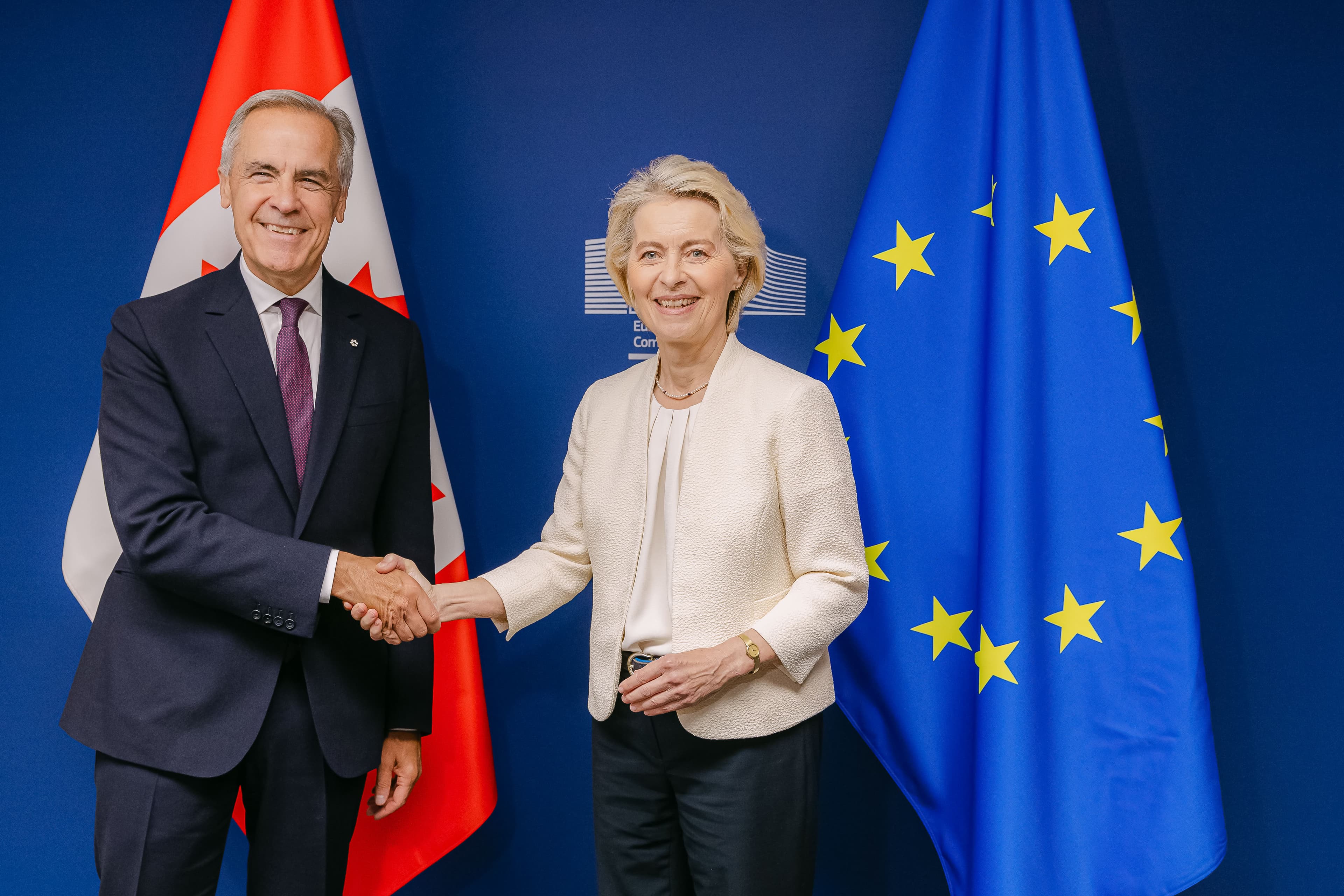
The European Commission president offered to open the door for Canada to become the European Union's first associate member. Mark Carney welcomed the ambition, Pierre Poilievre set red lines, and Donald Trump threatened tariffs. Nobody has defined what the status would mean.
Role at the time: Prime Minister of Canada, addressing the European Parliament
Defended or excused
Statement summary
Addressing the European Parliament the day after the proposal, Carney said Canada welcomes the ambition and cited polling showing majority Canadian support for closer ties with Europe. He attributed the associate-member phrase to von der Leyen rather than using it of his own position, said he was not proposing a rival power bloc, and framed the aim as resilience against outside control of markets, sovereignty and territorial integrity.
Quotation excerpt
“Yesterday, President von der Leyen spoke of moving beyond CETA to an alliance for the future – opening the door to Canada becoming the European Union’s first associate member. Canada welcomes this ambition – polling shows an overwhelming…”
Read full quotation
“Yesterday, President von der Leyen spoke of moving beyond CETA to an alliance for the future – opening the door to Canada becoming the European Union’s first associate member. Canada welcomes this ambition – polling shows an overwhelming majority of Canadians support much closer ties with Europe.” … “I want to be precise about what I am not proposing. I am not proposing a third bloc in order to become a great-power rival – only with better manners.” … “We are pursuing resilience so that no one can control our open markets, impair our sovereignty, threaten our territorial integrity, or undermine our freedoms, our democracies, our rule of law.”
Read the official statement (opens in a new tab)Prime Minister Carney delivers address to the European ParliamentPassages on welcoming the ambition, on what is not being proposed, and on pursuing resilience
What this label refers to
Relative to whether Canada should become an associate member of the European Union, Carney welcomes the proposal and commits his government to pursuing it, which supports the proposition. The closest competing label is mixed_or_conditional, and it is a genuine question here, because he welcomes von der Leyen's “ambition” rather than the label itself, his office's readout of their meeting avoids the term, and he has promised a parliamentary vote on the final structure. Those are qualifications about scope and process rather than conditions on his own support, which is why this stays a defence. An editor may reasonably disagree.
Role at the time: Former Canadian ambassador to Germany and to France and former special envoy to the European Union, now diplomat in residence at the Université de Montréal, interviewed on CBC's Power & Politics
Challenged the characterization
Statement summary
Interviewed on CBC's Power & Politics, former Canadian ambassador and EU special envoy Stéphane Dion described Ursula von der Leyen's associate-membership offer as a "friendly exaggeration": an overstatement because the term is not clear and, in his account, not one Canada or the member-state leaders were ready to endorse, but friendly because it signalled how closely she wants to work with Canada. He said Canada will not transfer federal or provincial sovereignty to Brussels and that the EU cannot extend its advantages without its constraints, and argued the substance should instead be concrete results — trade beyond the current 8 per cent share, investment in critical minerals, and scientific and military cooperation — ahead of the EU–Canada summit at the end of October. Dion's account of what member-state leaders were prepared to endorse is his own.
Quotation excerpt
“Madame von der Leyen did what we may call a friendly exaggeration. … So it's an exaggeration, but it's a friendly one, because it shows how much she's willing to have close links with us. … Canada doesn't want to transfer sovereignty,…”
Read full quotation
“Madame von der Leyen did what we may call a friendly exaggeration. … So it's an exaggeration, but it's a friendly one, because it shows how much she's willing to have close links with us. … Canada doesn't want to transfer sovereignty, whether federal or provincial, to Brussels. That's something that will not happen. And the EU cannot give to Canada all the advantages of the EU without the constraints, because the EU members would say it's unfair for us. … Maybe she did not choose the right words, but it's a good wake-up call for everyone.”
Open the original interview (opens in a new tab)CBC Power & Politics: "Would EU 'associate member' status fly in Canada?"00:53–09:17: Stéphane Dion interview; 01:26–02:10: "friendly exaggeration" passage; 05:25–06:00: sovereignty and CETA trade share; 08:27–09:05: expectations for the October EU–Canada summit. 09:19–10:40: Carney clip; 10:40–11:06: Poilievre clip; 11:06 onward: Power Panel.
What this label refers to
This dossier's fixed reference point is the proposition that Canada should become an associate member of the European Union. Dion does not endorse or reject it; he disputes the label itself, calling it an exaggeration that was not clear and not ready to be endorsed, and saying von der Leyen "did not choose the right words." He redirects to what he regards as the real substance, concrete deliverables before the October summit. That is a challenge to the characterisation, matching how Canada's EU ambassador Jonathan Wilkinson (949) is classified for saying Ottawa is not seeking membership. The closest competing label is mixed_or_conditional, which is used here for Poilievre (945) and Piker (953); it loses because Dion states no condition and takes no position for or against the underlying arrangement, only against the word used to describe it.
Role at the time: Conservative member of Parliament and House Leader of the Official Opposition
Condemned
Statement summary
Posting on X, Scheer rejected associate membership outright, pairing it with Donald Trump's talk of Canada as a 51st American state. The reference to 28 is to Canada joining the European Union's twenty-seven members as a twenty-eighth, and he framed his party leader's objections as a defence of Canadian sovereignty.
“Never 51. Never 28. Pierre standing up for Canadian sovereignty!”
Relative to whether Canada should become an associate member of the European Union, Scheer rejects it flatly and without condition, which separates him from Poilievre's conditional red lines even though he is endorsing Poilievre's stand. The closest competing label is challenges_characterization, which loses because he is not disputing what the arrangement would be called or involve; he is refusing the outcome itself. Equating the proposal with American annexation is rhetorical framing rather than a separate claim, and the record does not treat the two as equivalent.
Role at the time: Ambassador of Canada to the European Union
Challenged the characterization
Statement summary
Canada's ambassador to the European Union said Ottawa is not seeking membership of the bloc, describing membership as a sovereignty question in which countries give up parts of their sovereignty. He said the aim is to get as close as possible while not giving up significant portions of it.
Quotation excerpt
“We are not looking to be a member of the European Union, because that is a sovereignty issue and people give up certain portions of their sovereignty (to be part of the bloc).” … “At the end of the day, what we are looking to do is get as…”
Read full quotation
“We are not looking to be a member of the European Union, because that is a sovereignty issue and people give up certain portions of their sovereignty (to be part of the bloc).” … “At the end of the day, what we are looking to do is get as close as we possibly can in a manner that’s going to actually strengthen all of our respective countries without giving up significant chunks of sovereignty.”
Open source (opens in a new tab)How Canada-EU 'associate member' proposal raises questions for Carney's criticsWilkinson on sovereignty and on not seeking membership
What this label refers to
Relative to whether Canada should become an associate member of the European Union, Wilkinson's distinctive move is to reject how the proposal is being described, saying Canada is not seeking membership at all, while still wanting maximum closeness. He neither endorses associate membership nor argues against closer ties, which is what separates this from a defence. The closest competing label is mixed_or_conditional, because his support for closeness carries an express sovereignty limit. It loses narrowly, since the sovereignty point is offered as the reason membership is the wrong frame rather than as a condition he attaches to a proposal he accepts. This is a borderline call worth a second reading.
Role at the time: President of the United States, speaking to reporters on arrival in Charlotte, North Carolina
Condemned
Statement summary
Asked about the proposal on the day it was made, Trump said that if he judged it a hostile act he would impose very serious tariffs on Europe or curtail trade in many goods, and that heavy tariffs would follow if he read the intention as bad. He called the idea laughable and described Canada as a terrible trade partner.
Quotation excerpt
“If they do that, if I think it’s at all a hostile act, I will put very serious tariffs or stop trading with Europe on many things.” … “If it’s a good intention, that’s fine. If it’s a bad intention, we’ll put very heavy tariffs on Europe.”…”
Read full quotation
“If they do that, if I think it’s at all a hostile act, I will put very serious tariffs or stop trading with Europe on many things.” … “If it’s a good intention, that’s fine. If it’s a bad intention, we’ll put very heavy tariffs on Europe.” … “I think it’s laughable … Canada has been a terrible trade partner.”
Watch the original video (opens in a new tab)President Trump gaggles with press upon arrival at Charlotte, North CarolinaExchange on the EU-Canada associate-member proposal and tariff threat
What this label refers to
Relative to whether Canada should become an associate member of the European Union, Trump is against it and attaches a penalty to it, which is a substantive criticism of the proposal rather than of how it has been described. The conditional wording does not make this mixed: the condition attaches to his own reading of European intent and to what he would do about it, not to whether he supports the arrangement, and he separately calls the idea laughable. The closest competing label is minimizes, which loses because he treats the proposal as consequential enough to threaten trade over.
Role at the time: Leader of the Conservative Party of Canada and Leader of the Official Opposition
Mixed or conditional
Statement summary
Poilievre said the terms of any arrangement have not been disclosed and that Canada already has tariff-free access to the European market for almost all its goods and services. He set out three conditions on which he would judge it a disaster: Canadians paying taxes to Brussels, following European laws they did not vote on, or adopting European immigration policy. He has separately said Parliament should decide.
Quotation excerpt
“Nobody knows because he won’t say. We already have free trade with Europe … 99 per cent of our products and services can enter the European market tariff-free.” … “That leaves very little left for him to sign. You know, if he’s talking…”
Read full quotation
“Nobody knows because he won’t say. We already have free trade with Europe … 99 per cent of our products and services can enter the European market tariff-free.” … “That leaves very little left for him to sign. You know, if he’s talking about forcing Canadians to pay taxes to Brussels bureaucrats or to follow European Union laws that we never voted on, or God forbid, to bring European policies for immigration, that would be a disaster for Canada.”
Open the original interview (opens in a new tab)Poilievre interview on the EU associate-member proposalPoilievre's red lines on taxes, laws and immigration, and on the absence of published terms
What this label refers to
Relative to whether Canada should become an associate member of the European Union, Poilievre neither endorses the proposition nor rejects it outright. His stated conclusion depends on an express unresolved condition, namely what the arrangement turns out to contain, which is the definition of a conditional position. He is plainly hostile in tone and flatly critical of the process, but the criticism of secrecy targets how the proposal has been handled rather than the proposal itself. Reporting that renders his conditions as warnings that Canada would fund the EU budget, follow Brussels regulation and cede immigration control turns questions into assertions, and this record deliberately does not follow it.
Role at the time: President of the European Commission, addressing the European Parliament
Defended or excused
Statement summary
In her State of the European Union address, von der Leyen proposed moving beyond the CETA trade agreement to what she called an Alliance for the Future, listing joint work on manufacturing, technology, defence industry, the Arctic, energy, critical minerals and artificial intelligence, and said she would like to work with Carney on opening the door for Canada to be the first associate member of the European Union.
Quotation excerpt
“We are joining forces voluntarily. We will move from CETA to an Alliance for the Future to create a common prosperity and economic security space.” … “In short, we want to bring the relationship with Canada to the highest level possible.” ……”
Read full quotation
“We are joining forces voluntarily. We will move from CETA to an Alliance for the Future to create a common prosperity and economic security space.” … “In short, we want to bring the relationship with Canada to the highest level possible.” … “I would like to work with you on opening the door for Canada to be the first associate member of the EU.”
Read the official statement (opens in a new tab)2026 State of the Union Address by President von der LeyenCanada passage: "Alliance for the Future" and "opening the door for Canada to be the first associate member of the EU"
What this label refers to
Relative to whether Canada should become an associate member of the European Union, von der Leyen is the source of the proposition and argues for it, framing it as bringing the relationship to the highest level possible. The closest competing label is mixed_or_conditional, which loses because the only qualification in her words is procedural: she offers to work on opening the door rather than claiming the door is open. That describes the stage the proposal has reached, not a condition on her support for it.
Canadian former politician and diplomat, now the first diplomat in residence at the Université de Montréal's Faculty of Arts and Science. He was Canada's ambassador to Germany from 2017 to 2022 and to France and Monaco from 2022 to 2025, and special envoy to the European Union and Europe from 2017 to 2025. He previously served as minister of foreign affairs, minister of the environment and minister of intergovernmental affairs, and led the Liberal Party from 2006 to 2008.
Conservative member of Parliament for Regina-Qu'Appelle and House Leader of the Official Opposition. He was the 35th Speaker of the House of Commons and led the Conservative Party of Canada from 2017 to 2020.
Canada's ambassador to the European Union, appointed in 2026. He previously served in cabinet as minister of fisheries and oceans, of environment and climate change, and of energy and natural resources, and as member of Parliament for North Vancouver.
President of the European Commission, the European Union's executive body, which proposes legislation and negotiates international agreements on the Union's behalf.
Donald Trump is the 45th and 47th president of the United States. Before entering national politics, he worked in real estate development and entertainment.