
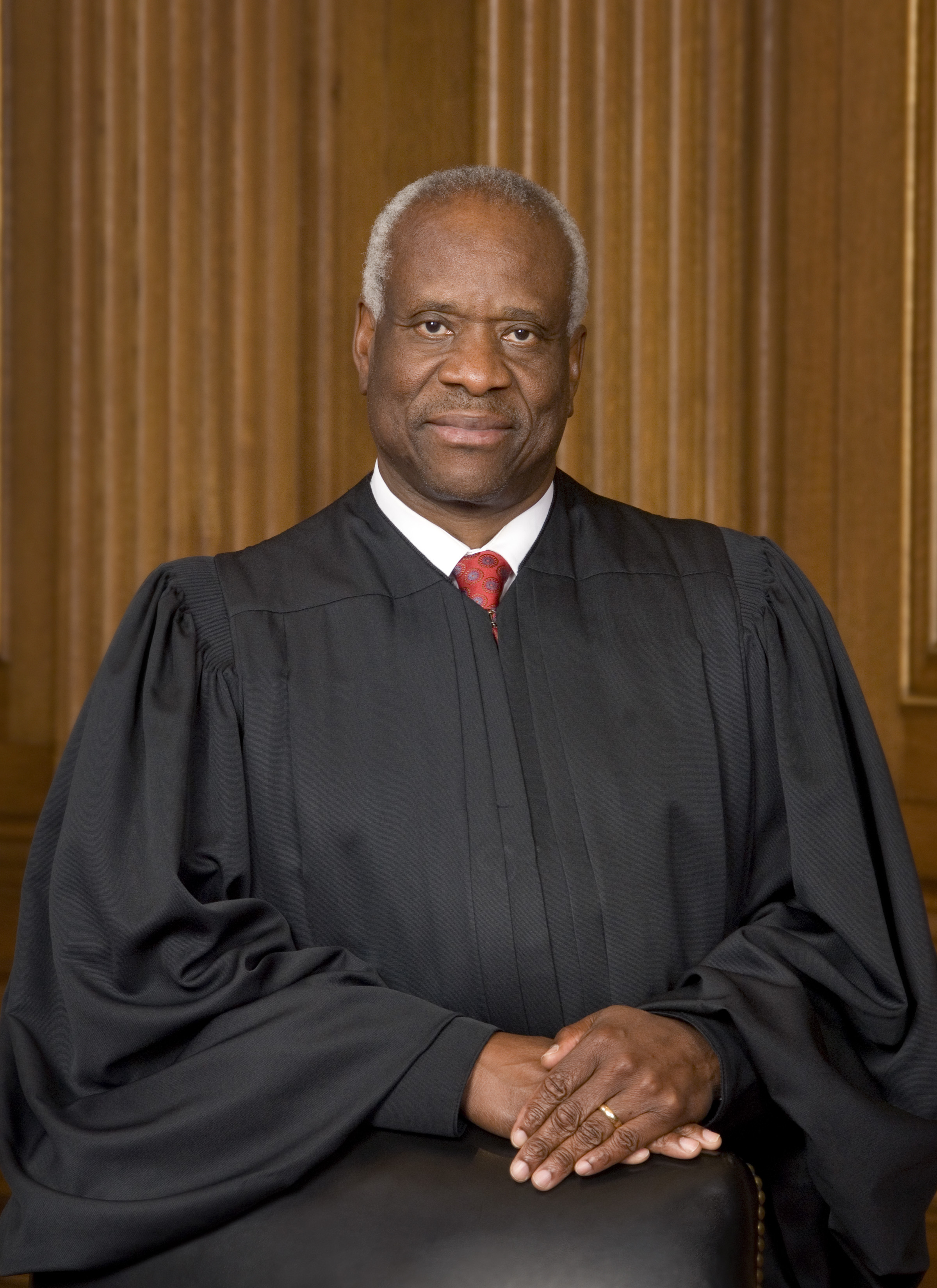
Clarence Thomas

Portrait of Clarence Thomas
Supreme Court of the United States

Clarence Thomas is an associate justice of the Supreme Court of the United States.

What DI has documented

DI has documented statements by Clarence Thomas on 2026 Midterm Elections, Copyright, and Education, among other topics. Read the quotations, original sources and related cases below.

Topics in this coverage

Show all 13 topics

Statements by Clarence Thomas

Portrait of Clarence Thomas

Clarence Thomas

Role at the time: Supreme Court associate justice, joining the dissent

Defended or excused

Statement summary

Thomas joins the position that enforcement should be allowed during the appeal.

“Recorded action: Thomas expressly joined Alito’s dissent in favor of granting the government’s stay request.”
Read the original text (opens in a new tab)Supreme Court stay denial, Kavanaugh concurrence and Alito dissent: USPS v. California · Supreme Court of the United StatesPDF p.1: concurrence; pp.2–9: dissent and Thomas’s express joinder
Why we used this label

Defends enforcement through an express joinder.

Portrait of Clarence Thomas

Clarence Thomas

Role at the time: Supreme Court justice dissenting from denial of review

Condemned

Statement summary

Thomas calls for reconsidering the actual-malice standard for public figures and says he would have granted review in Dershowitz v. CNN.

“I and others have thus called for reconsideration of the actual-malice ... standard for public figures.”
Read the original text (opens in a new tab)Dershowitz v. CNN: Thomas dissent joined by Gorsuch · Supreme Court of the United States
Why we used this label

Thomas calls for reconsidering the protection examined in this case, arguing that its public-figure standard lacks a constitutional basis. His dissent criticizes retaining that rule.

Portrait of Clarence Thomas

Clarence Thomas

Role at the time: U.S. Supreme Court justice, in a concurring opinion

Defended or excused

Statement summary

Thomas says Harvard's and UNC's admissions policies fail strict scrutiny and joins the majority opinion in full.

“Because the Court today applies genuine strict scrutiny to the race-conscious admissions policies employed at Harvard and the University of North Carolina (UNC) and finds that they fail that searching review, I join the majority opinion in full.”
Read the original text (opens in a new tab)Students for Fair Admissions v. Harvard and UNC: opinions · Supreme Court of the United States
Why we used this label

The action examined here is the Court's rejection of Harvard's and UNC's challenged admissions programs. Thomas expressly joins and justifies that result. He is defending the ruling, not defending the admissions programs.

Portrait of Clarence Thomas

Clarence Thomas

Role at the time: Associate justice writing a dissent, joined by Justice Alito

Condemned

Statement summary

Thomas, joined by Alito, argues that the code is copyrightable and that Google's copying was not fair use.

“Google’s use of that copyrighted code was anything but fair.”
Read the original text (opens in a new tab)Google LLC v. Oracle America: Supreme Court majority and dissentNo. 18-956; majority opening and conclusion; Thomas dissent pages 1-2 and 18-19
Why we used this label

The reference is Google's copying. Thomas expressly rejects the justification and argues that the copying harmed the rights holder's market.

Portrait of Clarence Thomas

Clarence Thomas

Role at the time: Associate justice of the United States Supreme Court

Defended or excused

Statement summary

Thomas says the government obtained the carriers' records rather than searching Carpenter's property.

“By obtaining the cell-site records of MetroPCS and Sprint, the Government did not search Carpenter’s property. He did not create the records, he does not maintain them, he cannot control them, and he cannot destroy them. Neither the terms of his contracts nor any provision of law makes the records his. The records belong to MetroPCS and Sprint.”
Read the original text (opens in a new tab)Carpenter v. United States, 585 U.S. 296 (2018), No. 16-402, opinion of the Court · Supreme Court of the United States
Why we used this label

Relative to police obtaining Carpenter's location records without a warrant, Thomas argues that the records belong to the carriers and rejects Carpenter's claimed Fourth Amendment interest.

Portrait of Clarence Thomas

Clarence Thomas

Role at the time: Supreme Court associate justice, writing a dissent

Condemned

Statement summary

Thomas argues that the decision departs from the original meaning of the Public Use Clause.

“Today’s decision is simply the latest in a string of our cases construing the Public Use Clause to be a virtual nullity, without the slightest nod to its original meaning.”
Read the original text (opens in a new tab)Kelo v. New London: Supreme Court opinionsSeparate authored opinions, excluding the syllabus as a quotation by a justice
Why we used this label

Thomas rejects the New London result because he disputes the majority's interpretation of public use.

A participant is a subject of the case. A speaker has a statement documented in it. A commentator has an opinion or editorial documented in it.

Case

Google v. Oracle: Breyer and Thomas split over Java API fair use

Relationship to this case: Participant

Stephen Breyer's majority treated Google's particular reuse of Java API declaring code as fair use. Clarence Thomas dissented, arguing it undermined copyright protection and Oracle's market. Oracle also publicly criticized the ruling.

CopyrightUpdated