
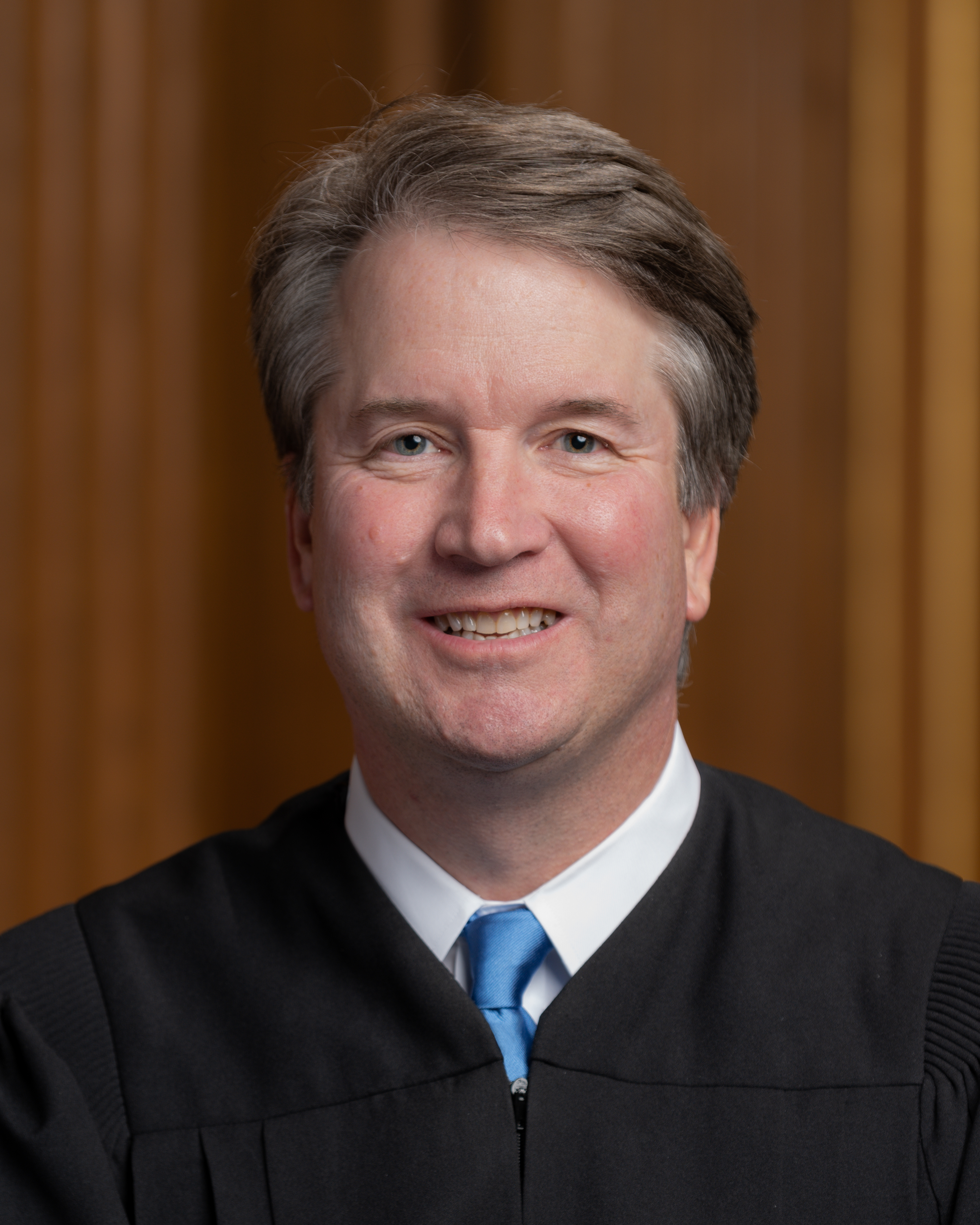
Brett Kavanaugh

Portrait of Brett Kavanaugh
Supreme Court of the United States

Brett Kavanaugh is an associate justice of the Supreme Court of the United States.

What DI has documented

DI has documented statements by Brett Kavanaugh on 2026 Midterm Elections, Criminal Justice Policy, and Education, among other topics. Read the quotations, original sources and related cases below.

Topics in this coverage

Show all 11 topics

Statements by Brett Kavanaugh

Portrait of Brett Kavanaugh

Brett Kavanaugh

Role at the time: Supreme Court associate justice, concurring

Condemned

Response to this claim

Applying the new USPS rule in the 2026 elections would be arbitrary and capricious because election officials lack sufficient implementation time.

“applying the rule in the 2026 elections would be arbitrary and capricious”
Read the original text (opens in a new tab)Supreme Court stay denial, Kavanaugh concurrence and Alito dissent: USPS v. California · Supreme Court of the United StatesPDF p.1: concurrence; pp.2–9: dissent and Thomas’s express joinder
Why we used this label

Rejects the present rollout; later possibilities do not change that stance.

Portrait of Brett Kavanaugh

Brett Kavanaugh

Role at the time: Supreme Court justice writing the majority opinion, joined by Roberts, Thomas, Alito, Gorsuch and Barrett

Defended or excused

Statement summary

Kavanaugh says Section 666 does not criminalize gratuities given as tokens of appreciation after official acts.

“The question in this case is whether §666 also makes it a crime for state and local officials to accept gratuities—for example, gift cards, lunches, plaques, books, framed photos, or the like—that may be given as a token of appreciation after the official act. The answer is no.”
Read the original text (opens in a new tab)Supreme Court opinions in Snyder v. United StatesMajority printed page 1; Jackson dissent printed pages 1-2
Why we used this label

The case examines the Court's decision to exclude gratuities from Section 666. Kavanaugh expressly argues that Section 666 does not criminalize gratuities and defends that exclusion.

Portrait of Brett Kavanaugh

Brett Kavanaugh

Role at the time: Associate justice of the Supreme Court, writing for the six-justice majority

Defended or excused

Statement summary

Writing for the Court, Kavanaugh held that after a state seizes personal property and seeks its forfeiture, due process requires a timely forfeiture hearing but not a separate preliminary hearing.

“After a State seizes and seeks civil forfeiture of personal property, due process requires a timely forfeiture hearing but does not require a separate preliminary hearing.”
Read the original text (opens in a new tab)Culley v. Marshall, No. 22-585: Supreme Court opinion, concurrence and dissent (May 9, 2024) · Supreme Court of the United StatesMajority opinion by Justice Kavanaugh (slip opinion pages 1-14); concurrence by Justice Gorsuch, joined by Justice Thomas; dissent by Justice Sotomayor, joined by Justices Kagan and Jackson.
Why we used this label

The reference point is Alabama's practice, defended by Attorney General Steve Marshall, of holding seized cars until the civil forfeiture hearing without a separate preliminary hearing, which the owners argued the Due Process Clause requires. Label: Defended or excused. The majority opinion holds that this practice satisfies due process, because a timely forfeiture hearing is all the Constitution requires. The closest competing label is Mixed or conditional; it loses because the opinion attaches no condition to that holding beyond the existing requirement that the forfeiture hearing be timely.

Portrait of Brett Kavanaugh

Brett Kavanaugh

Role at the time: Supreme Court justice writing a concurrence

Defended or excused

Statement summary

Kavanaugh argues that the ruling follows Grutter's 25-year expectation and its requirement that racial preferences be temporary.

“In light of the Constitution’s text, history, and precedent, the Court’s decision today appropriately respects and abides by Grutter’s explicit temporal limit on the use of race-based affirmative action in higher education.”
Read the original text (opens in a new tab)Students for Fair Admissions v. Harvard and UNC: opinions · Supreme Court of the United States
Why we used this label

His concurrence directly defends the challenged ruling. Acknowledging racial inequality does not make his evaluation of that ruling mixed.

Portrait of Brett Kavanaugh

Brett Kavanaugh

Role at the time: Associate justice, concurring in the judgment

Condemned

Response to this claim

Clean Water Act coverage of adjacent wetlands requires a continuous surface connection that makes the wetland practically indistinguishable from covered waters.

“In my view, the Court’s “continuous surface connection” test departs from the statutory text, from 45 years of consistent agency practice, and from this Court’s precedents.”
Read the original text (opens in a new tab)Sackett v. EPA: majority and separate opinions · Supreme Court of the United StatesNo. 21-454; Alito majority pages 19-22 and 27-28; Kavanaugh concurrence pages 1-14
Why we used this label

His criticism is directed at the majority's test. Agreement with the judgment does not defend that test.

A participant is a subject of the case. A speaker has a statement documented in it. A commentator has an opinion or editorial documented in it.