
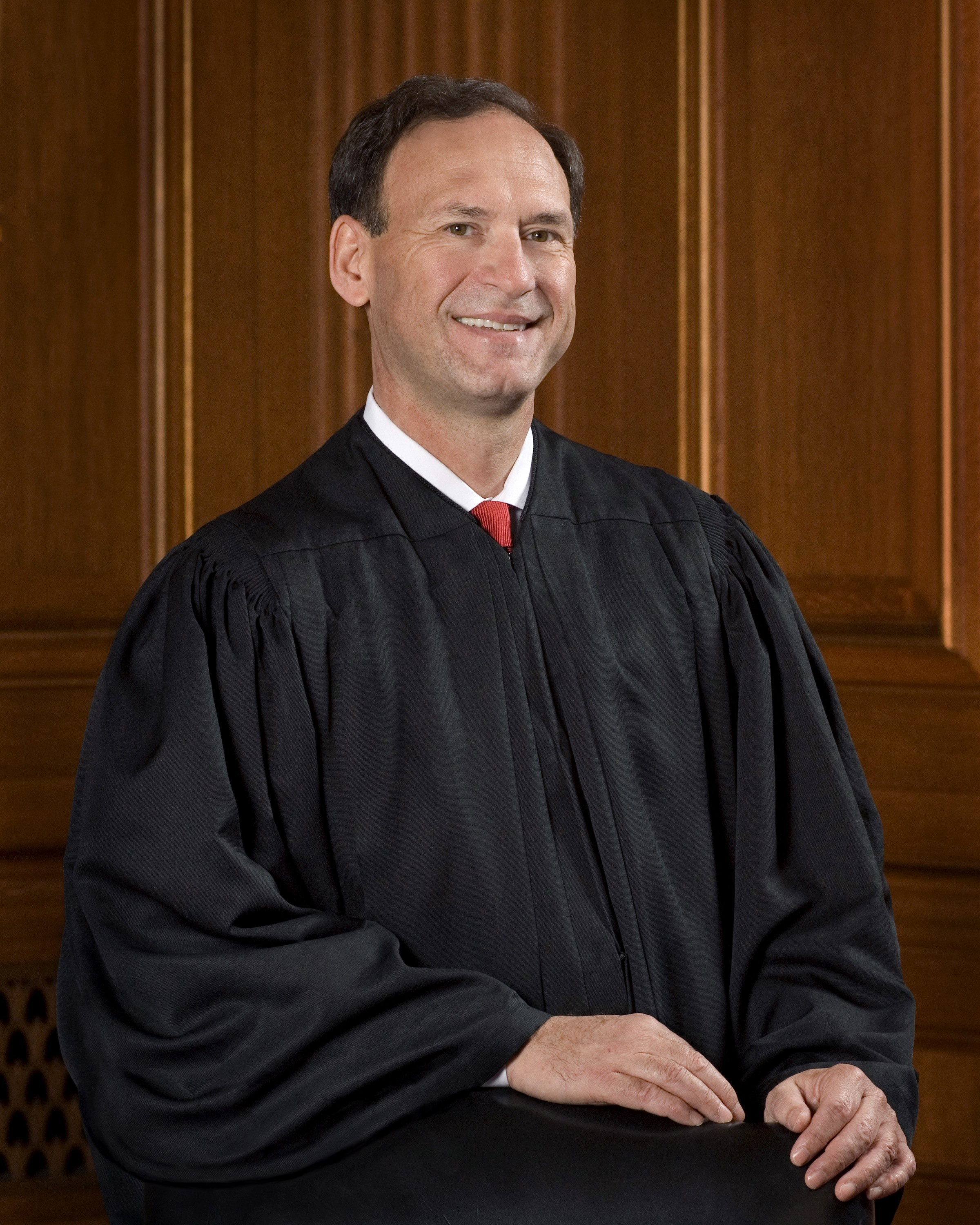
Samuel Alito

Portrait of Samuel Alito
Collection of the Supreme Court of the United States / photo by Steve Petteway

Samuel Alito is an associate justice of the Supreme Court of the United States.

What DI has documented

DI has documented statements by Samuel Alito on 2026 Midterm Elections, Criminal Justice Policy, and Energy Policy, among other topics. Read the quotations, original sources and related cases below.

Topics in this coverage

Show all 8 topics

Statements by Samuel Alito

Portrait of Samuel Alito

Samuel Alito

Role at the time: Supreme Court associate justice, dissenting

Defended or excused

Statement summary

Alito would allow enforcement while the injunction is appealed.

“I would grant the Government’s application”
Read the original text (opens in a new tab)Supreme Court stay denial, Kavanaugh concurrence and Alito dissent: USPS v. California · Supreme Court of the United StatesPDF p.1: concurrence; pp.2–9: dissent and Thomas’s express joinder
Why we used this label

Defends 2026 enforcement by supporting a stay.

Portrait of Samuel Alito

Samuel Alito

Role at the time: Associate justice of the Supreme Court, dissenting

Defended or excused

Statement summary

Alito argued that sharing location information for Google's own use meant assuming the risk of police disclosure.

“So, by giving Google his location information for its own use, Chatrie assumed the risk that Google might disclose location information to others, including the police.”
Read the original text (opens in a new tab)Chatrie v. United States: Supreme Court opinion and separate opinionsMajority pages 2, 4, 24-33; Alito dissent pages 12-17; Gorsuch concurrence and Barrett dissent.
Why we used this label

The case examines the no-search treatment of voluntarily shared Location History. Alito defends that treatment. His procedural objections do not erase his substantive position on privacy.

Portrait of Samuel Alito

Samuel Alito

Role at the time: Associate justice, writing the Court's majority opinion

Defended or excused

Response to this claim

Clean Water Act coverage of adjacent wetlands requires a continuous surface connection that makes the wetland practically indistinguishable from covered waters.

“We agree with this formulation of when wetlands are part of “the waters of the United States.””
Read the original text (opens in a new tab)Sackett v. EPA: majority and separate opinions · Supreme Court of the United StatesNo. 21-454; Alito majority pages 19-22 and 27-28; Kavanaugh concurrence pages 1-14
Why we used this label

The reference point is the Sackett majority's continuous-surface-connection restriction on Clean Water Act coverage of wetlands. Alito's majority opinion adopts that test as the Court's reading of when wetlands are part of the waters of the United States, which treats the restriction as the correct rule, so we used Defended or excused. The closest competing label is Challenged characterization; it loses because Alito does not dispute how the test is described but adopts it as the governing rule.

Portrait of Samuel Alito

Samuel Alito

Role at the time: Associate justice of the United States Supreme Court

Defended or excused

Statement summary

Alito says Carpenter threatens legitimate investigative practices despite its concern for privacy.

“I share the Court’s concern about the effect of new technology on personal privacy, but I fear that today’s decision will do far more harm than good. The Court’s reasoning fractures two fundamental pillars of Fourth Amendment law, and in doing so, it guarantees a blizzard of litigation while threatening many legitimate and valuable investigative practices upon which law enforcement has rightfully come to rely.”
Read the original text (opens in a new tab)Carpenter v. United States, 585 U.S. 296 (2018), No. 16-402, opinion of the Court · Supreme Court of the United States
Why we used this label

Relative to police obtaining historical cellphone location records without a probable-cause warrant, Alito defends access through court orders and subpoenas. He calls imposing the new warrant requirement a serious mistake and warns that it threatens legitimate investigations.

A participant is a subject of the case. A speaker has a statement documented in it. A commentator has an opinion or editorial documented in it.