
Explainer
How do data centers affect electricity bills?
Data centers use a growing share of U.S. electricity. State regulators, grid operators and federal rules decide who pays for the power plants, lines and upgrades built to serve them, and researchers, utilities and consumer advocates disagree about whether, and by how much, the boom has raised household bills.
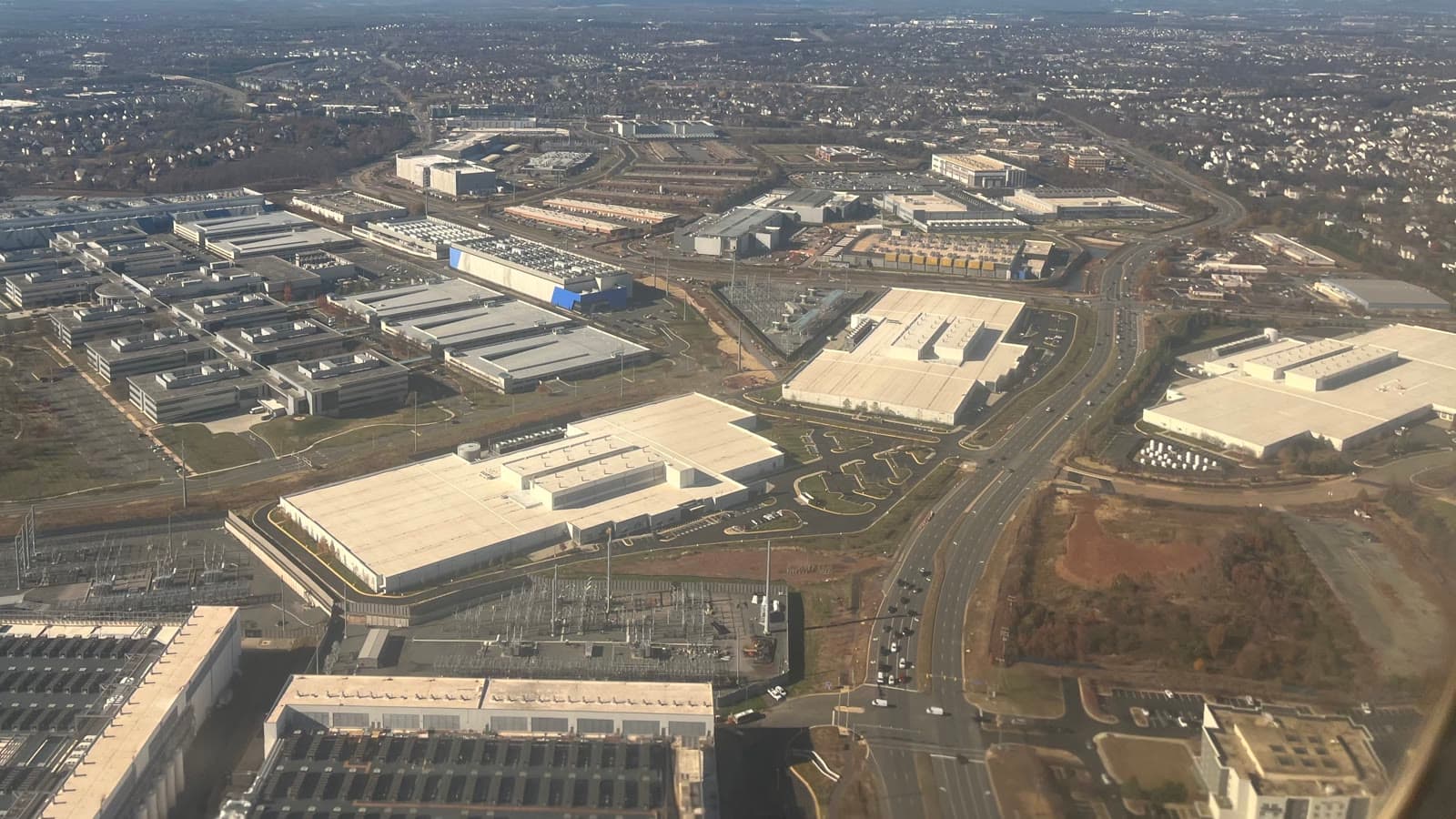
Why data centers use so much electricity
A data center is a building filled with computer servers, storage and network equipment, and it uses electricity both to run the computers and to cool them. The Congressional Research Service says roughly half of the demand comes from the computing equipment, and cooling systems typically account for another 40 percent.1
Researchers at Lawrence Berkeley National Laboratory estimate that U.S. data centers used 192 terawatt-hours in 2024, or 4.7 percent of the nation's electricity. In a June 2026 update, they projected 649 terawatt-hours in 2030, or 11.8 percent of U.S. use, within a range of 9.5 to 15.3 percent. They attribute the growth mainly to rising shipments and higher power ratings of accelerated servers, which use graphics processors and other specialized chips for AI. In their central case, AI servers account for 55 percent of data center electricity in 2030.2 The Energy Information Administration estimates that servers alone used about 7 percent of the electricity consumed by the commercial sector in 2025.3
What grid operators expect
The Energy Information Administration reports that commercial electricity sales in Virginia rose by nearly 30 million megawatt-hours from 2019 to 2025, largely because of data centers.4
PJM Interconnection, which runs the grid for more than 67 million people in 13 states and the District of Columbia, including Virginia,5 forecast in January 2026 that its summer peak would grow an average of 3.6 percent a year, reaching 222,106 megawatts in 2036.6 It raised the forecasts for 14 utility zones to account for data center growth, but it also discounted large-load requests without firm commitments, which helped lower its near-term forecast compared with 2025.6
In Texas, the grid operator ERCOT filed a preliminary forecast in April 2026 showing about 367,790 megawatts of demand by 2032, against an all-time peak of 85,508 megawatts. Its chief executive, Pablo Vegas, said ERCOT believed the forecast was "higher than expected future load growth."7
Who sets the price of electricity
A retail electricity rate combines the cost of generating power, the cost of delivering it over transmission and distribution lines, and other costs that regulators approve. State or local regulators approve the rates utilities charge. The Federal Energy Regulatory Commission (FERC) sets wholesale transmission rates and regulates the regional grid operators other than ERCOT, and where generation is competitive, markets largely set the wholesale price of power.1
Utility rates are set separately for classes of customers, such as residential, commercial and industrial.8 Most customers pay a rate based on the average cost of serving similar customers, while a few large users pay individual rates negotiated with the utility, often with the regulator's approval.9
Berkeley Lab researchers note that much of the cost of the grid is fixed, so more sales can spread those costs over more kilowatt-hours and push average prices down. Growth can also raise prices, they say, depending on how fully existing equipment is used, what new supply and lines cost, and how costs are divided among customers.10
Who pays for new lines and substations
A large data center can require equipment that serves it alone, such as a dedicated substation, as well as upgrades to the shared network that would not otherwise have been built. An October 2026 report by Senators Elizabeth Warren, Chris Van Hollen and Richard Blumenthal says the companies commit to paying for the first kind but "dispute how much they should pay for shared infrastructure," arguing that upgrades benefiting many customers should be paid for by all of them.11 Google told the senators in January 2026 that "Google, not local residents, pays for any new grid infrastructure required for our growth."12
The Union of Concerned Scientists, a nonprofit, identified 130 projects approved in 2024 to connect data centers to the high-voltage grid in seven PJM states and found that more than 95 percent passed all of their connection costs, $4.3 billion in total, on to local customers' bills.13 In a May 2026 complaint at FERC, Maryland's Office of People's Counsel argued that data centers "should be charged 100 percent of upfront network upgrade costs, with appropriate crediting."14
On July 31, 2026, Virginia's State Corporation Commission directed Dominion Energy to propose a policy requiring new or expanding large-load customers to pay upfront, net of expected transmission revenue, for the substations and lines that connect them to the bulk transmission system. The commission said this may not cover every transmission cost that large loads cause.15 The Data Center Coalition, a trade group for data center developers, said the order would continue a trend of "large users like data centers picking up more of the cost for transmission infrastructure."16
Capacity auctions in the PJM region
PJM also buys capacity: commitments from power plants and demand-response providers to be available to meet forecast peak demand, plus a reserve margin, in a future year. PJM says capacity is a fraction of wholesale power costs, which are in turn a portion of retail bills, and that customers hedged through self-supply or contracts are not exposed to the auction price.5
The auction price rose from $28.92 per megawatt-day for the 2024/2025 delivery year to $269.92 for 2025/2026, then to $329.17, $333.44 and, for 2028/2029, $325.00. The last three auctions ran under a temporary price cap and floor, first set under an agreement between PJM and Pennsylvania Gov. Josh Shapiro.1718 The July 2026 auction fell 6,831 megawatts short of PJM's reliability requirement.5
PJM's independent market monitor, Monitoring Analytics, estimates that including data center load in the forecast added $9.3 billion to the cost of the 2025/2026 auction and $6.3 billion to the 2028/2029 auction, $29.4 billion across four auctions. It concludes: "There would have been no shortfall but for the forecast data center load."18 A May 2026 white paper by the consulting firm E3, funded by the Data Center Coalition, which reviewed it before publication, attributed about half of the price jump between the 2024/2025 and 2025/2026 auctions to load growth, mostly from data centers, and the rest to other changes such as market design updates and power plant retirements.19 As of the market monitor's October 30, 2026 report, the next auction, for 2029/2030, was scheduled for December 9 to 15, 2026.18
The evidence on household bills
A Berkeley Lab and Brattle Group review published in April 2026 found that from 2019 to 2025, states with the highest growth in electricity demand generally saw average retail prices fall after inflation, and that significant data center load did not appear to change that pattern. The authors caution that the past "need not be prelude," pointing to PJM, where fast load growth met supply and delivery constraints.10 E3's paper for the Data Center Coalition says the few quantitative studies so far have found no evidence that other customers have subsidized data centers, though "the risk is not absent."19
In Virginia, a December 2024 report by the Joint Legislative Audit and Review Commission, which drew on modeling by E3, found that data centers were paying their full cost of service but that growing demand was likely to raise other customers' costs, by an estimated $14 to $37 a month in generation and transmission costs for a typical Dominion household by 2040, in inflation-adjusted dollars.20 A modeling study led by North Carolina State University, cited by the Congressional Research Service, found that data center and cryptocurrency growth could raise national average electricity costs by 6 to 29 percent, depending on the scenario.1
Eliza Martin and Ari Peskoe of the Harvard Electricity Law Initiative reviewed nearly 50 regulatory proceedings and wrote that utilities assure regulators their data center deals keep costs off other customers' bills, but that "verifying this claim is all but impossible."9 Some utilities project the opposite effect: PG&E estimates that 10 gigawatts of data center growth could lower its customers' bills by 10 percent by using existing infrastructure. Berkeley Lab lists such claims as possible benefits whose "positive outcomes are not assured and require monitoring."10
Large-load tariffs and company pledges
A common approach is a large-load tariff, a separate rate or set of terms for very large customers. A Berkeley Lab and Brattle review of 55 such tariffs, published in August 2026, found that the median minimum contract length rose from 5 years for tariffs proposed before 2025 to 12 years for those proposed since. Many tariffs set a minimum billing demand, a median of 80 percent of the contracted amount, that the customer pays whether or not it uses the power, and collateral requirements are very common.8
In July 2025, Ohio regulators approved a tariff requiring large new data center customers of AEP Ohio to pay for at least 85 percent of the power they subscribe to, even if they use less, for 12 years including a four-year ramp-up, with an exit fee for canceled projects.21 Dominion Energy's GS-5 schedule in Virginia requires a 14-year minimum contract and collateral of $1.5 million per megawatt.8 The senators' report says the companies pushed for lower minimums, with one large technology company calling 90 percent monthly minimum demand charges "insanely high."11
On March 4, 2026, President Trump announced a Ratepayer Protection Pledge.1 Companies that sign it agree to pay for "all new power delivery infrastructure upgrades required to service their data centers" and to pay for the power brought online for them "whether they use the electricity or not."22 The Congressional Research Service notes that the pledge has no enforcement mechanism.1
State laws and federal bills
A 2025 Texas law, Senate Bill 6, directs state regulators to ensure that customers seeking large new connections, generally 75 megawatts or more, contribute to the cost of connecting them to the grid.23 According to the Congressional Research Service, many state legislatures have considered or passed bills meant to make data centers cover the full cost of their power, and Texas Gov. Greg Abbott ordered a pause on data center development in August 2026 pending an audit.1 Gina Hinojosa, who defeated Abbott in November, pledged during the campaign to ban all data center approvals until the Legislature passes laws to protect Texans.24
In Congress, at least a dozen bills aim to keep data center power costs off other customers' bills, the Congressional Research Service counted in September 2026.1 The Ratepayer Protection Act, H.R. 9340, would add a federal standard under which rates for data centers of 100 megawatts or more are designed to recover the "full, incremental cost" of the upgrades needed to serve them. State regulators would have to consider the standard and decide on it within two years.25 The House passed the bill 417-3 on September 16, 2026.26 In the Senate, where Jon Husted brought it to the floor, a cloture vote on taking up the bill failed, 57-43, on September 30, 2026.2728 On November 19, the Senate passed a broader permitting bill, 62-33, that CNBC reports includes a provision "forcing hyperscalers to pay for upgrades to the grid."2930 CNBC reported that the bill next goes to the House.30
At the federal level, FERC ordered the regional grid operators in June 2026 to show that their rules handle large-load connections or to propose changes, after an October 2025 directive from the Energy Department.1 Federal agencies are also considering data centers on public land: a July 2026 U.S. Geological Survey report for the Bureau of Land Management mapped the bureau's land within 10 miles of existing high-voltage lines, while stating that it does not identify or recommend sites for data centers.31
History
- December 9, 2024
Virginia's Joint Legislative Audit and Review Commission reports that data centers pay their full cost of service under current rates but that growing demand is likely to raise other customers' costs.20
- December 2024
Lawrence Berkeley National Laboratory projects that data centers could use 6.7 to 12 percent of U.S. electricity by 2028.2
- March 5, 2025
Harvard Electricity Law Initiative researchers publish a paper arguing that utility contracts with data centers can shift costs to other customers.9
- July 9, 2025
Ohio regulators approve AEP Ohio's data center tariff, with minimum payments of 85 percent of subscribed power.21
- October 2025
The Energy Department directs FERC to begin a rulemaking on connecting large loads to the transmission system.1
- December 17, 2025
PJM's 2027/2028 capacity auction clears at the $333.44 cap, and PJM attributes nearly 5,100 megawatts of its higher forecast peak to data centers.32
- March 4, 2026
- June 2026
Berkeley Lab projects that data centers could use 11.8 percent of U.S. electricity in 2030.2
- June 18, 2026
FERC orders regional grid operators to show that their rules address large-load connections or to propose changes.1
- July 14, 2026
PJM's 2028/2029 capacity auction clears at the $325 cap and falls 6,831 megawatts short of the reliability requirement.5
- July 31, 2026
Virginia regulators direct Dominion Energy to propose upfront charges to large-load customers for the transmission facilities that connect them.15
- August 3, 2026
- September 16, 2026
The House passes the Ratepayer Protection Act, 417-3.26
- September 30, 2026
A Senate cloture vote on taking up the Ratepayer Protection Act fails, 57-43.28
- October 30, 2026
PJM's independent market monitor puts data center load's addition to capacity costs over four auctions at $29.4 billion.18
- November 19, 2026
What is disputed
Whether Google should pay the full cost of the shared grid upgrades its data centers trigger, or only the infrastructure built to serve them.
See the case: Should Google have to pay the full cost of shared grid upgrades its data centers trigger?Whether the Ratepayer Protection Act, which Jon Husted leads in the Senate and which would require states to consider a full-cost standard for large data centers, would protect households from data center costs.
See the case: Would Jon Husted's Ratepayer Protection Act protect households from data-center costs?Whether Texas Governor-elect Gina Hinojosa will ban new data center approvals until lawmakers pass protections, as she has pledged.
See the case: Texas Governor-elect Gina Hinojosa vows to pause new data center approvals until lawmakers pass protectionsWhether Texas Governor-elect Gina Hinojosa can freeze electricity rates by declaring a high-cost emergency and issuing an executive order within an hour of taking office, as she has pledged; The Dallas Morning News editorial board says it is not clear a governor has that authority.
See the case: Gina Hinojosa pledges a day-one emergency order freezing Texas electricity rates; The Dallas Morning News says a governor may lack the authorityWhether Interior Secretary Doug Burgum should stay away from decisions on opening federal public lands to AI data centers while holding AI investments that ProPublica reports at up to $64.4 million, as Richard Painter, President George W. Bush's chief ethics lawyer, argues; the Interior Department says any suggestion his decisions are driven by personal investments is false.
See the case: ProPublica reports Burgum holds up to $64.4 million in AI companies while pushing data centers on public lands; Interior calls suggestions of a conflict falseWhether the Senate-passed permitting bill, which includes a data center cost provision, will lower electricity bills as its sponsors say.
See the case: Senate passes the bipartisan BAAJA permitting bill as environmental groups say it weakens bedrock environmental laws
Related explainers
What is fair use?
Fair use is a defense in U.S. copyright law that permits some unlicensed uses of protected works, such as criticism, news reporting, teaching and research. Courts decide it case by case, weighing factors set out in the Copyright Act, including the purpose of the use and its effect on the market for the original.
How are AI deepfakes and AI-generated content regulated?
A deepfake is AI-generated or altered audio, video or imagery that makes real people appear to say or do things they did not. No single U.S. law covers them. Many states regulate political deepfakes, federal rules reach AI robocalls and intimate images, and platforms set their own labels.
What is frontier AI safety?
Frontier AI safety means testing and limiting the most severe risks from the most capable general-purpose AI models. Safeguards include company commitments and legal requirements; their reach and enforcement remain disputed.
What is an AI agent?
An AI agent is software built on an AI model that pursues a goal by taking actions, such as browsing websites, writing code or making purchases, rather than only answering questions. Because agents act with less human oversight, mistakes can cause harm before a person steps in.
Sources
- Data Centers and the Electricity Grid: Frequently Asked Questions (CRS Report R49326) (opens in a new tab)
- United States Data Center Energy Usage Report: 2025 Update (opens in a new tab) · Saved copy (opens in a new tab)
- Data center server energy use grows across the commercial building stock (opens in a new tab) · Saved copy (opens in a new tab)
- Commercial electricity sales have soared in Virginia, driven by data centers (opens in a new tab) · Saved copy (opens in a new tab)
- PJM Capacity Auction Procures 138,318 MW of Generation Resources as Work Continues To Address Growing Electricity Demand (opens in a new tab) · Saved copy (opens in a new tab)
- 2026 PJM Load Forecast Report (opens in a new tab) · Saved copy (opens in a new tab)
- ERCOT releases preliminary long-term load forecast for 2026 through 2032 (opens in a new tab) · Saved copy (opens in a new tab)
- Electricity Rate Designs for Large Loads: Evolving Practices and Opportunities, 2026 Update (opens in a new tab) · Saved copy (opens in a new tab)
- Extracting Profits from the Public: How Utility Ratepayers Are Paying for Big Tech's Power (opens in a new tab) · Saved copy (opens in a new tab)
- Retail Electricity Price Trends and Drivers: Data Update, 2026 Edition (opens in a new tab) · Saved copy (opens in a new tab)
- Senators report on AI data-center cost allocation and electricity bills (opens in a new tab) · Saved copy (opens in a new tab)
- Google responds to senators about data-center electricity and infrastructure costs (opens in a new tab) · Saved copy (opens in a new tab)
- New UCS Analysis Reveals Billions of Dollars in Unreported Data Center Costs Passed onto PJM Customers (opens in a new tab) · Saved copy (opens in a new tab)
- Complaint of the Maryland Office of People's Counsel against PJM Interconnection, requesting fast-track processing (opens in a new tab)
- Final order on Dominion Energy's transmission rider, Case No. PUR-2026-00056 (Virginia State Corporation Commission) (opens in a new tab) · Saved copy (opens in a new tab)
- Virginia to offload more grid costs onto data centers (opens in a new tab)
- An Investigation of PJM's Capacity Market (opens in a new tab) · Saved copy (opens in a new tab)
- Analysis of the 2028/2029 RPM Base Residual Auction, Part A (opens in a new tab) · Saved copy (opens in a new tab)
- Understanding the Drivers of Rising Electricity Rates and the Role of Data Centers (opens in a new tab) · Saved copy (opens in a new tab)
- Data Centers in Virginia (JLARC Report 598) (opens in a new tab) · Saved copy (opens in a new tab)
- AEP Ohio Proposal on Data Centers to Protect Ohio Consumers Adopted by PUCO (opens in a new tab) · Saved copy (opens in a new tab)
- Ratepayer Protection Pledge (opens in a new tab)
- Texas S.B. 6, 89th Legislature: enrolled bill text (opens in a new tab) · Saved copy (opens in a new tab)
- Texas data centers face uncertain future after Hinojosa wins governor's race (opens in a new tab)
- H.R. 9340, Ratepayer Protection Act, Senate calendar text (opens in a new tab)
- House roll call 312 on the Ratepayer Protection Act (opens in a new tab) · Saved copy (opens in a new tab)
- Democrats block Husted's bill forcing data centers to pay their own way (opens in a new tab) · Saved copy (opens in a new tab)
- U.S. Senate Roll Call Vote 254: Cloture on the Motion to Proceed to H.R. 9340 (rejected, 57-43) (opens in a new tab) · Saved copy (opens in a new tab)
- U.S. Senate Roll Call Vote 270: Passage of H.R. 2347, as amended (passed, 62-33) (opens in a new tab) · Saved copy (opens in a new tab)
- Senate passes BAAJA permitting reform bill backed by AI, energy sectors (opens in a new tab) · Saved copy (opens in a new tab)
- Colocating Artificial Intelligence Data Centers with Energy Infrastructure on Federal Public Lands (USGS Scientific Investigations Report 2026-5035) (opens in a new tab) · Saved copy (opens in a new tab)
- PJM Auction Procures 134,479 MW of Generation Resources (opens in a new tab)
Last reviewed November 24, 2026. We review this explainer when a case that uses it changes. Report an error