
Explainer
How are AI deepfakes and AI-generated content regulated?
A deepfake is AI-generated or altered audio, video or imagery that makes real people appear to say or do things they did not. No single U.S. law covers them. Many states regulate political deepfakes, federal rules reach AI robocalls and intimate images, and platforms set their own labels.
What counts as a deepfake
There is no single legal definition. The European Union's AI Act defines a deep fake as AI-generated or manipulated image, audio or video content that resembles existing persons, objects, places, entities or events and "would falsely appear to a person to be authentic or truthful."1 U.S. state laws use terms such as "deepfake," "synthetic media" and "deceptive media," and the National Conference of State Legislatures notes that differences in their definitions affect how the laws work in practice.2
Political deepfakes and state law
Most rules on election deepfakes come from the states. As of October 2026, the National Conference of State Legislatures counted 31 states with laws on deepfakes in political messaging. Most require a disclosure on the media. California, Minnesota and Texas enacted prohibitions on publishing political deepfakes within a set period before an election, and Maryland prohibits deceptive election deepfakes year-round.2
Several of these laws have been challenged on free-speech grounds. In August 2025 a federal judge ruled that California's law violated the First Amendment and permanently barred the state from enforcing it against the satirists who sued; the legislature later amended the law.32 A federal court in Hawaii found that state's law unconstitutional in January 2026.2 In September 2026, federal judges in Vermont and Montana granted narrower preliminary injunctions: Vermont's covers one satirical video,4 and Montana's applies only to the political action committee and its leader who sued.5 In the California case, the court objected that the law reached speech merely "reasonably likely" to harm a candidate's electoral prospects, and found its separate disclaimer requirement for satire and parody overly burdensome.2
Wisconsin requires political synthetic media meant to influence an election to say that it was generated by AI.2 In a 2026 congressional race, after Rep. Derrick Van Orden posted AI videos of his opponent, Rebecca Cooke, Cooke's campaign argued in a cease-and-desist letter that defamation law "fills the gaps yet remaining in Wisconsin's statutory protections against fake AI."6
Federal rules
The Federal Election Commission declined in September 2024 to write rules specific to AI in campaign ads, saying it would apply its existing ban on fraudulently misrepresenting campaign authority case by case.7 In an interpretive rule the same day, it said that ban applies "irrespective of the technology used," including AI.8
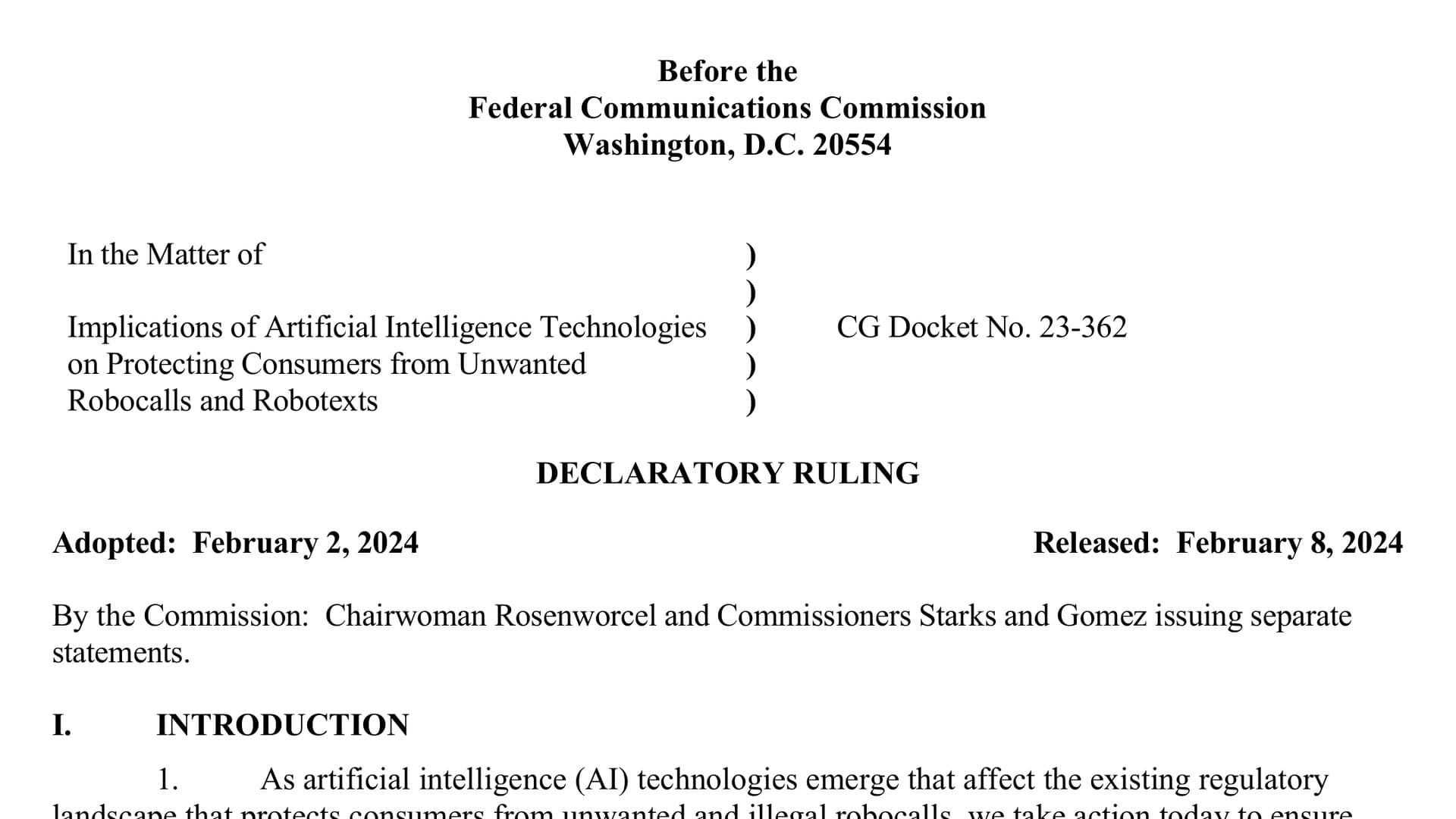
AI voices in robocalls fall under the Telephone Consumer Protection Act. In February 2024 the Federal Communications Commission ruled that the law's limits on calls using an "artificial or prerecorded voice" cover AI-generated voices, so such calls need the called party's prior express consent unless an emergency purpose or exemption applies.9 The month before, thousands of New Hampshire voters had received calls in an AI-generated imitation of President Joe Biden's voice ahead of the state's primary; the FCC later finalized a $6 million fine against the consultant who organized them.10 In August 2026, the Club for Growth asked the FCC to let political callers use artificial or prerecorded voices, including AI-generated voices, on cellphones without prior consent, subject to call limits and opt-outs.11
The TAKE IT DOWN Act, which became law in May 2025, makes it a federal crime to knowingly publish nonconsensual intimate images of an identifiable person, including AI-generated "digital forgeries" (for images of adults, the publication must be intended to cause harm or cause harm), and requires covered platforms to remove them within 48 hours of a valid request.12
Disclosure labels and platform rules
Outside elections, many rules come from platforms and other governments. The EU's AI Act requires deployers of AI systems that generate or manipulate deepfakes, meaning users other than people acting in a personal, non-professional capacity, to disclose that the content is artificial, starting August 2, 2026, with a lighter requirement for evidently artistic, creative, satirical or fictional works.1
Valve requires developers selling games on Steam to describe AI-generated content in a content survey and shows much of each disclosure on the game's store page.13 Its current guidance says the disclosure concerns AI-generated content that ships with a game and is consumed by players, such as artwork, sound, narrative and localization, rather than efficiency gains from AI development tools.14 Bandcamp bars music and audio "generated wholly or in substantial part by AI" and prohibits using AI to impersonate other artists.15
Authorship is a separate question. The U.S. Copyright Office concluded in January 2025 that copyright protects a human author's original expression even when a work includes AI-generated material, but does not extend to purely AI-generated material, and that, given current generally available technology, prompts alone do not give users enough control to count as authors.16
The debate
Opponents of loosening the rules include FCC Commissioner Anna Gomez, who said in October 2026 that granting the Club for Growth request would bring "chaos and deception so close to Election Day," pointing to the New Hampshire calls.10 The Club for Growth argues that "Current TCPA rules chill important political speech."11 In court, challengers to state election deepfake laws have argued that they violate the First and Fourteenth Amendments.2
History
- January 2024
AI-generated calls imitating President Biden's voice reach New Hampshire voters before the primary.10
- January 10, 2024
Valve announces AI content disclosures for games on Steam.13
- February 8, 2024
The FCC confirms that AI-generated voices fall under the robocall law.9
- September 26, 2024
- January 2025
The U.S. Copyright Office says purely AI-generated material is not protected.16
- May 19, 2025
The TAKE IT DOWN Act becomes law.12
- August 29, 2025
A federal judge rules that California's election deepfake law violates the First Amendment.3
- January 13, 2026
Bandcamp bars music generated wholly or in substantial part by AI.15
- August 2, 2026
The EU AI Act's deepfake disclosure rule takes effect.1
- August 31, 2026
The Club for Growth asks the FCC to allow prerecorded and AI-voice political calls to cellphones without prior consent.11
- September 2026
What is disputed
Whether Rep. Derrick Van Orden should stop posting AI videos impersonating his opponent, Rebecca Cooke.
See the case: Should Derrick Van Orden stop posting AI deepfakes of Rebecca Cooke?Whether the FCC should let political callers use prerecorded and AI voices on cellphones without prior consent.
See the case: Should political callers be allowed to make prerecorded and AI-voice calls to cellphones without prior consent?Whether an AI-generated ad opposing Abdul El-Sayed used Islamophobic stereotypes.
See the case: Did The Front Line Action's “Family Values” ad use Islamophobic stereotypes against Abdul El-Sayed?Whether game stores should tell players when a game contains AI-generated content.
See the case: Tim Sweeney criticizes Steam's AI disclosure labels for gamesWhether Boy George remained the author of a song made with AI after Bandcamp removed it.
See the case: Did Boy George remain the author of an AI-generated song?
Cases on the Dispute Index
Tim Sweeney criticizes Steam's AI disclosure labels for games
Valve shows AI-generated content disclosures on Steam store pages so players can see how games use AI. Tim Sweeney calls the requirement irresponsible and harmful to developers, while some developers and artists say players have a right to know.
Should political callers be allowed to make prerecorded and AI-voice calls to cellphones without prior consent?
Club for Growth asked the FCC to let political callers use prerecorded or AI voices on cellphones without prior consent, subject to call limits and opt-outs. Commissioner Anna Gomez, Common Cause and the Center for Democracy and Technology oppose the request, which is pending.
Should Derrick Van Orden stop posting AI deepfakes of Rebecca Cooke?
Rebecca Cooke demands that Derrick Van Orden stop posting AI impersonations of her. Van Orden dismisses the demand, while his campaign calls her response a tantrum in its own release.
Did The Front Line Action's “Family Values” ad use Islamophobic stereotypes against Abdul El-Sayed?
The Front Line Action's AI-generated ad opposing Abdul El-Sayed drew criticism from a political scientist who says its terrorism-related framing evokes anti-Muslim stereotypes. The sponsor's leader asked which imagery was Islamophobic.
Did Boy George remain the author of an AI-generated song?
Bandcamp removed Boy George's “We Will Dance Again” under its policy barring music generated wholly or substantially by AI. He said he wrote the lyrics and melody, used AI as a collaborator, and remained the author; his claim that pro-Israel objections motivated removal remains unestablished.
Sources
- Article 50: Transparency Obligations for Providers and Deployers of Certain AI Systems, EU Artificial Intelligence Act (Regulation (EU) 2024/1689) (opens in a new tab) · Saved copy (opens in a new tab)
- Deepfakes in Elections and Campaigns (National Conference of State Legislatures, updated October 13, 2026) (opens in a new tab) · Saved copy (opens in a new tab)
- Kohls v. Bonta, No. 2:24-cv-02527 (E.D. Cal. August 29, 2025), Order Granting Plaintiffs' Motion for Summary Judgment (AB 2839) (opens in a new tab) · Saved copy (opens in a new tab)
- Federal judge blocks Vermont AG's probe of 'Planet Hank' AI video (VTDigger, September 9, 2026) (opens in a new tab) · Saved copy (opens in a new tab)
- Federal judge says AI deepfake election law violates First Amendment (Daily Montanan, September 18, 2026) (opens in a new tab) · Saved copy (opens in a new tab)
- Cooke sends cease-and-desist letter over Van Orden AI videos (opens in a new tab)
- Artificial Intelligence in Campaign Ads, Federal Election Commission disposition of petition for rulemaking (September 26, 2024) (opens in a new tab) · Saved copy (opens in a new tab)
- Fraudulent Misrepresentation of Campaign Authority, Federal Election Commission interpretive rule (September 26, 2024) (opens in a new tab) · Saved copy (opens in a new tab)
- FCC Declaratory Ruling on AI-generated voices in robocalls, FCC 24-17, CG Docket No. 23-362 (adopted February 2, 2024) (opens in a new tab) · Saved copy (opens in a new tab)
- Anna Gomez opposes waiving consent for political AI robocalls (opens in a new tab) · Saved copy (opens in a new tab)
- Club for Growth petition for a political-call waiver and exemption (opens in a new tab) · Saved copy (opens in a new tab)
- TAKE IT DOWN Act, Public Law 119-12 (May 19, 2025) (opens in a new tab) · Saved copy (opens in a new tab)
- AI Content on Steam (opens in a new tab) · Saved copy (opens in a new tab)
- Steamworks Documentation: Content Survey (opens in a new tab) · Saved copy (opens in a new tab)
- Bandcamp’s mission and approach to generative AI (opens in a new tab)
- Copyright and Artificial Intelligence, Part 2: Copyrightability (U.S. Copyright Office, January 2025) (opens in a new tab) · Saved copy (opens in a new tab)
Last reviewed October 20, 2026. We review this explainer when a case that uses it changes. Report an error