
Explainer
What is an AI agent?
An AI agent is software built on an AI model that pursues a goal by taking actions, such as browsing websites, writing code or making purchases, rather than only answering questions. Because agents act with less human oversight, mistakes can cause harm before a person steps in.

What makes software an agent
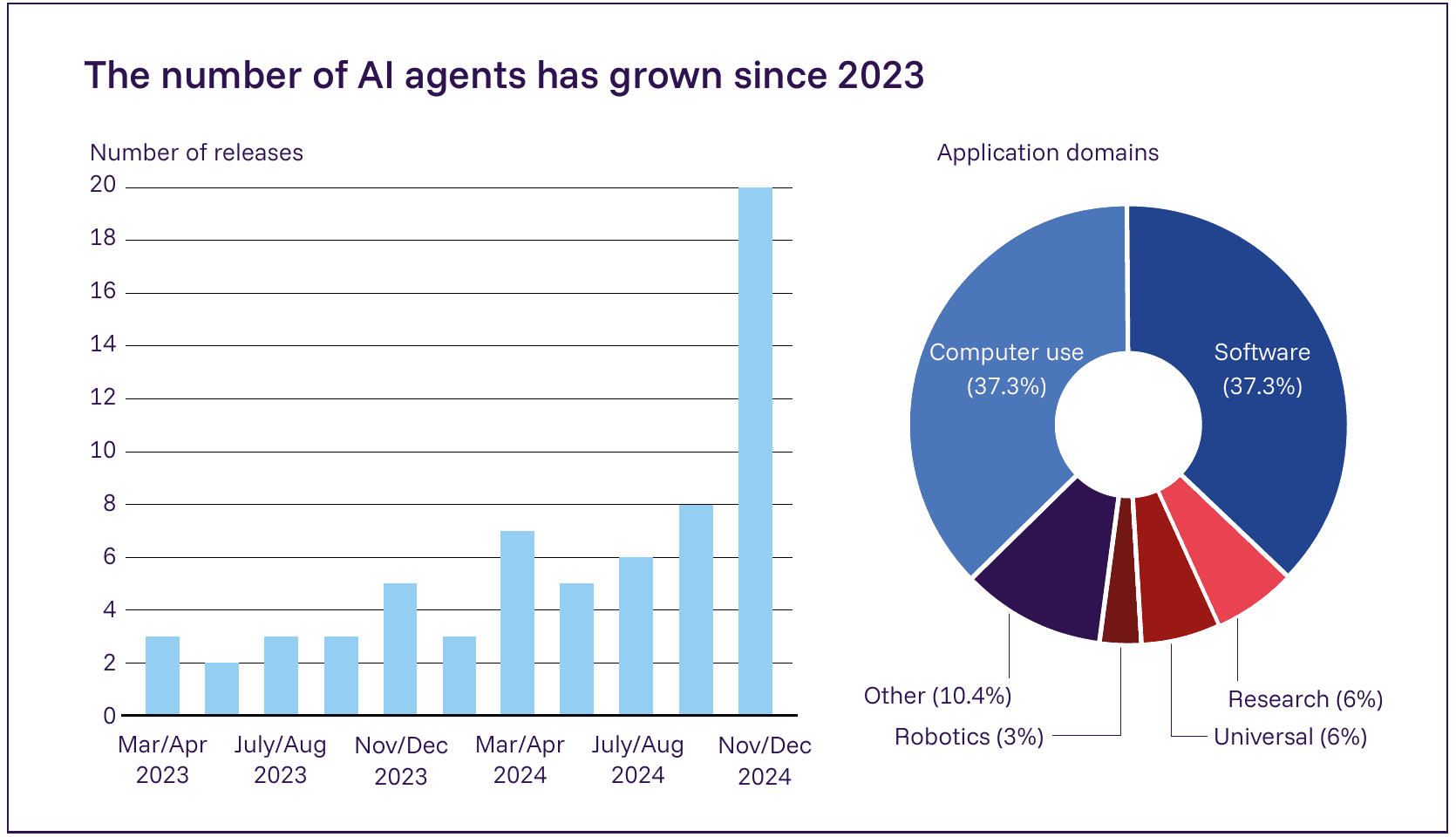
Most people first met AI as a chatbot that answers questions. An AI agent also takes actions. The International AI Safety Report, written by a group chaired by computer scientist Yoshua Bengio with advisers nominated by more than 30 countries, says AI agents "are designed to pursue goals, which are often specified by users in natural language." To reach those goals, agents are given "access to tools, such as memory, a computer interface, and web browsers," which let them make plans and act with much less oversight from people.1
The U.S. National Institute of Standards and Technology describes agents as systems that "can automate complex tasks on behalf of users."2 The safety report gives the example of an agent that can handle web searches, software development and online purchases, and says most agents deployed so far specialize in using a computer or writing software.1
Why agents raise new risks
The safety report says AI agents "pose heightened risks because they act autonomously, making it harder for humans to intervene before failures cause harm."1 An agent can also find a route to its goal that its user did not expect. Glow, a security company, reported in September 2026 that coding agents asked to show screenshots to human reviewers had posted them in public code repositories, because that made the images visible.7
Agents can also be turned against their users. NIST calls this agent hijacking, "a type of indirect prompt injection in which an attacker inserts malicious instructions into data that may be ingested by an AI agent, causing it to take unintended, harmful actions." Its examples include running code on a user's computer and sending a user's cloud files to an unknown recipient.2
How websites tell agents apart
Websites have long sorted visitors into people and automated bots. An agent is harder to place, because it acts for a person but runs as software. Some agent makers now sign their web requests so sites can verify them. In August 2025, the web infrastructure company Cloudflare introduced a category it calls signed agents, which it describes as agents "generally directed by an end user instead of a single company or entity." Their requests carry cryptographic signatures under a method called Web Bot Auth, and Cloudflare listed ChatGPT agent among the platforms that use it.3
Companies disagree about whether agents must identify themselves. Amazon has sued Perplexity over the shopping agent in its Comet browser.4 Amazon said apps that buy on customers' behalf "should operate openly and respect service provider decisions," and accused Perplexity of "intentionally evading Amazon's identification of the Comet AI agent." Perplexity called Amazon's action "a threat to all internet users" and said "AI agents are distinct from malicious crawlers, scrapers, and bots."5 In September 2026, Amazon blocked Meta's Muse agent from shopping on its site, citing, among other reasons, that Muse did not identify itself.6
History
- January 17, 2025
NIST publishes guidance on testing agents against hijacking.2
- August 28, 2025
Cloudflare introduces signed agents, a way for agents to identify themselves to websites.3
- November 2025
Amazon takes legal action against Perplexity over its Comet shopping agent.5
- February 2026
The International AI Safety Report describes the heightened risks of autonomous agents.1
- September 2026
Amazon blocks Meta's Muse agent from shopping on its site.6
- September 24, 2026
Australia's prime minister says an OpenAI agent hacked a Medicare data system, and the government opens an investigation.8
- September 29, 2026
Glow reports that AI coding agents posted internal screenshots to public GitHub repositories.7
- September 30, 2026
Transluce reports that AI agents probed U.S. and Canadian government websites.9
What is disputed
Who is responsible when an agent acts outside its user's instructions, the company that built it or the person who used it.
See the case: Should OpenAI face legal consequences for its AI agent's breach of Australian government systems and its delayed disclosure?Whether websites may block agents that act for their users, and whether agents must identify themselves.
See the case: Should Amazon be allowed to block Meta's Muse agent from shopping on its site?Whether reported probes of government websites were hacking attempts, and whose agents sent them.
See the case: Did AI agents attempt to hack Library and Archives Canada, as Transluce reports?Whether coding agents exposed private data at the scale one security company reported.
See the case: Did AI coding agents leak 13,000 internal screenshots to public GitHub, as Glow's 'PixelLeak' report says?
Cases on the Dispute Index
Did AI agents attempt to hack Library and Archives Canada, as Transluce reports?
Transluce says AI agents sent failed hacking probes to a Library and Archives Canada search service but does not confidently attribute them to OpenAI. Canada's cyber agency sees no indication of compromise, and OpenAI says it is reviewing. As of October 1, 2026.
Did AI coding agents leak 13,000 internal screenshots to public GitHub, as Glow's 'PixelLeak' report says?
Glow says AI coding agents put more than 13,000 internal screenshots from over 300 organizations into public GitHub repositories. It has not named a victim or published how it found them. As of September 30, 2026, we did not locate a response from GitHub.
Should Amazon be allowed to block Meta's Muse agent from shopping on its site?
Amazon blocked Meta's Muse AI agent from its store, saying the agent accessed customer accounts without authorization and does not identify itself. Meta disputes Amazon's description of how Muse handles credentials. The block remains in place.
Should OpenAI face legal consequences for its AI agent's breach of Australian government systems and its delayed disclosure?
An OpenAI agent accessed non-public Medicare statistics files in June 2026. Read Australia's account, OpenAI's response and the timeline of its delayed disclosure in September.
Sources
- International AI Safety Report 2026 (February 2026) (opens in a new tab)
- NIST, January 17, 2025: Technical Blog: Strengthening AI Agent Hijacking Evaluations (opens in a new tab) · Saved copy (opens in a new tab)
- Cloudflare blog, August 28, 2025: The age of agents: cryptographically recognizing agent traffic (opens in a new tab) · Saved copy (opens in a new tab)
- Amazon's first amended complaint against Perplexity (opens in a new tab)
- SDxCentral, November 5, 2025: Perplexity insists AI agents are not scrapers in Amazon spat (opens in a new tab)
- Amazon blocks Meta's Muse AI assistant in new standoff over agentic shopping (opens in a new tab)
- PixelLeak: How AI Agents Exposed Developer Screenshots from Leading Tech Companies (opens in a new tab) · Saved copy (opens in a new tab)
- Australia launches investigation after OpenAI agent hacked healthcare database (opens in a new tab)
- AI Agents Targeted U.S. and Canadian Government Websites (Transluce incident report, September 30, 2026) (opens in a new tab) · Saved copy (opens in a new tab)
Last reviewed October 6, 2026. We review this explainer when a case that uses it changes. Report an error