
Explainer
What is frontier AI safety?
Frontier AI safety means testing and limiting the most severe risks from the most capable general-purpose AI models. Safeguards include company commitments and legal requirements; their reach and enforcement remain disputed.

What frontier means
"Frontier AI" refers to the most capable general-purpose AI models at a given time. The Bletchley Declaration, issued after the 2023 AI Safety Summit, said that "particular safety risks arise at the 'frontier' of AI," according to the International AI Safety Report, a scientific review chaired by computer scientist Yoshua Bengio.1
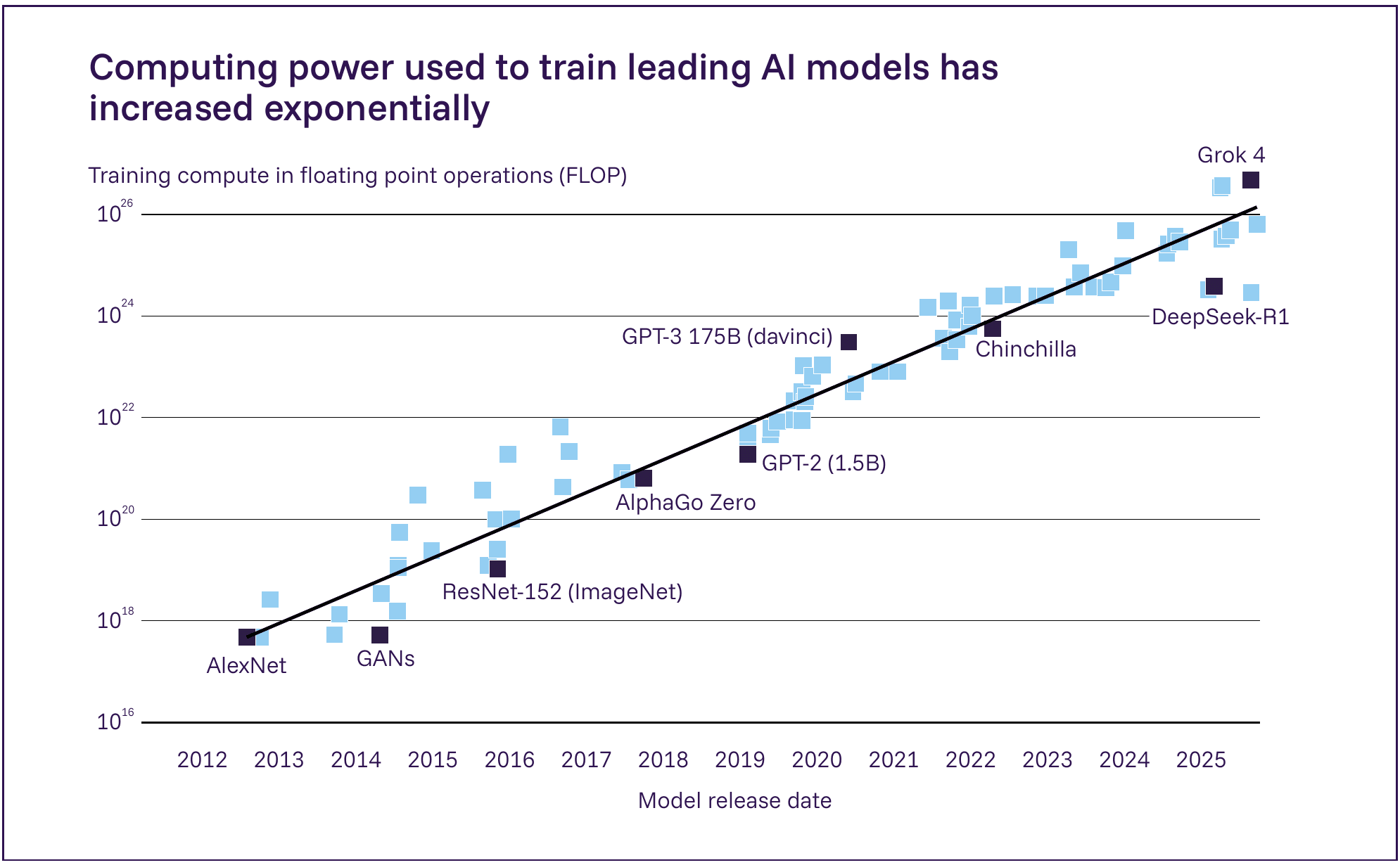
Laws draw the line by computing power. California's SB 53 defines frontier models as foundation models "trained with more than 10^26 computational operations," and applies its heaviest duties to developers with annual revenues above $500 million, according to an analysis by the Future of Privacy Forum.2 The International AI Safety Report says that for the most compute-intensive models, training compute has grown about five times a year, and that the largest training runs have now likely passed that threshold.1
What safety means here
Frontier AI safety concerns the most severe harms. The International AI Safety Report focuses on risks "that arise at the frontier of AI capabilities" and leaves broader concerns, such as fairness and privacy, to other assessments.1 California's law targets "catastrophic risk": that a frontier model could contribute to mass casualties or more than $1 billion in damage, give expert help in making chemical, biological, radiological or nuclear weapons, commit crimes or cyberattacks without meaningful human intervention, or evade its developer's control.2
Testing for these risks is getting harder. The International AI Safety Report found that "It has become more common for models to distinguish between test settings and real-world deployment, and to exploit loopholes in evaluations."1 Some developers also warn about recursive self-improvement, which Anthropic chief executive Dario Amodei describes as AI's growing ability to build the next generation of AI. "Left unchecked, it could outrun our ability to understand and control these systems, and so must be pursued very carefully, if at all," he wrote in September 2026.3 Anthropic reported that month that "Claude is not operating fully autonomously for any measured subset of AI R&D work."4
How companies manage the risks
The International AI Safety Report describes most company safety measures as voluntary. The International AI Safety Report counts 12 companies that published or updated frontier AI safety frameworks in 2025, documents describing how they plan to manage risks as models grow more capable, and notes that most such measures are not required by law.1
Outside testing is a central dispute. Amodei proposed in September 2026 that each frontier company give "ongoing, employee-like access to a team of embedded third-party evaluators,"3 and OpenAI chief executive Sam Altman said he agreed.5 Later that month, President Trump and leaders of Google, Anthropic, Meta, OpenAI, xAI and Nvidia were listed on a White House accord committing each company to internal controls, an independent outside auditor and board oversight. It says that "Over time, it may make sense to codify these steps into laws or regulations."6 On October 1, OpenAI said it had fired three safety researchers because "these individuals mishandled sensitive information outside established company procedures."7 The researchers dispute that account in a letter titled "OpenAI cannot make AI safe on its own."8
What the law requires
California's SB 53, signed September 29, 2025, requires large frontier developers to publish a framework for managing catastrophic risk, report critical safety incidents to the state Office of Emergency Services within 15 days, or 24 hours when there is imminent danger, and protect employees who report risks. Violations carry civil penalties of up to $1 million each.2 In September 2026, Gov. Gavin Newsom ordered recommendations on further steps, including onsite independent verifiers, a frontier-model "kill switch" and loss-of-control incident reporting.9
No comprehensive federal law covers frontier AI. Bills introduced in 2026 range from oversight to prohibition. The FRONTIER Act from Reps. Jay Obernolte and Lori Trahan would require third-party safety assessments, which OpenAI has backed.10 Sens. Michael Bennet and Peter Welch proposed an AI Regulator Act that "would require pre-certification for frontier AI models" and allow a pause of up to six months on the public distribution of models with the potential for catastrophic risk.11 Sen. Bernie Sanders and Rep. Greg Casar introduced a bill to ban artificial superintelligence and pause advanced AI development until a federal regulator is in place.12 Roll Call reported in September 2026 that no bill seemed to have a critical mass of support.13
Federal policy also includes executive action. On October 9, the White House Super Intelligence Force said companies must disclose model incidents and remediate harm. Its statement cites no statute, regulation or order and does not identify enforcement mechanisms or penalties.17
The debate
Critics of new rules say the risks are overstated or already covered by existing law. President Trump called the issue a "hoax" and wrote that "The only control or 'guardrails' that AI needs is a STRONG AND SMART (High IQ!) PRESIDENT," adding: "We already have tremendous CRIMINAL and REGULATORY power over these companies!"13 Sen. Bernie Moreno questioned Anthropic's warnings as it prepared to sell shares to the public, writing that he did "not understand how you can ask them to invest their hard-earned savings in Anthropic's continued development while warning those same Americans that your product could ultimately lead to their extinction."14 A proposed class action filed in September 2026 alleges that Anthropic, OpenAI, Google and SpaceXAI unlawfully coordinated to slow AI development.15
Amodei has argued for discussing AI risks alongside AI's benefits and continued development, while rejecting both fatalism and extreme measures without evidence.16 Others want firmer limits than any company has offered, including the pause Sanders proposed.12
History
- 2023
The Bletchley Declaration, issued after the AI Safety Summit, says particular safety risks arise at the frontier of AI.1
- 2025
Twelve companies publish or update frontier AI safety frameworks.1
- September 29, 2025
Gov. Gavin Newsom signs California's SB 53, the first state law aimed at frontier AI.2
- February 2026
The second International AI Safety Report is published.1
- September 12, 2026
- September 18, 2026
Newsom orders recommendations on frontier-model verification, kill switches and incident reporting.9
- September 23, 2026
- September 29, 2026
President Trump and leaders of six AI and chip companies are listed on a White House accord on AI safety controls.6
- October 1, 2026
OpenAI says it fired three safety researchers for mishandling sensitive information.7
- October 5, 2026
Sen. Bernie Moreno writes to Amodei questioning Anthropic's risk warnings ahead of its planned share sale.14
What is disputed
Whether Washington should impose enforceable safeguards on frontier AI now, and in what form.
See the case: Should Washington impose stronger safeguards on frontier AI?Whether frontier labs are acting responsibly as AI systems begin to speed up their own development.
See the case: Is Anthropic acting responsibly while advancing toward recursive self-improvement?Whether the leading labs' regulatory proposals differ in the way Sam Altman described.
See the case: Did Sam Altman fairly describe Anthropic's AI regulation proposals?Whether a company can credibly warn of catastrophic AI risk while seeking public investment.
See the case: Are Anthropic's AI-risk warnings hypocritical, as Bernie Moreno claims?Whether OpenAI was justified in firing three safety researchers, and what the firings mean for outside safety scrutiny.
See the case: Was OpenAI justified in firing three AI safety researchers?
Cases on the Dispute Index
Anthropic says small AI models may be months from being able to self-replicate on smart devices; critics question its experiments
Anthropic researchers say small AI models may be months away from being able to copy themselves onto cheap internet-connected devices. Critics say the experiments were simplified, ran the controlling model elsewhere and do not show self-replication.
Was OpenAI justified in firing three AI safety researchers?
OpenAI cites information-handling violations in firing three safety researchers. Their individual accounts and joint letter dispute those reasons and warn that the dismissals could weaken outside scrutiny of AI risks.
Are Anthropic's AI-risk warnings hypocritical, as Bernie Moreno claims?
Bernie Moreno calls Anthropic's catastrophic AI warnings inconsistent with its planned IPO. Dario Amodei's earlier writing argues for careful risk discussion alongside AI's benefits, continued development and evidence-based safeguards.
Did Sam Altman fairly describe Anthropic's AI regulation proposals?
Sam Altman describes frontier-only AI restrictions as a policy difference between OpenAI and Anthropic. Anthropic says its proposals already focus on frontier models. The dispute concerns the accuracy of Altman's comparison.
Should Washington impose stronger safeguards on frontier AI?
Trump backs company controls and outside audits for frontier AI. Critics want enforceable federal safeguards, and the White House now calls incident reporting mandatory without identifying enforcement mechanisms or penalties.
Is Anthropic acting responsibly while advancing toward recursive self-improvement?
After leaving Anthropic, Jacob Coxon said Anthropic and OpenAI were irresponsibly racing toward self-improving superintelligence, while praising Anthropic's current practices. Responses dispute catastrophic-risk forecasts, working inside AI labs, and whether governments should pause or regulate development.
Sources
- International AI Safety Report 2026 (February 2026) (opens in a new tab)
- Future of Privacy Forum, October 3, 2025: California's SB 53: The First Frontier AI Law, Explained (opens in a new tab) · Saved copy (opens in a new tab)
- Dario Amodei: We Must Pace the Frontier (opens in a new tab) · Saved copy (opens in a new tab)
- Anthropic publishes metrics on AI-led R&D and safety oversight (opens in a new tab) · Saved copy (opens in a new tab)
- Altman agrees with Amodei on pacing frontier AI and independent evaluators (opens in a new tab) · Saved copy (opens in a new tab)
- White House Accord on Super Intelligence (opens in a new tab) · Saved copy (opens in a new tab)
- OpenAI parts ways with three researchers who mishandled sensitive information (opens in a new tab)
- OpenAI cannot make AI safe on its own (opens in a new tab) · Saved copy (opens in a new tab)
- California Executive Order N-9-26 on independent AI verification and potential frontier-model safeguards (opens in a new tab) · Saved copy (opens in a new tab)
- OpenAI backs bipartisan House plan for third-party safety assessments (opens in a new tab)
- Bennet and Welch announce the AI Regulator Act (opens in a new tab) · Saved copy (opens in a new tab)
- Sanders and Casar introduce the Ban Artificial Superintelligence Act (opens in a new tab) · Saved copy (opens in a new tab)
- AI threats confront a Congress far from erecting guardrails (opens in a new tab)
- Moreno letter criticizes Anthropic's AI-risk warnings and planned IPO (opens in a new tab) · Saved copy (opens in a new tab)
- Lawsuit says Anthropic, OpenAI, SpaceXAI and Google made illegal agreement on AI slowdown (opens in a new tab)
- Dario Amodei: The Adolescence of Technology (opens in a new tab) · Saved copy (opens in a new tab)
- White House task force calls AI incident reporting mandatory (opens in a new tab) · Saved copy (opens in a new tab)
Last reviewed October 12, 2026. We review this explainer when a case that uses it changes. Report an error