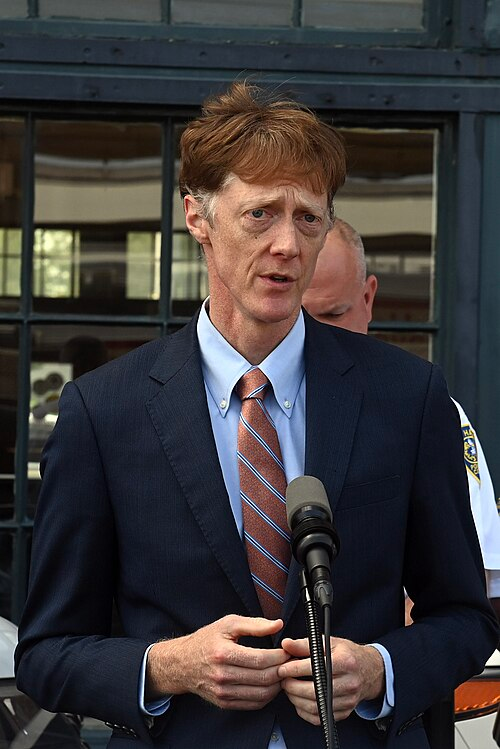
Marc A. Hermann / Metropolitan Transportation AuthoritySourceCC BY 2.0Image converted to PNG and resized proportionally.
Justin Elicker is the Democratic mayor of New Haven, Connecticut. First sworn into office in January 2020, he was re-elected to a fourth two-year term in 2025. Before becoming mayor he served on the New Haven Board of Alders and as executive director of the New Haven Land Trust.
We have documented 2 statements by Justin Elicker, in 2 cases. Each statement below gives the quotation, its original source and a link to the full case.
Case updates
Want the next important update?
Follow "Should DOJ send election monitors to all 50 states?" and get an email when an important development changes the record.
Important updates only. Free. Confirm your email to start. Unsubscribe anytime. How we handle your email.
Role at the time: Mayor of New Haven, in a city statement
Condemned
Statement summary
Elicker says that, given Trump's attempts to cast doubt on elections and the politicization of DOJ, posting federal monitors at polling places would make them feel less accessible.
“Given President Trump’s repeated attempts to undermine and cast doubt on free and fair elections across the nation and given the politicization of the Department of Justice under the Trump Administration, we believe posting federal election monitors at polling places would be counterproductive and make our polling places feel less accessible.”
Open source (opens in a new tab)United States Department of Justice to send election monitors to New Haven on Election Day, mayor saysStatement by Mayor Justin Elicker and the registrars of voters
Why we used this label
The case asks whether DOJ should send monitors to all 50 states. Elicker opposes posting federal monitors at New Haven polling places, citing the president's attacks on elections and the department's politicization.
Mayor Justin Elicker said New Haven, which does not use Flock for its safety cameras, intends to keep using safety cameras and license plate readers, and urged the governor and legislators not to add restrictions without working with cities.
“While New Haven does not use Flock as the provider for our safety camera system, safety cameras are an invaluable tool for the New Haven Police Department that are helping to keep our residents and community safe. ... We intend to continue to use safety cameras and license plate reader technology in a manner that appropriately balances the need to keep our community safe while also respecting the privacy of our residents.”
Read the official statement (opens in a new tab)Statement by Mayor Elicker in Response to Governor Lamont's Call for Municipalities to Pause the Installation of New Safety Cameras and Automated License Plate Reader Equipment and TechnologyStatement posted August 7, 2026; second paragraph of the quoted statement
Why we used this label
The reference point is whether networked license-plate reader systems such as Flock should exist and be used. Elicker calls safety cameras "an invaluable tool" and says the city will "continue to use safety cameras and license plate reader technology" while urging the state not to add restrictions. That is a defense of continued use, so we labeled it Defended or excused and placed it at Keep on the remedy ladder. The closest competing label is Mixed or conditional, which would fit a call for new guardrails; he points to privacy protections the city already has and asks for none beyond them.
DOJ plans election monitoring in every state and calls it routine enforcement work. The NAACP questions the program's authority and risks to voters, and seeks records through a FOIA lawsuit.
Networked automated license-plate cameras can assemble searchable records of vehicle movements. Candidates and officials disagree over whether to ban the systems, keep them with limits, or defend them as investigative tools. This tracker separates outright bans from narrower restrictions.