
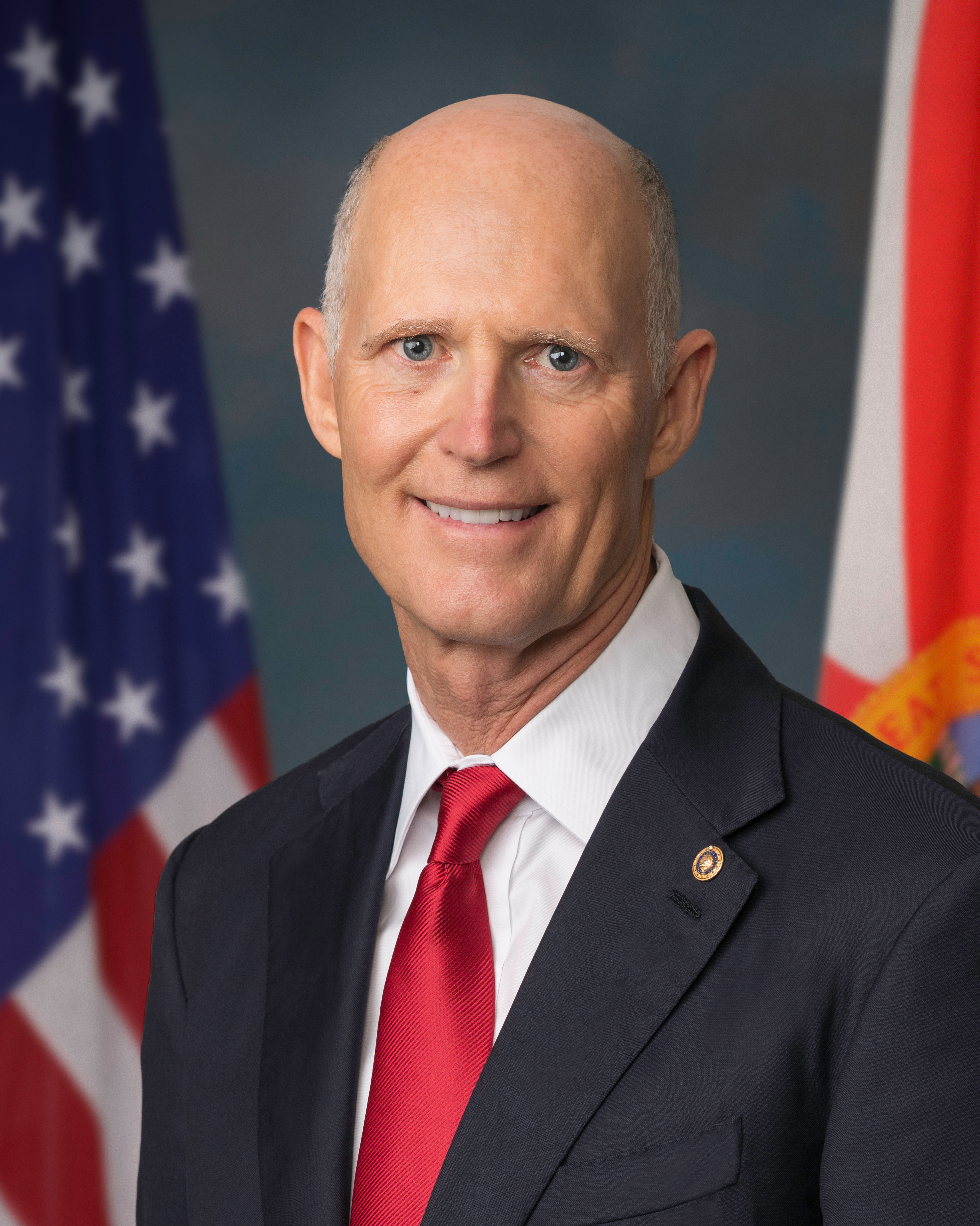
Rick Scott

Portrait of Rick Scott
U.S. Congress

United States Senator (Republican) from Florida.

What DI has documented

DI has documented statements by Rick Scott on 2026 Midterm Elections, Artificial Intelligence, and Education, among other topics. Read the quotations, original sources and related cases below.

Topics in this coverage

Show all 8 topics

Statements by Rick Scott

Portrait of Rick Scott

Rick Scott

Role at the time: U.S. senator from Florida

Mixed or conditional

Statement summary

Scott supports reducing unnecessary senior leadership in principle, while saying he has not seen Hegseth's plan.

“most organizations have become top-heavy”
Open the original interview (opens in a new tab)Senators respond to Hegseth's proposed general and admiral cuts · The HillBudd answer to whether the cuts are a good move; Slotkin's morale remarks; Scott's qualified support; Blumenthal's criticism of the decision process.
Why we used this label

Scott endorses efficiency and reducing top-heavy leadership, but qualifies his assessment by saying he has not seen the specific plan.

Portrait of Rick Scott

Rick Scott

Role at the time: U.S. Senator, Florida

Defended or excused

Statement summary

Rick Scott voted nay on H.Con.Res. 89, a vote against directing the removal of U.S. forces from unauthorized hostilities with Iran.

“On the Concurrent Resolution H.Con.Res. 89: A concurrent resolution directing the President, pursuant to section 5(c) of the War Powers Resolution, to remove United States Armed Forces from hostilities with Iran.”
Read the official statement (opens in a new tab)U.S. Senate Roll Call Vote 244: H.Con.Res. 89, Iran War Powers Resolution (rejected, 49-50)
Why we used this label

Voted against directing the removal of U.S. forces from unauthorized hostilities with Iran, a vote to let U.S. involvement continue without congressional authorization.

Portrait of Rick Scott

Rick Scott

Role at the time: United States senator from Florida, speaking to reporters

Mixed or conditional

Statement summary

Sen. Rick Scott split his answer on AI regulation. On children's safety he said Congress can act now, that he has introduced a bill and others have too, and that children must be told they are talking to a computer rather than a person and that AI systems cannot encourage them to take their own lives. On what he called destroying mankind, he said the companies need to do the right thing on their own, that Congress will not get smart enough to regulate them and will not get something done. The clip circulated widely with only the self-regulation passage quoted.

“I think first we need to be focused on kids safety. I think that's something we actually can do right now. I've got a bill. Others have bills. … But with regard to destroying mankind, these companies need to do the right thing on their own. We're not going to get smart enough to regulate them. We're not going to get something done up here to regulate them. But with regard to our kids, we need to make sure … they know that this is not a human being these kids are talking to, and they cannot be teaching our kids to commit suicide.”
Read the original post (opens in a new tab)Rick Scott on AI regulation: "these companies need to do the right thing on their own"0:45 clip. 00:00–00:20: child-safety proposals; 00:20–00:32: the self-regulation passage on existential risk; 00:32–00:45: return to child safety.
Why we used this label

Scott combines materially different positions on it: he supports federal legislation on child safety and says he has already introduced a bill, while rejecting federal action on catastrophic risk and directing that to industry self-regulation. That is the definition of “Mixed or conditional”. The closest competing label is condemns, which is how this case classifies speakers who reject the proposition outright, including Huang (727), Johnson (729) and Zuckerberg (939); it loses because Scott does not reject federal safeguards as such but carves out a category where he is actively legislating. Note that the widely circulated excerpt carries only the self-regulation half, which on its own would read as condemns; the full clip does not support that.

Portrait of Rick Scott

Rick Scott

Role at the time: U.S. Senator, Florida

Defended or excused

Statement summary

Rick Scott voted Nay on H.Con.Res. 86, the Senate resolution directing the President to remove U.S. Armed Forces from hostilities with Iran.

“On the Concurrent Resolution H.Con.Res. 86: Directing the President, pursuant to section 5(c) of the War Powers Resolution, to remove United States Armed Forces from hostilities with Iran.”
Read the official statement (opens in a new tab)U.S. Senate Roll Call Vote 184: H.Con.Res. 86, Iran War Powers Resolution (agreed to, 50-48)
Why we used this label

A nay vote opposed the resolution directing the removal of U.S. Armed Forces from hostilities with Iran, allowing U.S. military operations in the war to continue.

Portrait of Rick Scott

Rick Scott

Role at the time: U.S. Senator for Florida at the statement date.

Defended or excused

Statement summary

Scott supports continuing the military campaign until the United States achieves its nuclear-related objectives, with withdrawal afterward.

“We must win. Nothing less than victory is an option for America.”
Read the original text (opens in a new tab)Scott calls for continuing the Iran campaign until victoryComplete signed op-ed reproduced on official Senate website
Why we used this label

Relative to U.S. military involvement in the 2026 Iran war, Scott supports continuing the military campaign until the United States achieves its nuclear-related objectives, with withdrawal afterward.

Portrait of Rick Scott

Rick Scott

Role at the time: U.S. senator from Florida

Defended or excused

Statement summary

Scott says the admissions ruling was right and should have been unanimous.

“Today’s Supreme Court decision was the right one for our nation and should have been 9-0.”
Read the official statement (opens in a new tab)Rick Scott applauds the Supreme Court admissions decisionFirst sentence of Rick Scott statement
Why we used this label

Scott expressly approves the admissions ruling and says every justice should have supported it.

A participant is a subject of the case. A speaker has a statement documented in it. A commentator has an opinion or editorial documented in it.

Case

Do they support the war in Iran?

Relationship to this case: Speaker

An issue tracker recording where members of Congress and 2026 midterm candidates stand on the unauthorized Iran war, based on their votes on war-powers resolutions, campaign statements, and public remarks.

Iran WarU.S. PoliticsUpdated