
Explainer
What does a public figure have to prove to win a defamation suit?
Defamation is a false statement of fact that harms someone's reputation, governed mainly by state law. Under New York Times Co. v. Sullivan (1964) and later cases, public officials and public figures must also prove actual malice: that the speaker knew the statement was false or recklessly disregarded whether it was.
What defamation is
Defamation is a statement that harms another person's reputation. Libel generally covers written or recorded statements and slander spoken ones. It is governed mainly by state common law and statutes, so the elements, defenses and damages vary from state to state. A claim generally requires a false statement presented as fact, its publication to a third party, the level of fault the law requires, and reputational or other legally recognized harm. Truth is generally a complete defense.1
Calling a statement opinion does not automatically protect it. In 1990 the Supreme Court rejected a blanket exemption for opinion, but held that a statement on a matter of public concern must be provable as false before there can be liability, at least when the defendant is a media outlet. The Court also reaffirmed that statements that cannot reasonably be interpreted as stating actual facts are protected.2
The actual-malice rule
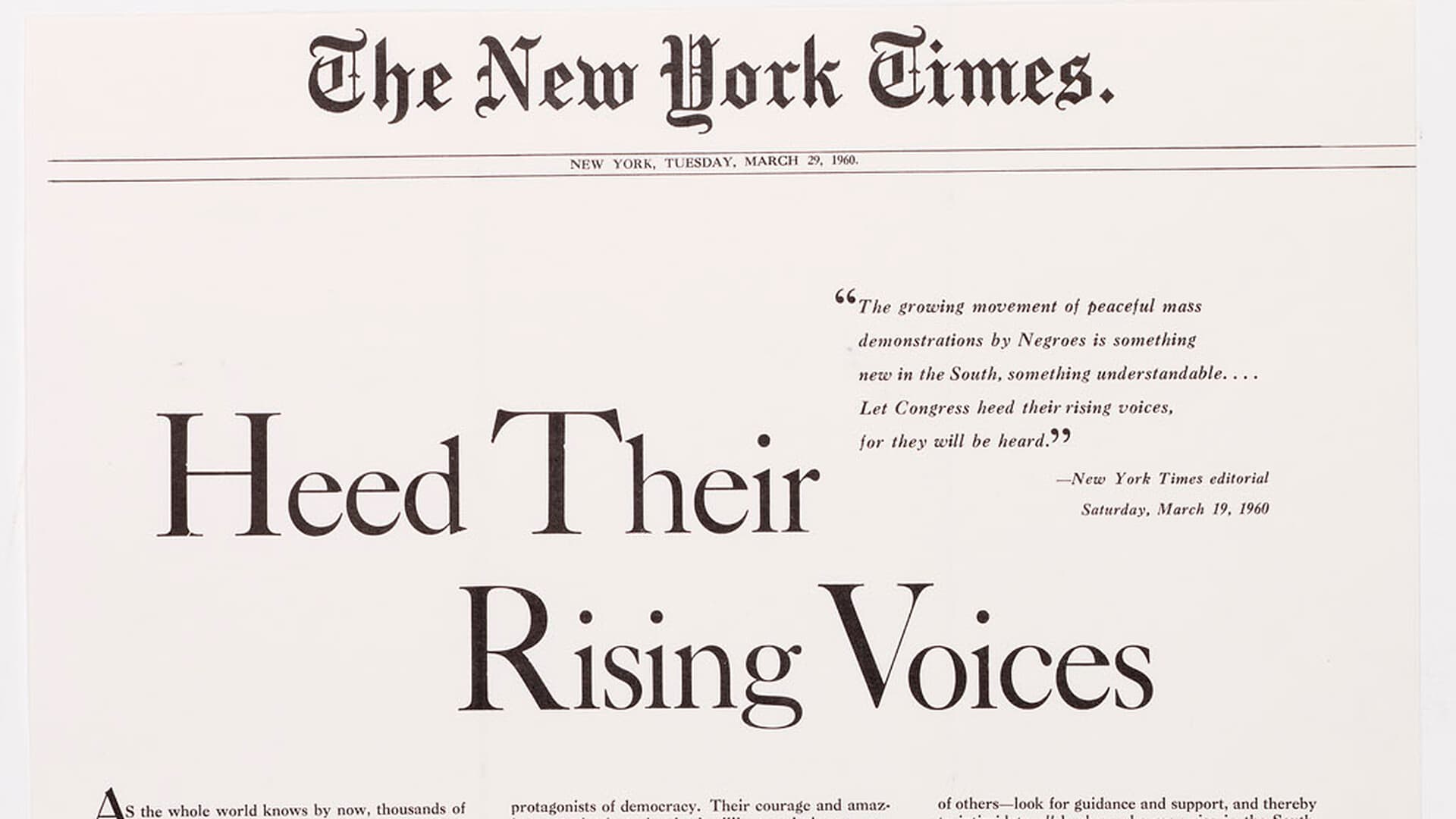
The modern rule began with a newspaper advertisement. On March 29, 1960, The New York Times ran a full-page ad, "Heed Their Rising Voices," that appealed for money to support civil rights protesters and the legal defense of Martin Luther King Jr. L. B. Sullivan, a Montgomery, Alabama, city commissioner who supervised the police department, sued over statements in it, and an Alabama jury awarded him $500,000.3
The Supreme Court reversed in 1964. Writing for the Court, Justice William Brennan described "a profound national commitment to the principle that debate on public issues should be uninhibited, robust, and wide-open." The Court held that a public official cannot recover damages for a defamatory falsehood about his official conduct unless he proves actual malice: that the statement was made "with knowledge that it was false or with reckless disregard of whether it was false or not."3
Actual malice is not the same as spite or ill will, which is what "malice" can mean elsewhere in defamation law, and it must be proved by clear and convincing evidence.1 Reckless disregard is not measured by whether a reasonably careful publisher would have checked further; there must be evidence that the defendant "in fact entertained serious doubts as to the truth of his publication."4 A failure to investigate does not by itself show actual malice, but "the purposeful avoidance of the truth is in a different category."5
Public figures and private people
Three years after Sullivan, a majority of the Court extended the rule to public figures in Curtis Publishing Co. v. Butts. In Gertz v. Robert Welch in 1974, the Court described two kinds of public figure: a person with "such pervasive fame or notoriety that he becomes a public figure for all purposes and in all contexts," and, more commonly, a person who "voluntarily injects himself or is drawn into a particular public controversy" and becomes a public figure for a limited range of issues.6
Private individuals face a lower bar. For their suits against publishers and broadcasters, Gertz lets each state set its own standard as long as it does not impose liability without fault. When the speech involves a matter of public concern, they cannot recover presumed or punitive damages without proving actual malice.61 When a media defendant's speech concerns a matter of public concern, the plaintiff must also prove that the statement was false, rather than the defendant having to prove it true.7
The debate over Sullivan
Justice Clarence Thomas has called for reconsidering the actual-malice standard for public figures since 2019.8 Dissenting when the Court declined on June 29, 2026 to hear Alan Dershowitz's appeal in his defamation suit against CNN, he wrote, quoting his own 2021 dissent, which quoted Judge Silberman of the D.C. Circuit, that the actual-malice standard for public figures bears "no relation to the text, history, or structure of the Constitution," and that the founding generation believed public figures, if anything, had stronger claims for damages when they were defamed. Justice Neil Gorsuch joined that dissent.9
Gorsuch set out his own case in 2021. Dissenting in Berisha v. Lawson, he wrote that since 1964 the media had "shifted in ways few could have foreseen" and that actual malice had "evolved from a high bar to recovery into an effective immunity from liability." He cited data showing that defamation trials involving publications fell from an average of 27 a year in the 1980s to 3 in 2018.8
Some defenders of the rule answer that the problem lies elsewhere. Nabiha Syed, writing for the Knight First Amendment Institute in 2021, argued that most of the falsehoods the two justices worry about are not governed by defamation law, and that Gorsuch's proposal would further imperil journalists amid "meritless litigation over unpleasant truths about the powerful."10 The Court has not agreed to reconsider Sullivan, which remains the governing rule.9
History
- March 29, 1960
The New York Times runs the "Heed Their Rising Voices" advertisement.3
- March 9, 1964
The Supreme Court decides New York Times Co. v. Sullivan and adopts the actual-malice rule for public officials.3
- 1967
Curtis Publishing Co. v. Butts extends the rule to public figures.6
- April 29, 1968
St. Amant v. Thompson defines reckless disregard as serious doubts about the truth.4
- June 25, 1974
Gertz v. Robert Welch sets the rules for private individuals.6
- April 21, 1986
Philadelphia Newspapers v. Hepps puts the burden of proving falsity on the plaintiff when a media defendant's speech is of public concern.7
- June 22, 1989
Harte-Hanks v. Connaughton holds that purposeful avoidance of the truth can show actual malice.5
- June 21, 1990
Milkovich v. Lorain Journal rejects a blanket exemption for opinion.2
- July 2, 2021
Justices Thomas and Gorsuch dissent from the denial of review in Berisha v. Lawson.8
- June 29, 2026
The Court declines to hear Dershowitz v. CNN; Thomas, joined by Gorsuch, dissents.9
What is disputed
Whether the Supreme Court should keep the actual-malice rule and its extension to public figures, as Justices Thomas and Gorsuch question.
See the case: Should the Supreme Court keep New York Times v. Sullivan's rule and its public-figure extensions?Whether a BBC documentary edit defamed Donald Trump, and whether a court in Florida can hear his claim.
See the case: Trump says the BBC's January 6 edit defamed him; the BBC disputes his claimWhether MS NOW accurately reported that Kash Patel ordered agents protecting Alexis Wilkins to drive her friend home, as her defamation suit disputes.
See the case: Did FBI Director Kash Patel order the security detail protecting Alexis Wilkins to drive a friend home, as MS NOW reported?Whether commentators who suggested Alexis Wilkins is a foreign intelligence "honeypot" defamed her. She denies the claim and sued three of them; one suit is still pending.
See the case: Is Alexis Wilkins a foreign 'honeypot' agent, as Kyle Seraphin and other commentators suggested?Whether AI-generated videos putting words in a candidate's mouth can be defamatory when an election deepfake law does not apply.
See the case: Should Derrick Van Orden stop posting AI deepfakes of Rebecca Cooke?Whether Kimberly Guilfoyle offered Eric Deters access to administration officials for $100,000, which he alleges and she denies.
See the case: Eric Deters alleges Kimberly Guilfoyle offered administration access for $100,000; she denies it
Cases on the Dispute Index
Should the Supreme Court keep New York Times v. Sullivan's rule and its public-figure extensions?
Thomas and Gorsuch question the constitutional basis and present-day effects of actual malice. Defenders stress protection for criticism and reporting. The Court's June 2026 refusal to hear Dershowitz's challenge left the rule in place.
Trump says the BBC's January 6 edit defamed him; the BBC disputes his claim
Trump says a BBC documentary edit falsely portrayed him calling for violence on January 6. The BBC apologized for the editing decision but disputes defamation. The parties continue to contest the case in federal court.
Eric Deters alleges Kimberly Guilfoyle offered administration access for $100,000; she denies it
Trump donor Eric Deters alleges Kimberly Guilfoyle asked him in 2025 to pay her $100,000 credit card bill while offering him access to administration officials. Guilfoyle says the allegations are false, and her lawyers say she was collecting a debt for past work.
Should Derrick Van Orden stop posting AI deepfakes of Rebecca Cooke?
Rebecca Cooke demands that Derrick Van Orden stop posting AI impersonations of her. Van Orden dismisses the demand, while his campaign calls her response a tantrum in its own release.
Is Alexis Wilkins a foreign 'honeypot' agent, as Kyle Seraphin and other commentators suggested?
Commentators including Kyle Seraphin suggested that Alexis Wilkins, Kash Patel's fiancee, is a Mossad "honeypot." She denies it and sued three of them: the Schaffer suit was dismissed and he retracted, one was dismissed on jurisdiction and one is pending.
Did FBI Director Kash Patel order the security detail protecting Alexis Wilkins to drive a friend home, as MS NOW reported?
MS NOW reported, citing three unnamed sources, that Kash Patel ordered the FBI detail protecting Alexis Wilkins to drive a friend home. The FBI and Wilkins say it did not happen, MS NOW stands by its reporting, and her defamation suit is pending.
Sources
- Defamation (Wex legal encyclopedia, Legal Information Institute) (opens in a new tab) · Saved copy (opens in a new tab)
- Milkovich v. Lorain Journal Co., 497 U.S. 1 (1990) (Legal Information Institute) (opens in a new tab) · Saved copy (opens in a new tab)
- New York Times Co. v. Sullivan, 376 U.S. 254 (1964) (opens in a new tab) · Saved copy (opens in a new tab)
- St. Amant v. Thompson, 390 U.S. 727 (1968) (Legal Information Institute) (opens in a new tab) · Saved copy (opens in a new tab)
- Harte-Hanks Communications, Inc. v. Connaughton, 491 U.S. 657 (1989) (Legal Information Institute) (opens in a new tab) · Saved copy (opens in a new tab)
- Gertz v. Robert Welch, Inc., 418 U.S. 323 (1974) (Legal Information Institute) (opens in a new tab) · Saved copy (opens in a new tab)
- Philadelphia Newspapers, Inc. v. Hepps, 475 U.S. 767 (1986) (Legal Information Institute) (opens in a new tab) · Saved copy (opens in a new tab)
- Berisha v. Lawson: Thomas and Gorsuch dissents from denial of review (opens in a new tab) · Saved copy (opens in a new tab)
- Dershowitz v. CNN: Thomas dissent joined by Gorsuch (opens in a new tab) · Saved copy (opens in a new tab)
- Sullivan Is Not the Problem (opens in a new tab) · Saved copy (opens in a new tab)
Last reviewed October 19, 2026. We review this explainer when a case that uses it changes. Report an error