
Explainer
What does the First Amendment protect?
The First Amendment bars the government from abridging the freedom of speech or of the press. It limits government, not private companies. Courts presume content-based laws and prior restraints unconstitutional, and only a few narrow categories, such as incitement, true threats and obscenity, fall outside it.
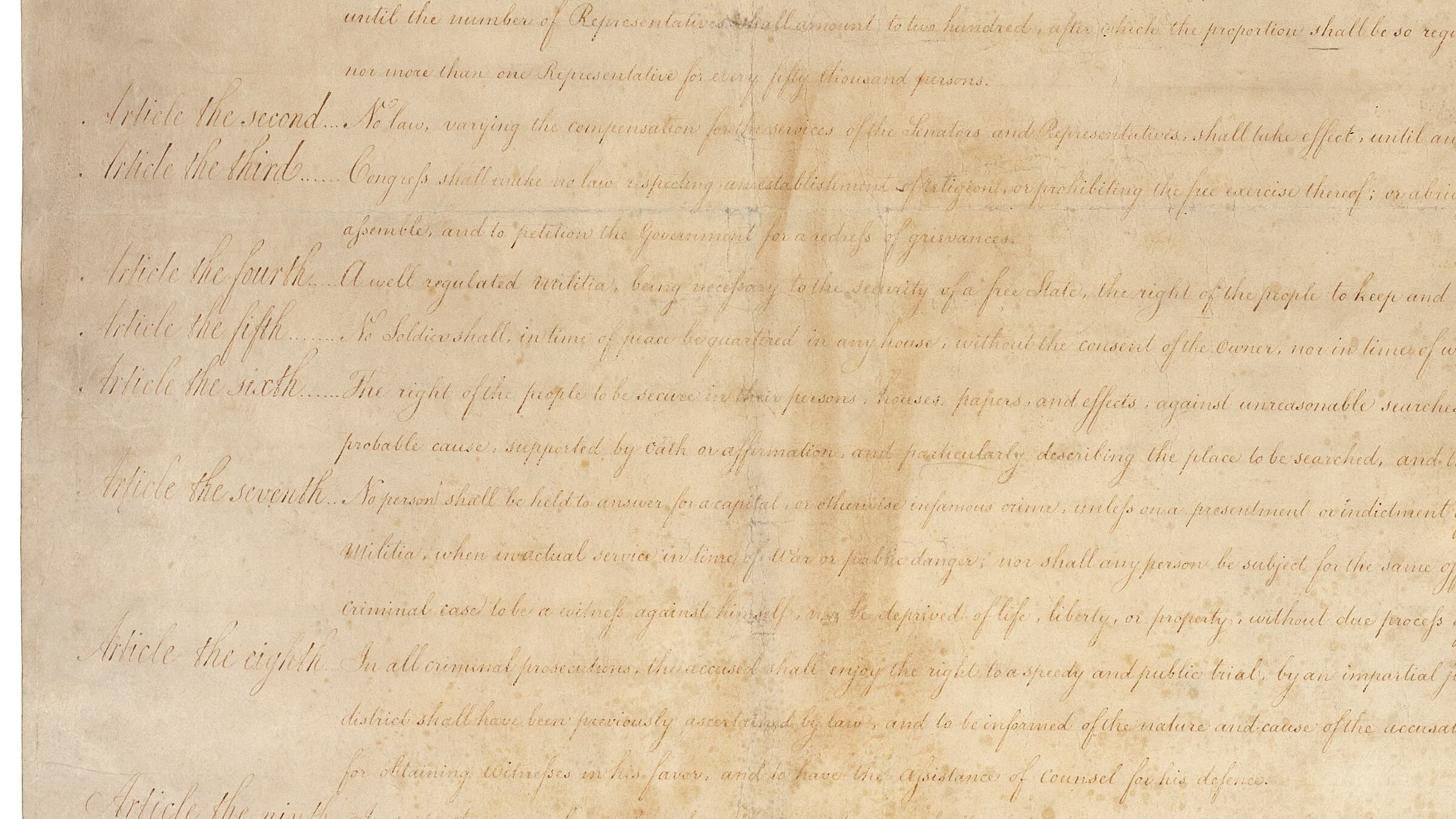
The text and whom it binds
The First Amendment reads: "Congress shall make no law respecting an establishment of religion, or prohibiting the free exercise thereof; or abridging the freedom of speech, or of the press; or the right of the people peaceably to assemble, and to petition the Government for a redress of grievances." The National Archives says the first ten amendments, the Bill of Rights, were ratified on December 15, 1791. In the 1789 joint resolution of Congress that proposed them, the text appears as "Article the third."1 This page covers the speech and press guarantees; the religion, assembly and petition clauses are separate subjects.
The amendment restrains government, not private parties. In Manhattan Community Access Corp. v. Halleck (2019), the Supreme Court said the Free Speech Clause "does not prohibit private abridgment of speech," and that a private entity that provides a forum for speech does not become a government actor for that reason alone.2 The same rule separates public and private colleges: the Congressional Research Service (CRS) says public colleges are generally bound by the First Amendment, while private colleges are not required to provide the same protections.3
The text names Congress, but the Court applies the guarantee to state governments through the Fourteenth Amendment.3 By 1931 the Court called that point "no longer open to doubt."4
How courts test limits on speech
Courts first ask whether a law targets speech because of what it says. In Reed v. Town of Gilbert (2015), the Supreme Court said content-based laws "are presumptively unconstitutional and may be justified only if the government proves that they are narrowly tailored to serve compelling state interests," a test known as strict scrutiny. A law that is content based on its face gets that scrutiny even if the government's motive is benign.5
Rules that do not turn on content get more room. In Ward v. Rock Against Racism (1989), the Court said that even in a public forum the government may set reasonable restrictions on the time, place or manner of speech if they are content neutral, narrowly tailored to a significant government interest and leave open ample other ways to communicate. Such a rule need not be the least restrictive way to serve that interest.6
The Court has refused to weigh the value of speech case by case. In United States v. Stevens (2010), it rejected the idea that free speech protection extends only to categories of speech that survive "an ad hoc balancing of relative social costs and benefits."7
Speech the First Amendment does not protect
A few historic categories fall outside the amendment. In Free Speech Coalition v. Paxton (2025), the Court, quoting its 2010 Stevens decision, listed "obscenity, defamation, fraud, incitement, and speech integral to criminal conduct."8 Each is narrow.
In Brandenburg v. Ohio (1969), the Court held that a state may punish advocacy of force or lawbreaking only where it is directed to inciting or producing imminent lawless action and is likely to do so.9
In Counterman v. Colorado (2023), the Court said true threats of violence are outside First Amendment protection and punishable as crimes, and held that prosecutors must show at least recklessness about the threatening nature of the statement.10
Under Miller v. California (1973), obscene material is unprotected, but the label is limited to works that, taken as a whole, appeal to the prurient interest, depict sexual conduct in a patently offensive way and lack serious literary, artistic, political or scientific value.11
False statements of fact that damage a reputation can be the basis of a lawsuit, with added protection when the plaintiff is a public figure. See What is defamation, and what is actual malice? (opens in a new tab)
Prior restraint
Orders that stop speech before it is published face a heavy presumption against their validity. In Near v. Minnesota (1931), the Court described preventing such "previous restraints upon publication" as the chief purpose of the press guarantee, and held unconstitutional, as applied in that case, a Minnesota law that let courts shut down a "malicious, scandalous and defamatory" newspaper as a public nuisance.4
In New York Times Co. v. United States (1971), the government asked courts to stop The New York Times and The Washington Post from publishing a classified study of U.S. decision-making on Vietnam. In a short unsigned opinion, the Court said that "any system of prior restraints of expression comes to this Court bearing a heavy presumption against its constitutional validity," and agreed with the trial courts and the D.C. Circuit that the government had not met its burden.12
When the government is the speaker
The Free Speech Clause "restricts government regulation of private speech; it does not regulate government speech," the Court said in Pleasant Grove City v. Summum (2009), which treated a city's choice of permanent monuments in a public park as the city's own speech.13 In Walker v. Texas Division, Sons of Confederate Veterans (2015), the Court held that Texas specialty license plate designs are government speech, so the state could reject a design featuring the Confederate battle flag.14
How far that idea reaches is disputed. On May 23, 2025, the full U.S. Court of Appeals for the Fifth Circuit ruled against library patrons who challenged Llano County, Texas, for removing books, and ordered their free speech claims dismissed. Ten judges joined the parts of Judge Stuart Kyle Duncan's opinion holding that patrons cannot invoke a right to receive information to challenge a library's removal of books. Seven of them also joined a part saying a library's collection decisions are government speech and so not subject to a free speech challenge. Judge Stephen Higginson, joined by six other judges, dissented, writing that the majority "sanctions government censorship in every section of every public library in our circuit."15 The Supreme Court denied review on December 8, 2025.16
Public employees, students and noncitizens
Government employees keep some speech rights. In Pickering v. Board of Education (1968), the Court said courts must balance an employee's interest, as a citizen, in commenting on matters of public concern against the government's interest as an employer in running its services efficiently.17 In Garcetti v. Ceballos (2006), it held that when public employees make statements pursuant to their official duties, they are not speaking as citizens for First Amendment purposes.18
In Tinker v. Des Moines (1969), the Court said students and teachers have First Amendment rights, "applied in light of the special characteristics of the school environment."19
Whether the government may deport noncitizens or revoke their visas because of their speech is being litigated. On August 28, 2026, Judge Noël Wise of the U.S. District Court for the Northern District of California declared that challenged parts of the Immigration and Nationality Act's deportation and visa revocation provisions violate the First Amendment when enforced based on protected speech, but declined to enter a permanent injunction, saying one was not appropriate at that stage for the visa provision and that only the Supreme Court could provide that relief for the deportation provision.20
The press
The Court has not read the Press Clause to excuse reporters from grand jury subpoenas. In Branzburg v. Hayes (1972), the question was whether reporters must respond to grand jury subpoenas "as other citizens do." The Court said citizens generally are not constitutionally immune from grand jury subpoenas, while also saying newsgathering qualifies for some First Amendment protection.21
Publishing what others obtained illegally is another matter. In Bartnicki v. Vopper (2001), the Court held that "a stranger's illegal conduct does not suffice to remove the First Amendment shield from speech about a matter of public concern," protecting people who published an intercepted phone call they had no part in intercepting.22
In Zacchini v. Scripps-Howard Broadcasting (1977), the Court held that the First Amendment does not immunize news media that broadcast a performer's entire act without his consent, while noting that his state-law right of publicity would not stop the station from reporting the newsworthy facts about the act.23 In Hustler Magazine v. Falwell (1988), it held that public figures may not recover for intentional infliction of emotional distress over a publication like the ad parody at issue unless it contains a false statement of fact made with actual malice.24
Money in elections
The Court has treated limits on political spending as limits on speech. In Buckley v. Valeo (1976), it said a limit on what a person or group can spend on political communication "necessarily reduces the quantity of expression." The Court upheld limits on individual contributions, disclosure rules and public financing, but struck down limits on campaign spending, independent spending and candidates' spending of their own money.25
In Citizens United v. FEC (2010), Justice Anthony Kennedy's majority opinion said the government "may not suppress political speech on the basis of the speaker's corporate identity," and concluded that independent expenditures, including corporations', "do not give rise to corruption or the appearance of corruption."26 Justice John Paul Stevens, joined by three other justices, dissented in part, calling the ruling "a rejection of the common sense of the American people."27
Platforms, minors and AI
In Moody v. NetChoice (2024), the Court said that when platforms build certain feeds, they "make choices about what third-party speech to display and how to display it," and that Texas's law, applied to feeds like Facebook's News Feed or YouTube's homepage, would prevent the kind of editorial judgments the Court has protected. It vacated both appeals court rulings without deciding the First Amendment merits, because neither court had properly considered that the challenges were facial.28
The Court has allowed some age checks. In Free Speech Coalition v. Paxton (2025), it held that the burdens a Texas law requiring sexually explicit websites to verify visitors' ages places on adults likely do not make it unconstitutional, applying intermediate scrutiny. Justice Elena Kagan, joined by two justices, dissented, arguing for strict scrutiny because the law impedes adults from viewing a class of speech protected for them and defined by its content.8
Challenges to state laws limiting minors' use of social media have gone different ways. On August 14, 2025, the Supreme Court denied NetChoice's application to lift a stay in its challenge to Mississippi's law. Justice Brett Kavanaugh, concurring, wrote that NetChoice was likely to succeed on its First Amendment claim but had not shown that the balance of harms and equities favored it at that time. He noted that the district court had blocked the Mississippi law and that seven other federal district courts had blocked similar state laws.29
On September 9, 2025, a Ninth Circuit panel reviewing California's SB 976 said some personalized recommendation algorithms may be expressive and others may not, a fact-intensive question. It blocked the law's default limit on minors seeing like counts as content based, but otherwise left the law, including its limits on personalized feeds, in place at that stage.30
On October 15, 2026, an Eleventh Circuit panel vacated a preliminary injunction against a Georgia law barring minors under 16 from holding accounts without a parent's consent. It held that NetChoice had not carried its burden on a facial challenge, and did not reach the First Amendment merits.31
Whether the output of an AI chatbot is protected speech is unsettled. In May 2025, a federal judge in the Middle District of Florida said the court was "not prepared to hold" at an early stage that the Character.AI chatbot's output is speech, while also ruling that the company could assert its users' First Amendment rights.32
History
- December 15, 1791
The Bill of Rights, including the First Amendment, is ratified.1
- June 1, 1931
Near v. Minnesota holds unconstitutional a state law as used to shut down a newspaper, and applies the press guarantee to the states.4
- June 3, 1968
Pickering v. Board of Education sets a balancing test for public employees' speech on matters of public concern.17
- February 24, 1969
Tinker v. Des Moines says students and teachers keep First Amendment rights at school.19
- June 9, 1969
Brandenburg v. Ohio limits punishment of advocacy to speech directed to and likely to produce imminent lawless action.9
- June 30, 1971
New York Times Co. v. United States refuses to stop publication of a classified study of Vietnam policy.12
- June 29, 1972
Branzburg v. Hayes holds that reporters, like other citizens, must generally answer grand jury subpoenas.21
- June 21, 1973
Miller v. California sets the test for obscenity.11
- January 30, 1976
Buckley v. Valeo upholds contribution limits but strikes down limits on campaign spending.25
- May 30, 2006
Garcetti v. Ceballos holds that statements made pursuant to official duties are not citizen speech.18
- January 21, 2010
Citizens United v. FEC strikes down limits on independent election spending by corporations.26
- June 18, 2015
Reed v. Town of Gilbert applies strict scrutiny to laws that are content based on their face, whatever the government's motive.5
- June 27, 2023
Counterman v. Colorado holds that a true-threats prosecution requires at least recklessness.10
- July 1, 2024
Moody v. NetChoice says curating feeds involves protected editorial choices and returns the platform cases to the lower courts.28
- May 23, 2025
The full Fifth Circuit rules against library patrons in the Llano County book removal case.15
- June 27, 2025
Free Speech Coalition v. Paxton holds that Texas's age-verification law for sexually explicit websites is subject to, and likely survives, intermediate scrutiny.8
- August 28, 2026
A federal judge declares that challenged parts of two immigration law provisions violate the First Amendment when enforced based on protected speech.20
- October 15, 2026
The Eleventh Circuit vacates a preliminary injunction against Georgia's under-16 social media account law, holding NetChoice had not carried its facial-challenge burden, without reaching the First Amendment merits.31
What is disputed
Whether the White House may bar CNN, MS NOW and Politico because of their coverage, or whether that exclusion is retaliation for protected reporting.
See the case: Should President Trump bar CNN, MS NOW and Politico from the White House over their coverage?Whether the FCC's early renewal review of eight ABC-owned station licenses is authorized oversight or retaliation for protected programming and journalism.
See the case: Is the FCC's early review of ABC's broadcast licenses legitimate oversight or retaliation?Whether the government may deport noncitizens or revoke their visas because of protected speech, which a federal judge's declaratory judgment rejected for the challenged provisions and which the government is contesting on appeal.
See the case: Rubio appeals Stanford Daily's protected-speech ruling; FIRE defends itWhether Michigan State University's revised trustee ethics code unconstitutionally restricts an elected trustee's speech, or sets permissible governance rules.
See the case: Michael Balow challenges MSU's trustee ethics code; Brianna Scott defends it.Whether California's AB 1709 limits on personalized feeds and autoplay for users under 16 restrict platforms' protected editorial choices, as Google, Meta and TikTok argue, or are permissible child-safety rules.
See the case: Google, Meta and TikTok challenge California's under-16 feed and autoplay limits signed by NewsomWhether Florida's and Texas's limits on platform content moderation regulate discriminatory conduct, as Texas argues, or restrict and compel the platforms' protected editorial choices, as NetChoice argues.
See the case: NetChoice challenges Florida and Texas social-media moderation lawsWhether a chatbot's output is speech protected by the First Amendment, so that tort claims over it are barred, as Character.AI argued, or not speech, as the plaintiff's lawyers argued.
See the case: Character.AI argues the First Amendment bars a lawsuit blaming its chatbot for a teen's suicideWhether claims that ChatGPT's design contributed to the FSU shooting target a defective product, as the estate argues, or information and expression the First Amendment protects, as OpenAI and industry groups argue.
See the case: Should OpenAI face liability for ChatGPT's alleged role in the FSU shooting?Whether a public library's removal of books is beyond patrons' free speech challenge, as ten judges of the full Fifth Circuit held (seven of them calling it government speech), or abridges patrons' rights, as the seven dissenting judges and library advocates argue.
See the case: Llano County's library book removals raise a government-speech disputeWhether the First Amendment bars limits on independent election spending by corporations and unions, as the Citizens United majority held, or permits them to prevent corruption, as the dissent and later critics argue.
See the case: Citizens United: Corporate election spending and free speech
Cases on the Dispute Index
Supreme Court declines to review California's implicit bias requirement for medical education courses; Justices Thomas and Alito dissent
The Supreme Court declined on November 16, 2026 to hear a doctor's challenge to California's rule that continuing medical education courses cover implicit bias. Justice Thomas, joined by Justice Alito, dissented, saying a state cannot regulate its way out of First Amendment scrutiny.
Google, Meta and TikTok challenge California's under-16 feed and autoplay limits signed by Newsom
Google, Meta and TikTok challenge California's limits on personalized feeds and autoplay for users under 16, arguing the law overrides editorial discretion and parental choice. Newsom signed it in September as a child-safety measure.
Was Branzburg v. Hayes right to require reporters' grand-jury testimony?
Branzburg rejected a First Amendment privilege against relevant grand-jury testimony. The majority stressed criminal investigations; Stewart's dissent stressed confidential reporting. Powell joined the opinion while describing protections against harassment and demands lacking a legitimate law-enforcement need.
Should OpenAI face liability for ChatGPT's alleged role in the FSU shooting?
An estate representative says ChatGPT's design and safeguards contributed to the FSU shooting. OpenAI disputes liability, and industry groups invoke users' speech rights. The parties disagree over whether the claims target product design or protected information.
Michael Balow challenges MSU's trustee ethics code; Brianna Scott defends it.
Michael Balow challenges MSU's trustee code as a restriction on dissent. Brianna Scott defends its governance rules, which combine commitments to open debate with majority-support requirements and sanctions for refusing to sign.
Zacchini v. Scripps-Howard: performer challenges broadcast of his entire act; broadcaster claims press protection
The Supreme Court split over broadcasting an entire performance without consent. White's majority rejected constitutional immunity but left state-law protection open. Powell's dissent argued that routine news use deserved First Amendment protection.
Hustler Magazine v. Falwell: Supreme Court reverses emotional-distress award over ad parody
Falwell sought damages over an offensive Hustler parody that a jury found could not reasonably be understood as factual. Hustler invoked the First Amendment. In 1988, the Supreme Court reversed the emotional-distress award, with all participating justices agreeing in the judgment.
Rubio appeals Stanford Daily's protected-speech ruling; FIRE defends it
The Stanford Daily and Jane Doe challenged immigration provisions used against protected expression. Judge Noel Wise granted declaratory relief limited to the challenged statutory portions. Federal defendants appealed on October 14, 2026; the plaintiffs defend the ruling.
Bartnicki v. Vopper: justices split over publishing an illegally intercepted call
The Supreme Court protects disclosure of a call by recipients who did not participate in its illegal interception. The majority emphasizes public concern; the dissent stresses privacy and the incentive for others to intercept communications.
Garcetti: Kennedy and Souter split over public employees' duty-related speech
In Garcetti v. Ceballos, Justice Anthony Kennedy wrote for a five-to-four majority that the First Amendment does not protect public employees' statements made under their official duties. Justice David Souter dissented, favoring a balancing test for some warnings of wrongdoing.
Citizens United: Corporate election spending and free speech
The Supreme Court protected corporate and union independent election spending in Citizens United. Defenders say the ruling protects political speech and association. Critics say it gives wealthy interests excessive influence and undermines democratic accountability.
NetChoice challenges Florida and Texas social-media moderation laws
States defend rules against platform viewpoint discrimination. NetChoice asserts editorial rights. The Supreme Court required further analysis; the cases' present enforceability has not been verified.
Llano County's library book removals raise a government-speech dispute
Llano County argues that library curation is outside the First Amendment speech claim brought by patrons. Library advocates call viewpoint-based removals censorship. The Fifth Circuit dismissed the patrons' speech claims; the Supreme Court later declined review.
Character.AI argues the First Amendment bars a lawsuit blaming its chatbot for a teen's suicide
Character.AI argued that the First Amendment bars a lawsuit blaming its chatbot for a teen's suicide. The mother's lawyers said chatbot output is not protected speech. A federal judge declined to call it speech at an early stage, and the case settled.
Is the FCC's early review of ABC's broadcast licenses legitimate oversight or retaliation?
Disney says the FCC is using eight local station licenses to punish ABC's programming. The agency says it is investigating employment practices under its licensing authority.
Should President Trump bar CNN, MS NOW and Politico from the White House over their coverage?
Trump announced a White House ban on CNN, MS NOW and Politico over their coverage. Read his original post, the outlets' responses and their accounts of reporters being refused entry.
Sources
- The Bill of Rights: A Transcription (opens in a new tab) · Saved copy (opens in a new tab)
- Manhattan Community Access Corp. v. Halleck, No. 17-1702 (2019): slip opinion (opens in a new tab) · Saved copy (opens in a new tab)
- Free Speech on College Campuses: Considerations for Congress (LSB10438) (opens in a new tab) · Saved copy (opens in a new tab)
- Near v. Minnesota ex rel. Olson, 283 U.S. 697 (1931) (opens in a new tab) · Saved copy (opens in a new tab)
- Reed v. Town of Gilbert, 576 U.S. 155 (2015) (opens in a new tab) · Saved copy (opens in a new tab)
- Ward v. Rock Against Racism, 491 U.S. 781 (1989) (opens in a new tab) · Saved copy (opens in a new tab)
- United States v. Stevens, 559 U.S. 460 (2010): opinion of the Court (opens in a new tab) · Saved copy (opens in a new tab)
- Free Speech Coalition, Inc. v. Paxton, No. 23-1122 (2025): slip opinion (opens in a new tab) · Saved copy (opens in a new tab)
- Brandenburg v. Ohio, 395 U.S. 444 (1969) (opens in a new tab) · Saved copy (opens in a new tab)
- Counterman v. Colorado, No. 22-138 (2023): slip opinion (opens in a new tab) · Saved copy (opens in a new tab)
- Miller v. California, 413 U.S. 15 (1973) (opens in a new tab) · Saved copy (opens in a new tab)
- New York Times Co. v. United States, 403 U.S. 713 (1971) (opens in a new tab) · Saved copy (opens in a new tab)
- Pleasant Grove City v. Summum, 555 U.S. 460 (2009): opinion of the Court (opens in a new tab) · Saved copy (opens in a new tab)
- Walker v. Texas Division, Sons of Confederate Veterans, Inc., 576 U.S. 200 (2015) (opens in a new tab) · Saved copy (opens in a new tab)
- Little v Llano County: En banc opinion (opens in a new tab) · Saved copy (opens in a new tab)
- Supreme Court docket 25-284: Little v. Llano County (opens in a new tab) · Saved copy (opens in a new tab)
- Pickering v. Board of Education, 391 U.S. 563 (1968) (opens in a new tab) · Saved copy (opens in a new tab)
- Supreme Court opinions in Garcetti v. Ceballos (opens in a new tab)
- Tinker v. Des Moines Independent Community School District, 393 U.S. 503 (opens in a new tab) · Saved copy (opens in a new tab)
- Stanford Daily v. Rubio: memorandum of decision (opens in a new tab) · Saved copy (opens in a new tab)
- Branzburg v. Hayes, 408 U.S. 665: full opinions (opens in a new tab) · Saved copy (opens in a new tab)
- Supreme Court opinions in Bartnicki v. Vopper (opens in a new tab) · Saved copy (opens in a new tab)
- Zacchini v. Scripps-Howard: readable full opinion text (opens in a new tab) · Saved copy (opens in a new tab)
- Hustler Magazine v. Falwell: Supreme Court opinion (opens in a new tab) · Saved copy (opens in a new tab)
- Buckley v. Valeo, 424 U.S. 1 (1976) (opens in a new tab) · Saved copy (opens in a new tab)
- Citizens United: Kennedy opinion of the Court (opens in a new tab) · Saved copy (opens in a new tab)
- Citizens United: Stevens dissent (opens in a new tab) · Saved copy (opens in a new tab)
- Supreme Court opinion in Moody v. NetChoice and NetChoice v. Paxton (opens in a new tab) · Saved copy (opens in a new tab)
- NetChoice, LLC v. Fitch, No. 25A97 (2025): order and concurrence (opens in a new tab) · Saved copy (opens in a new tab)
- NetChoice, LLC v. Bonta, No. 25-146 (9th Cir. Sept. 9, 2025) (opens in a new tab) · Saved copy (opens in a new tab)
- NetChoice v. Attorney General, State of Georgia, No. 25-12436 (11th Cir. Oct. 15, 2026) (opens in a new tab) · Saved copy (opens in a new tab)
- Order on the motions to dismiss, Garcia v. Character Technologies (M.D. Fla.) (opens in a new tab) · Saved copy (opens in a new tab)
Last reviewed November 9, 2026. We review this explainer when a case that uses it changes. Report an error