All topics

Trade Policy

Public disputes concerning tariffs, trade agreements, market access, and the commercial terms countries set with one another.

Published coverage on this page: 1 case · 2 statements. Statements are ordered newest first.

Related cases

Statements

Filter by response label (1 selected)

Labels describe a response to the linked claim or the action explained in the statement summary. Choose one or more.

2 matching statements

Stéphane Dion

Role at the time: Former Canadian ambassador to Germany and to France and former special envoy to the European Union, now diplomat in residence at the Université de Montréal, interviewed on CBC's Power & Politics

Challenged the characterization

Statement summary

Interviewed on CBC's Power & Politics, former Canadian ambassador and EU special envoy Stéphane Dion described Ursula von der Leyen's associate-membership offer as a "friendly exaggeration": an overstatement because the term is not clear and, in his account, not one Canada or the member-state leaders were ready to endorse, but friendly because it signalled how closely she wants to work with Canada. He said Canada will not transfer federal or provincial sovereignty to Brussels and that the EU cannot extend its advantages without its constraints, and argued the substance should instead be concrete results — trade beyond the current 8 per cent share, investment in critical minerals, and scientific and military cooperation — ahead of the EU–Canada summit at the end of October. Dion's account of what member-state leaders were prepared to endorse is his own.

Quotation excerpt

Madame von der Leyen did what we may call a friendly exaggeration. … So it's an exaggeration, but it's a friendly one, because it shows how much she's willing to have close links with us. … Canada doesn't want to transfer sovereignty,…
Read full quotation
Madame von der Leyen did what we may call a friendly exaggeration. … So it's an exaggeration, but it's a friendly one, because it shows how much she's willing to have close links with us. … Canada doesn't want to transfer sovereignty, whether federal or provincial, to Brussels. That's something that will not happen. And the EU cannot give to Canada all the advantages of the EU without the constraints, because the EU members would say it's unfair for us. … Maybe she did not choose the right words, but it's a good wake-up call for everyone.
Open the original interview (opens in a new tab)CBC Power & Politics: "Would EU 'associate member' status fly in Canada?"00:53–09:17: Stéphane Dion interview; 01:26–02:10: "friendly exaggeration" passage; 05:25–06:00: sovereignty and CETA trade share; 08:27–09:05: expectations for the October EU–Canada summit. 09:19–10:40: Carney clip; 10:40–11:06: Poilievre clip; 11:06 onward: Power Panel.

What this label refers to

This dossier's fixed reference point is the proposition that Canada should become an associate member of the European Union. Dion does not endorse or reject it; he disputes the label itself, calling it an exaggeration that was not clear and not ready to be endorsed, and saying von der Leyen "did not choose the right words." He redirects to what he regards as the real substance, concrete deliverables before the October summit. That is a challenge to the characterisation, matching how Canada's EU ambassador Jonathan Wilkinson (949) is classified for saying Ottawa is not seeking membership. The closest competing label is mixed_or_conditional, which is used here for Poilievre (945) and Piker (953); it loses because Dion states no condition and takes no position for or against the underlying arrangement, only against the word used to describe it.

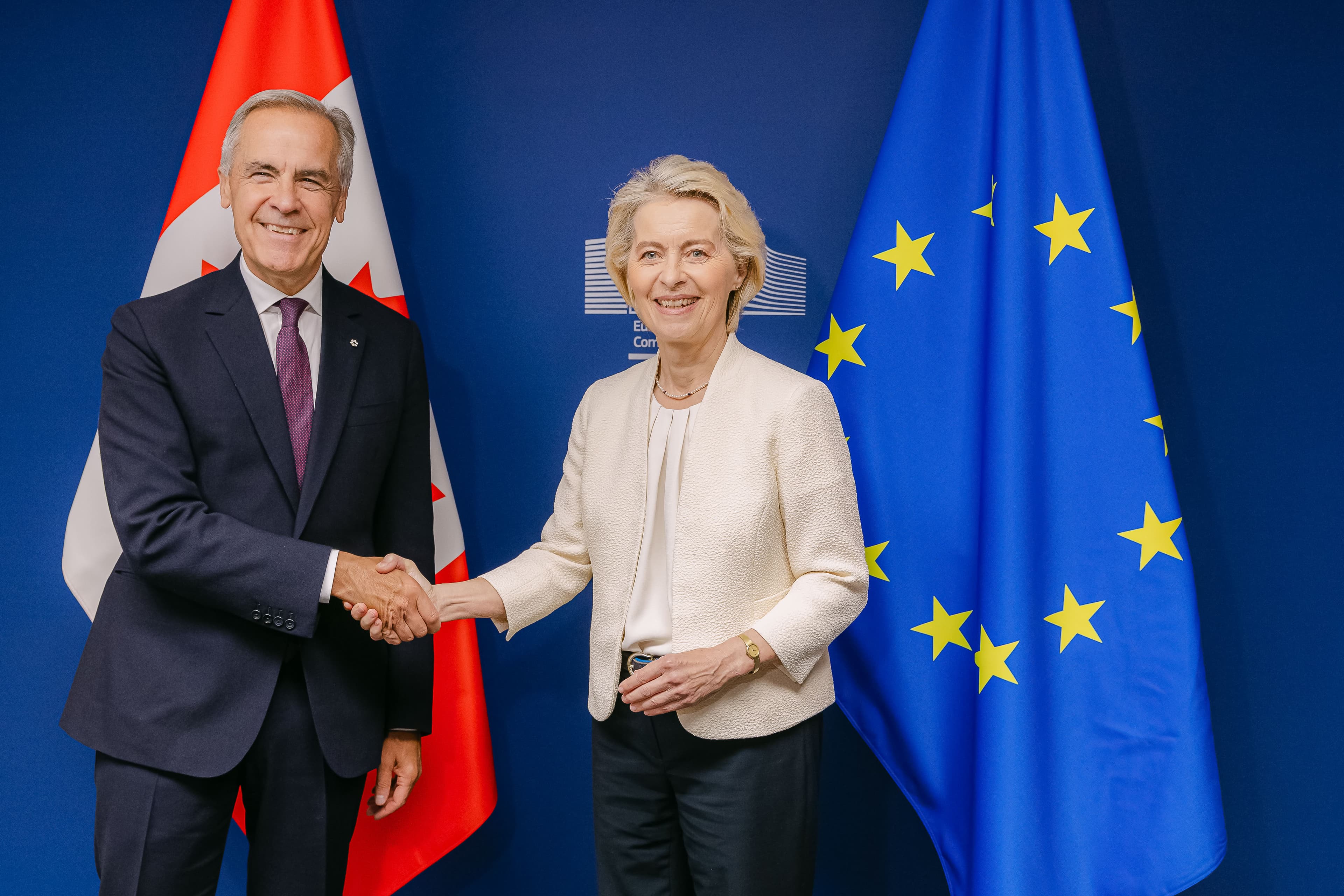
Jonathan Wilkinson

Role at the time: Ambassador of Canada to the European Union

Challenged the characterization

Statement summary

Canada's ambassador to the European Union said Ottawa is not seeking membership of the bloc, describing membership as a sovereignty question in which countries give up parts of their sovereignty. He said the aim is to get as close as possible while not giving up significant portions of it.

Quotation excerpt

We are not looking to be a member of the European Union, because that is a sovereignty issue and people give up certain portions of their sovereignty (to be part of the bloc).” … “At the end of the day, what we are looking to do is get as…
Read full quotation
We are not looking to be a member of the European Union, because that is a sovereignty issue and people give up certain portions of their sovereignty (to be part of the bloc).” … “At the end of the day, what we are looking to do is get as close as we possibly can in a manner that’s going to actually strengthen all of our respective countries without giving up significant chunks of sovereignty.
Open source (opens in a new tab)How Canada-EU 'associate member' proposal raises questions for Carney's criticsWilkinson on sovereignty and on not seeking membership

What this label refers to

Relative to whether Canada should become an associate member of the European Union, Wilkinson's distinctive move is to reject how the proposal is being described, saying Canada is not seeking membership at all, while still wanting maximum closeness. He neither endorses associate membership nor argues against closer ties, which is what separates this from a defence. The closest competing label is mixed_or_conditional, because his support for closeness carries an express sovereignty limit. It loses narrowly, since the sovereignty point is offered as the reason membership is the wrong frame rather than as a condition he attaches to a proposal he accepts. This is a borderline call worth a second reading.

People in this topic

Mark Carney

Prime minister of Canada.

1 case and 2 statements

Josh Udall

Canadian political commentator and host of The Elevate Report, a daily Canadian politics podcast and Substack newsletter also published as The Elev8 Podcast. He previously worked in user-experience design and founded the design firm Depth in 2020.

1 case and 1 statement

Stéphane Dion

Canadian former politician and diplomat, now the first diplomat in residence at the Université de Montréal's Faculty of Arts and Science. He was Canada's ambassador to Germany from 2017 to 2022 and to France and Monaco from 2022 to 2025, and special envoy to the European Union and Europe from 2017 to 2025. He previously served as minister of foreign affairs, minister of the environment and minister of intergovernmental affairs, and led the Liberal Party from 2006 to 2008.

1 case and 1 statement

Andrew Scheer

Conservative member of Parliament for Regina-Qu'Appelle and House Leader of the Official Opposition. He was the 35th Speaker of the House of Commons and led the Conservative Party of Canada from 2017 to 2020.

1 case and 1 statement

Jonathan Wilkinson

Canada's ambassador to the European Union, appointed in 2026. He previously served in cabinet as minister of fisheries and oceans, of environment and climate change, and of energy and natural resources, and as member of Parliament for North Vancouver.

1 case and 1 statement

Pierre Poilievre

Leader of the Conservative Party of Canada and Leader of the Official Opposition in the House of Commons.

1 case and 1 statement

Ursula von der Leyen

President of the European Commission, the European Union's executive body, which proposes legislation and negotiates international agreements on the Union's behalf.

1 case and 1 statement

Donald Trump

Donald Trump is the 45th and 47th president of the United States. Before entering national politics, he worked in real estate development and entertainment.

1 case and 1 statement

Hasan Piker

Hasan Piker, also known as HasanAbi, is a political livestreamer and commentator.

1 case and 1 statement