
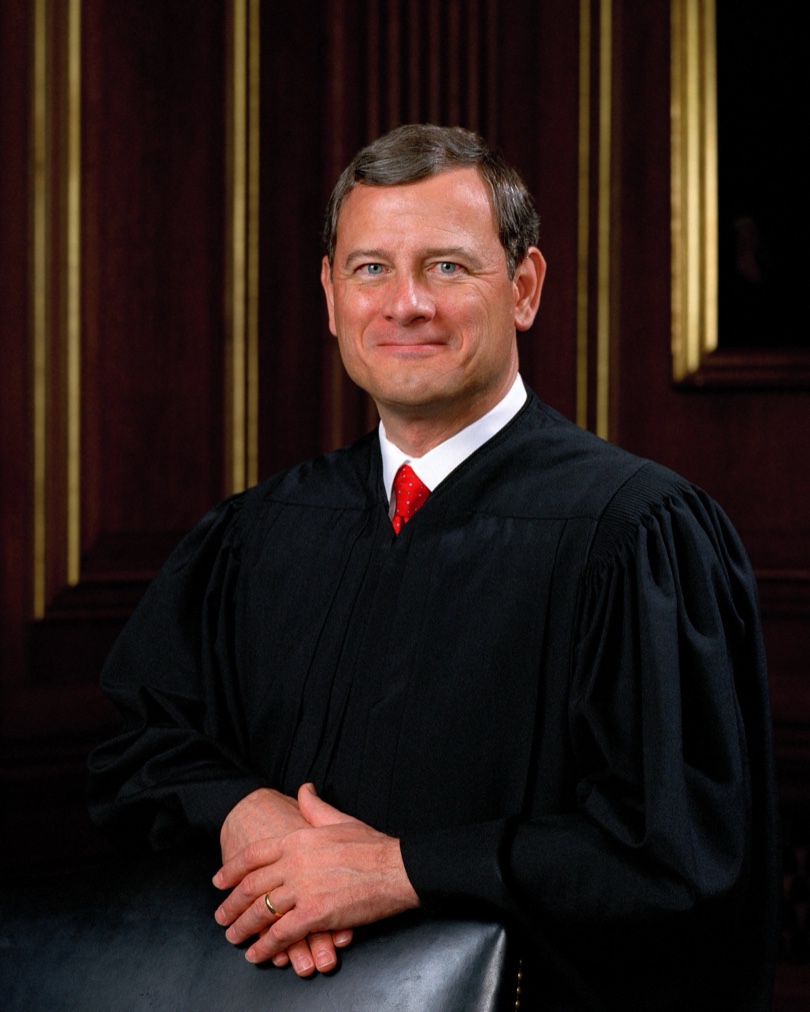
John G. Roberts Jr.

Portrait of John G. Roberts Jr.
Steve Petteway, Collection of the Supreme Court of the United StatesSourcePublic domain (U.S. federal government work)Resized.

John G. Roberts Jr. is the Chief Justice of the United States. Nominated by President George W. Bush, he took office on September 29, 2005. He previously served on the U.S. Court of Appeals for the District of Columbia Circuit and was principal deputy solicitor general.

Also known as John Roberts, Chief Justice John RobertsWebsite (opens in a new tab)

What DI has documented

DI has documented statements by John G. Roberts Jr. on Criminal Justice Policy, Law Enforcement, and Privacy. Read the quotations, original sources and related cases below.

Topics in this coverage

Statements by John G. Roberts Jr.

Portrait of John G. Roberts Jr.

John G. Roberts Jr.

Role at the time: Chief justice, writing the Supreme Court majority opinion

Condemned

Response to this claim

Obtaining carriers' historical cell-site business records does not search the customer for Fourth Amendment purposes.

“Given the unique nature of cell phone location records, the fact that the information is held by a third party does not by itself overcome the user’s claim to Fourth Amendment protection.”
Read the original text (opens in a new tab)Carpenter v. United States, 585 U.S. 296 (2018), No. 16-402, opinion of the Court · Supreme Court of the United States
Why we used this label

The subject is warrantless acquisition of Carpenter's location records. Roberts's majority reasoning rejects the government's argument that carrier possession removes Fourth Amendment protection. This is legal criticism of the acquisition, not a personal denunciation.

Portrait of John G. Roberts Jr.

John G. Roberts Jr.

Role at the time: Chief justice, writing the Court's majority opinion

Defended or excused

Response to this claim

An objectively reasonable mistake of substantive law can justify a traffic stop under the Fourth Amendment.

“The Fourth Amendment tolerates only reasonable mistakes, and those mistakes—whether of fact or of law—must be objectively reasonable.”
Read the original text (opens in a new tab)Heien v. North Carolina: majority, concurrence and dissent · Supreme Court of the United States574 U.S. 54, Roberts pages 57-68; Kagan pages 68-71; Sotomayor pages 71-80
Why we used this label

He supports allowing the stop on this basis, the conduct and rule at issue.

A participant is a subject of the case. A speaker has a statement documented in it. A commentator has an opinion or editorial documented in it.