
Explainer
What is the War Powers Resolution?
The War Powers Resolution is a 1973 law that requires the president to report to Congress within 48 hours of sending U.S. forces into hostilities and to end their use within 60 days unless Congress authorizes it. Presidents of both parties have called parts of it unconstitutional.
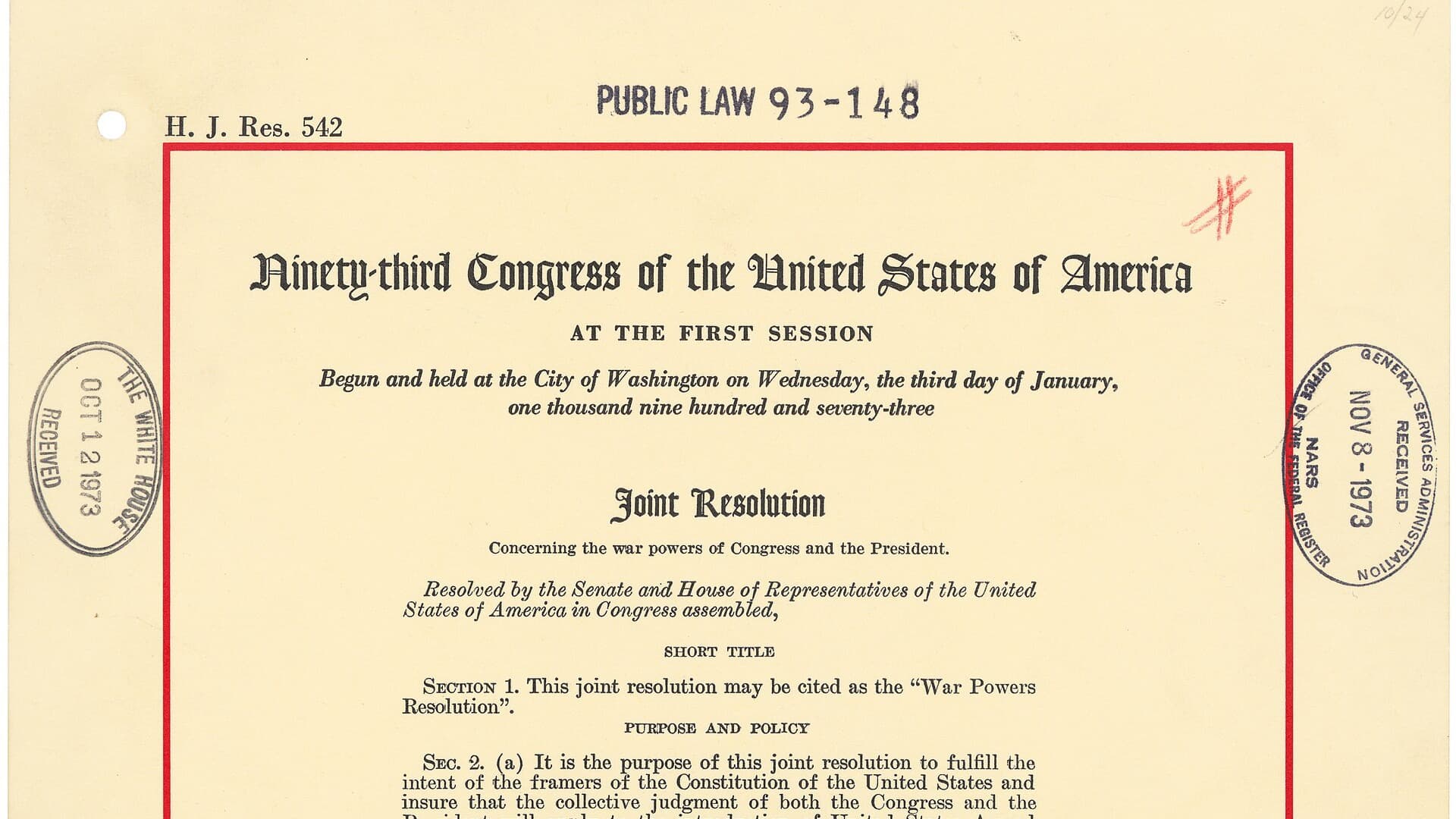
What the law requires
Congress passed the War Powers Resolution over President Richard Nixon's veto on November 7, 1973, after searching during the Vietnam War for a way to assert its say over decisions to send U.S. forces into hostilities.2 The law states that the president's power as commander in chief to send forces into hostilities is exercised only under "a declaration of war," "specific statutory authorization," or "a national emergency created by attack upon the United States, its territories or possessions, or its armed forces."1
It sets three main duties. The president must consult Congress "in every possible instance" before sending forces into hostilities, and must report to Congress within 48 hours after forces are introduced into hostilities or into situations where hostilities are clearly imminent.2 Within 60 days of that report, or of the date it was required, the president must end the use of those forces unless Congress has declared war, authorized the action or extended the deadline by law. The president can add up to 30 days by certifying in writing that the troops' safety requires more time to withdraw them.1
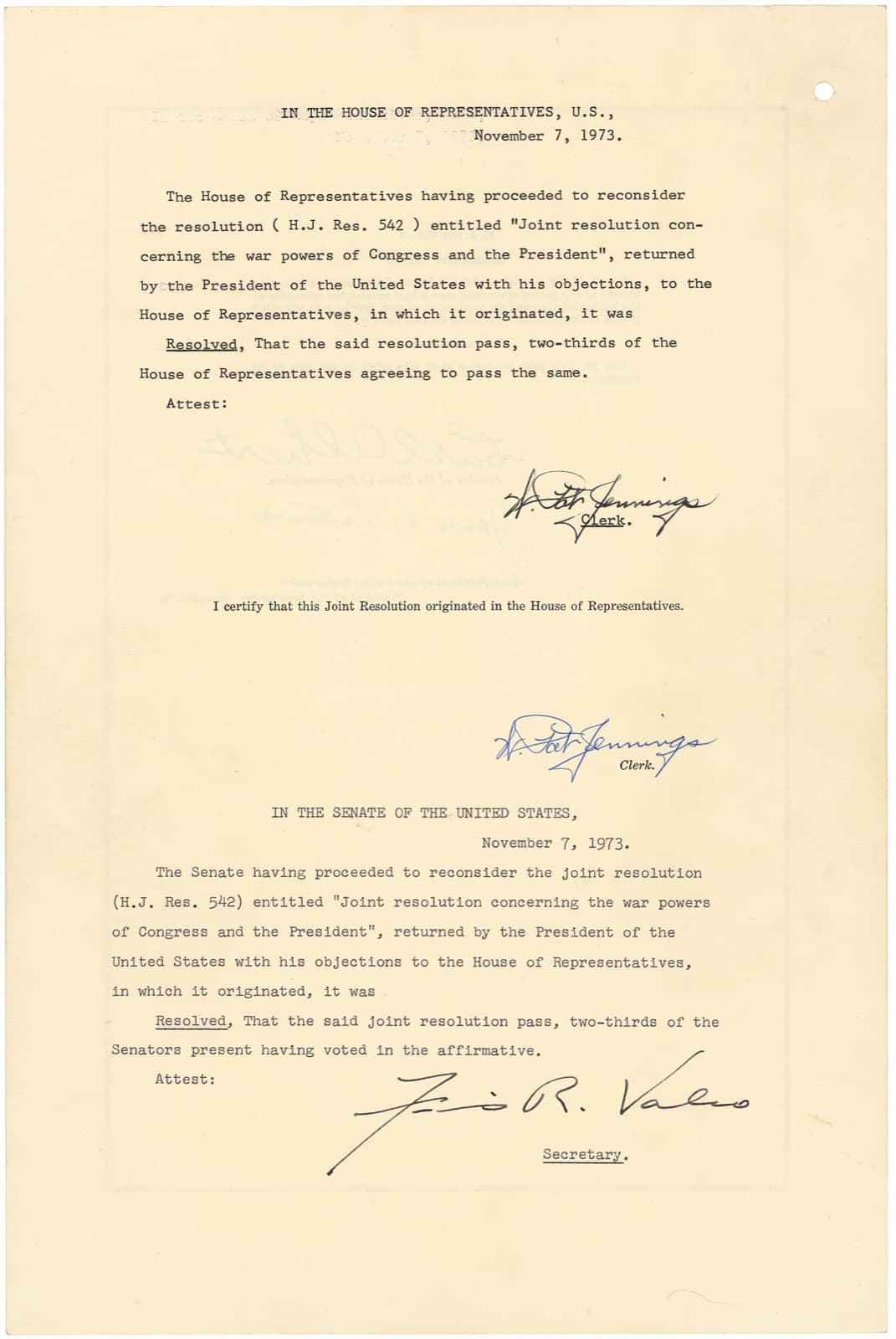
How Congress can order troops out
The law says forces in unauthorized hostilities abroad "shall be removed by the President if the Congress so directs by concurrent resolution," a measure passed by both chambers that does not go to the president.1 In 1983, in INS v. Chadha, the Supreme Court struck down a legislative veto in immigration law and said such action requires passage by both chambers and presentment to the president. The Congressional Research Service says the ruling leaves the effect of the concurrent-resolution provision uncertain.2
Later in 1983, Congress set fast-track procedures for a joint resolution or bill requiring the removal of forces.1 A joint resolution goes to the president, who can veto it, and overriding a veto takes two-thirds of each chamber. In 2020, after the U.S. strike that killed Iranian general Qassem Soleimani, Congress passed such a resolution on Iran, S.J.Res. 68. President Trump vetoed it, calling it "a very insulting resolution,"3 and the Senate's attempt to override the veto failed 49 to 44.4
Presidents' objections
Every president since 1973 has treated central parts of the law as unconstitutional, according to the Congressional Research Service. In vetoing it, Nixon said the resolution would "attempt to take away, by a mere legislative act, authorities which the President has properly exercised under the Constitution for almost 200 years."2
Presidents have still filed reports with Congress. From 1975 through March 2017 they submitted 168 reports under the law, CRS found, but only one, about the 1975 Mayaguez seizure, cited the section that starts the 60-day clock, and in that case the military action was already over.2
What counts as hostilities
The law does not define "hostilities," and the 60-day clock turns on the word.1 In 2011, the Obama administration said U.S. air operations in Libya that continued past 60 days did not amount to hostilities under the law, because they did not involve sustained fighting or exchanges of fire with enemy forces and no U.S. ground troops were involved.2
The same question arose in the war with Iran that began on February 28, 2026. On May 1, about 60 days later, President Trump wrote to Congress that "the hostilities that began on February 28, 2026, have terminated," citing the April 7 ceasefire.5 On April 21, the State Department's Office of the Legal Adviser had described the operation as "only the latest round of an ongoing international armed conflict with Iran."6
The 2026 votes on Iran
Members of Congress have used the law's procedures repeatedly since then. The House agreed 215 to 208 on June 3, 2026, to H.Con.Res. 86, a concurrent resolution under the law directing the president to remove U.S. forces from hostilities with Iran.7 The Senate agreed to it 50 to 48 on June 23, making it the first Iran war powers resolution to pass both chambers.8 The White House had opposed it, saying there were "no present hostilities from which to remove U.S. Armed Forces."9 As a concurrent resolution, it was not sent to the president and did not become law.7
Later efforts failed or stalled. The Senate rejected a motion to discharge a joint resolution, S.J.Res. 181, from committee by 49 to 50 on July 30.10 The House agreed to another concurrent resolution, H.Con.Res. 93, by 220 to 204 on September 15, and the Senate rejected a third, H.Con.Res. 89, by 49 to 50 on September 24.1112
History
- November 7, 1973
Congress overrides President Nixon's veto and enacts the War Powers Resolution.2
- 1975
The report on the Mayaguez seizure becomes the only one through March 2017 to cite the section that starts the 60-day clock.2
- June 23, 1983
In INS v. Chadha, the Supreme Court strikes down a legislative veto, casting doubt on the law's concurrent-resolution provision.2
- November 22, 1983
Congress sets fast-track procedures for joint resolutions ordering troops out.1
- 2011
The Obama administration says air operations in Libya are not hostilities under the law.2
- May 7, 2020
The Senate fails, 49 to 44, to override President Trump's veto of an Iran war powers resolution.4
- February 28, 2026
Hostilities with Iran begin.5
- May 1, 2026
President Trump tells Congress the hostilities have terminated.5
- June 23, 2026
H.Con.Res. 86 becomes the first Iran war powers resolution to pass both chambers.8
- September 24, 2026
The Senate rejects H.Con.Res. 89, 49 to 50.12
What is disputed
Whether the fighting with Iran remained "hostilities" under the law after the April 7, 2026 ceasefire, which would keep the 60-day clock running. The president told Congress the hostilities had terminated.
See the case: Is the U.S. fight with Iran a war, as Vice President Vance says it is not?Whether a concurrent resolution such as H.Con.Res. 86 binds the president after INS v. Chadha.
Whether the law's central provisions are constitutional. Presidents of both parties have said they are not, and no court has settled the question.
Cases on the Dispute Index
What did Trump mean when he said 'Let them take out Los Angeles' at a Nebraska rally?
Trump told a Nebraska rally "Let them take out Los Angeles. Let them take out San Diego." California officials say he called attacks on the cities a small price for the Iran war; the White House says he meant a nuclear Iran's threat.
Did the military fail the troops wounded in the March 1 Iranian drone strike at Port Shuaiba?
Soldiers wounded in the March 1 Iranian drone strike at Port Shuaiba, Kuwait, say they lacked drone defenses and faced delayed care. Hegseth called the drone a "squirter" that hit a fortified site, and the Army has not released its investigation.
Is the U.S. fight with Iran a war, as Vice President Vance says it is not?
Vice President JD Vance said he would not call the U.S. fight with Iran a war, citing no active shooting. President Trump defended the description; Sanders, Schumer and Massie criticized it, and Iran's Foreign Ministry spokesperson called the fighting aggression, not war.
Was the U.S. military's September 19 Caribbean boat strike justified by evidence of narcotics trafficking?
U.S. Southern Command says confirmed intelligence showed a vessel it struck in the Caribbean on September 19 was involved in narco-trafficking, killing four. It did not release the evidence. A U.N. expert and U.S. critics dispute the legal basis for such strikes.
Do they support the war in Iran?
An issue tracker recording where members of Congress and 2026 midterm candidates stand on the unauthorized Iran war, based on their votes on war-powers resolutions, campaign statements, and public remarks.
Did White House officials fairly characterize coverage of U.S. troop deaths in the Iran war?
Hegseth accused the press of using U.S. troop deaths to hurt Trump. Read the briefing transcript and Collins's exchange with Leavitt over casualty coverage and the administration's characterization of it.
Is the Pentagon's public count of U.S. military deaths in the Iran war complete?
The Washington Post, citing six anonymous officials, reports at least 22 or 23 service member deaths in the Iran war, against 18 in the Pentagon's public database. Defense Secretary Pete Hegseth calls the report fake; the Post says it stands by it.
Should Pete Hegseth be impeached?
Read Hegseth impeachment filings on military operations, oversight and Signal, the inspector general's findings, and his response to the claim he was 'texting war plans.'
Sources
- War Powers Resolution, Public Law 93-148, as codified at 50 U.S.C. chapter 33 (sections 1541-1550) (opens in a new tab) · Saved copy (opens in a new tab)
- Congressional Research Service, R42699: The War Powers Resolution: Concepts and Practice (updated March 8, 2019) (opens in a new tab) · Saved copy (opens in a new tab)
- CBS News, May 7, 2020: Trump vetoes Iran war powers resolution, calling it an "insult" (opens in a new tab) · Saved copy (opens in a new tab)
- U.S. Senate Roll Call Vote 84 (116th Congress, 2nd session), May 7, 2020: override of the veto of S.J.Res. 68, Iran war powers (veto sustained, 49-44) (opens in a new tab)
- Letter from the President to the President pro tempore of the Senate, May 1, 2026 (opens in a new tab)
- Operation Epic Fury and International Law (opens in a new tab)
- House Roll Call 199: H. Con. Res. 86, directing removal of United States Armed Forces from hostilities with Iran (opens in a new tab)
- U.S. Senate Roll Call Vote 184: H.Con.Res. 86, Iran War Powers Resolution (agreed to, 50-48) (opens in a new tab) · Saved copy (opens in a new tab)
- Statement of Administration Policy on H. Con. Res. 86 (opens in a new tab)
- U.S. Senate Roll Call Vote 216: Motion to Discharge S.J.Res. 181, Iran War Powers (rejected, 49-50) (opens in a new tab) · Saved copy (opens in a new tab)
- U.S. House Roll Call Vote 307: H.Con.Res. 93, Iran War Powers Resolution (agreed to, 220-204) (opens in a new tab) · Saved copy (opens in a new tab)
- U.S. Senate Roll Call Vote 244: H.Con.Res. 89, Iran War Powers Resolution (rejected, 49-50) (opens in a new tab) · Saved copy (opens in a new tab)
Last reviewed October 6, 2026. We review this explainer when a case that uses it changes. Report an error