
Should Amazon be allowed to block Meta's Muse agent from shopping on its site?
Amazon blocked Meta's Muse AI agent from its store, saying the agent accessed customer accounts without authorization and does not identify itself. Meta disputes Amazon's description of how Muse handles credentials. The block remains in place.
Case period:
Published by The Dispute Index editorial teamPublished Updated
Overview
The fixed reference point for classification in this case is Amazon's decision, visible to users by September 20, 2026, to block Meta's Muse personal AI agent from shopping on Amazon.com. Responses are recorded against that block and the reasons Amazon gave for it. They are not recorded against Muse's privacy practices generally, other retailers' agent policies, or the wider debate over AI agents.
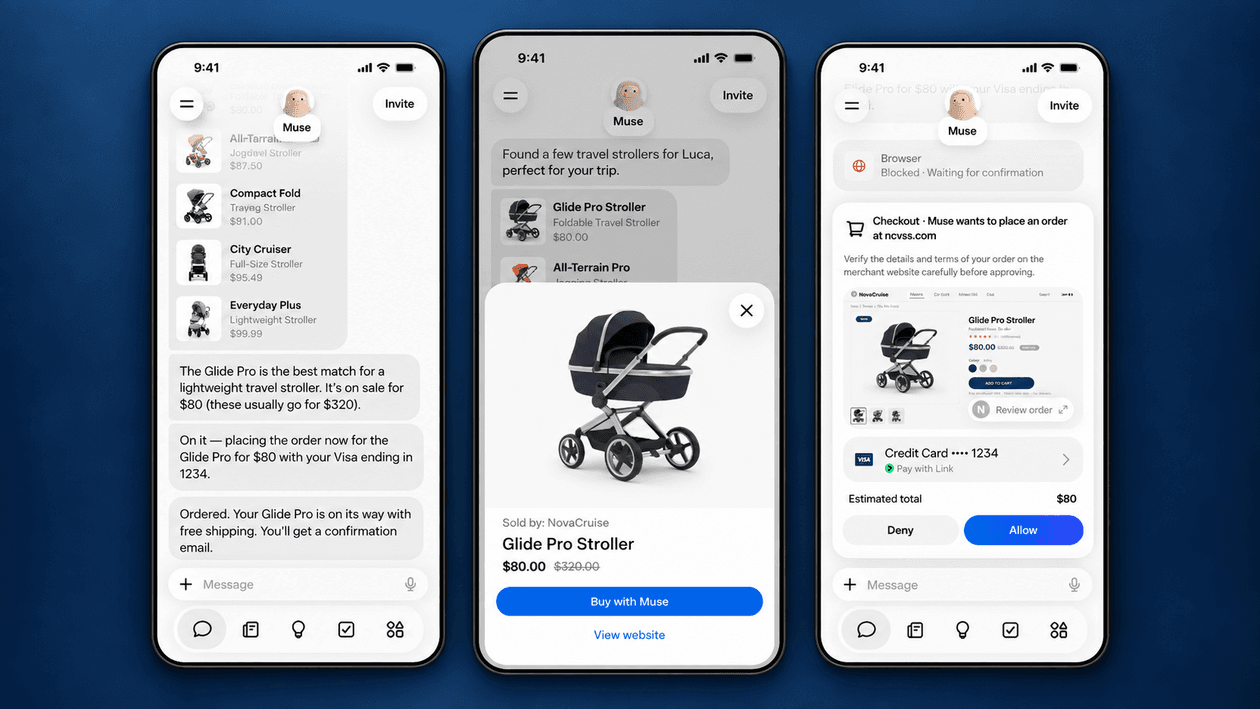
Meta launched Muse on September 8 as a free personal agent, with paid tiers, on iOS, Android, muse.ai and WhatsApp. It carries out multi-step tasks such as shopping, booking appointments and organizing calendars, using credentials the user provides. Meta says that where a service has no public API, the agent "can use the service through a browser the way you would," and that a separate monitoring agent called Sentinel must approve anything Muse sends to the internet. Muse reached the top of the U.S. iOS free app chart within days of launch.
GeekWire reported (opens in a new tab) that Amazon first asked Meta to voluntarily exclude Amazon.com from Muse's shopping features, that Meta did not do so, and that Amazon then deployed an anti-bot wall that stops Muse before it can load the search page. Amazon gave three reasons: it says it was not told in advance and never authorized the access, it says Muse does not identify itself as an automated agent while browsing, and it says the agent appears to capture and store customer login credentials. An Amazon spokesperson said that "third-party applications that offer to make purchases on behalf of customers from other businesses should operate openly and respect service provider decisions about whether or not to participate."
Meta disputes the credential claim. The company says Muse "has no visibility into people's passwords or payment methods" and that credentials "go into secure storage, so Muse can use them without seeing them." Meta announced a partnership with Shopify for some of Muse's shopping features. As of September 28, 2026, we could not locate a detailed public statement from Meta addressing the block itself, though Amazon said on September 21 that the two companies were in direct conversation.
The block follows a legal fight over the same question. Amazon sued Perplexity in November 2025 over its Comet browser shopping on Amazon. A federal judge granted Amazon a preliminary injunction in March 2026, but the Ninth Circuit vacated it on August 4 (opens in a new tab), ruling that the user, not the AI company, was the one accessing Amazon under federal anti-hacking law. The court denied Amazon's petition for rehearing on September 10, leaving contract and terms-of-service claims as Amazon's remaining avenue. The message Muse users now see cites Amazon's Conditions of Use rather than any hacking statute.
Other companies and executives have taken positions. Palo Alto Networks chief executive Nikesh Arora wrote on X (opens in a new tab) that every services, marketplace and commerce app will have to decide whether to open interfaces for consumer agents. Liat Ben-Zur, a former Microsoft vice president, told Fortune that the companies that control the rules of access will have enormous influence over whether agents actually work for the consumer. WION reported (opens in a new tab) that a researcher disclosed a vulnerability that could expose Muse's authentication system, which Amazon's defenders cite as support for the security rationale.
Silence is not a position. A refusal to comment, or a referral to an earlier statement, is recorded only where a source reports it.
People in this case
 Liat Ben-ZurCommented
 Nikesh AroraCommented
Timeline
9 timeline entries on this page. Dates: November 1, 2025 to September 28, 2026
November 2025
1 event
Amazon sues Perplexity over agent shopping on its store
In November 2025, Amazon sued the AI search company Perplexity over its Comet browser letting users shop on Amazon, an early legal fight over third-party AI agents acting for customers.
[01]Amazon Blocks Meta's Muse Agent From Shopping, And Signals a New Tollgate for Agent Commerce
Yahoo Finance analysis recounting the block, Amazon's stated reasons, Meta's response, and the procedural history of Amazon's lawsuit against Perplexity, including the March 2026 preliminary injunction and the Ninth Circuit's August 4, 2026 decision vacating it.
120 days between recorded events
March 2026
1 event
Federal court grants Amazon a preliminary injunction against Perplexity
In March 2026, a federal judge granted Amazon a preliminary injunction in the Perplexity case. The Ninth Circuit later vacated it.
[01]Amazon Blocks Meta's Muse Agent From Shopping, And Signals a New Tollgate for Agent Commerce
Yahoo Finance analysis recounting the block, Amazon's stated reasons, Meta's response, and the procedural history of Amazon's lawsuit against Perplexity, including the March 2026 preliminary injunction and the Ninth Circuit's August 4, 2026 decision vacating it.
156 days between recorded events
August 2026
1 event
Ninth Circuit vacates the Perplexity injunction
The Ninth Circuit vacated the preliminary injunction, ruling that it was the users, not Perplexity, who were technically accessing Amazon under federal anti-hacking law. Contract and terms-of-service claims remained open to Amazon.
[01]Amazon Blocks Meta's Muse Agent From Shopping, And Signals a New Tollgate for Agent Commerce
Yahoo Finance analysis recounting the block, Amazon's stated reasons, Meta's response, and the procedural history of Amazon's lawsuit against Perplexity, including the March 2026 preliminary injunction and the Ninth Circuit's August 4, 2026 decision vacating it.
35 days between recorded events
September 2026
6 events
Meta launches the Muse personal AI agent
Incident
Meta launched Muse, a personal AI agent that carries out multi-step tasks such as shopping and booking appointments, on iOS, Android, muse.ai and WhatsApp. It reached the top of the U.S. iOS free app chart within days.
[02]Meta's Muse AI is exploding in popularity, and drawing heated backlash
Fortune report on Muse's rise to the top of the U.S. iOS free app chart, Amazon's block and statement, Meta's Shopify partnership, and reactions from Nikesh Arora on X and Liat Ben-Zur in an interview.
Ninth Circuit denies Amazon's rehearing petition
The Ninth Circuit denied Amazon's petition for rehearing in the Perplexity case, leaving terms-of-service enforcement as Amazon's main remaining lever against outside agents.
[03]Amazon blocks Meta's Muse AI assistant in new standoff over agentic shopping
GeekWire report that Amazon blocked Meta's Muse personal AI agent from shopping on Amazon.com, with Amazon's stated reasons (no advance notice, no self-identification, credential handling), the text of the popup shown to users, Meta's response about credential storage, and the companies' prior contacts before the block.
Amazon blocks Muse from Amazon.com
Incident
Amazon deployed an anti-bot wall blocking Meta's Muse agent from shopping on Amazon.com. Users saw a message that continued access by an unauthorized AI agent violates Amazon's Conditions of Use. Amazon said it had first asked Meta to voluntarily exclude Amazon and Meta did not do so.
[03]Amazon blocks Meta's Muse AI assistant in new standoff over agentic shopping
GeekWire report that Amazon blocked Meta's Muse personal AI agent from shopping on Amazon.com, with Amazon's stated reasons (no advance notice, no self-identification, credential handling), the text of the popup shown to users, Meta's response about credential storage, and the companies' prior contacts before the block.
Amazon defends the block and says it is talking with Meta
Reaction
An Amazon spokesperson said third-party buying agents should operate openly and respect service provider decisions, and said the company was in direct conversation with Meta. Meta had disputed Amazon's credential claims but had not issued a detailed public statement about the block.
[03]Amazon blocks Meta's Muse AI assistant in new standoff over agentic shopping
GeekWire report that Amazon blocked Meta's Muse personal AI agent from shopping on Amazon.com, with Amazon's stated reasons (no advance notice, no self-identification, credential handling), the text of the popup shown to users, Meta's response about credential storage, and the companies' prior contacts before the block.
[02]Meta's Muse AI is exploding in popularity, and drawing heated backlash
Fortune report on Muse's rise to the top of the U.S. iOS free app chart, Amazon's block and statement, Meta's Shopify partnership, and reactions from Nikesh Arora on X and Liat Ben-Zur in an interview.
Executives publicly frame the stakes of agent access
Reaction
Palo Alto Networks chief executive Nikesh Arora wrote on X that every services, marketplace and commerce app will have to decide whether to open interfaces to consumer agents. Former Microsoft corporate vice president Liat Ben-Zur told Fortune that whoever controls the rules of access will influence whether agents work for consumers.
[02]Meta's Muse AI is exploding in popularity, and drawing heated backlash
Fortune report on Muse's rise to the top of the U.S. iOS free app chart, Amazon's block and statement, Meta's Shopify partnership, and reactions from Nikesh Arora on X and Liat Ben-Zur in an interview.
Researcher reports a Muse authentication vulnerability
Claim
WION reported that a researcher had disclosed a vulnerability said to be capable of exposing Muse's authentication system, adding a security claim to the dispute over Amazon's block.
[04]Meta Muse AI agent: Why Amazon blocked it and why hackers are now a concern
WION report on the Amazon block and on a researcher's disclosure of a vulnerability said to be capable of exposing Muse's authentication system.
Response record
Responses
Latest recorded positions: 4. Dates: September 20, 2026 to September 22, 2026
Choose one response filter, or select All responses to see the full record.
2 responses on this page
 Liat Ben-Zur
"This is bigger than a dispute over bot detection or website access. We are moving toward a world where agents will increasingly act as our representatives online. The companies that control the rules of access will have enormous influence over whether those agents actually work for the consumer."
Open source (opens in a new tab)Meta's Muse AI is exploding in popularity, and drawing heated backlashMixed or conditionalCase context: Should Amazon be allowed to block Meta's Muse agent from shopping on its site?
Read more
Liat Ben-Zur, a former Microsoft corporate vice president, told Fortune that the standoff is bigger than bot detection or website access, and that the companies controlling the rules of access will have enormous influence over whether AI agents actually work for the consumer.
Role at the time: Former Microsoft corporate vice president, in an interview with Fortune
Before the statement
Amazon had blocked Meta's Muse agent from its store, citing unauthorized access, and Meta had disputed Amazon's description of Muse's credential handling.
After the statement
Amazon operates its own shopping agent, Buy for Me, and has said brands can opt out of it; critics note that outside agents get no equivalent path on Amazon.
Why this label?
Ben-Zur identifies what is at stake in Amazon's decision and warns about gatekeeping power, but does not expressly say the block is right or wrong.
This label describes the statement's response within the context above.
 Nikesh Arora
"It is only a matter of time before there is an Apple and Google version of Muse and possibly TikTok, in addition to the frontier LLM agents. Every app that is a services, marketplace or commerce app will need to existentially decide to open [Application Programming Interfaces] for consumer agents to interact. Smaller players have no choice. Either the consumer benefits or distribution aggregators will demand a higher transaction fare."
Open source (opens in a new tab)Meta's Muse AI is exploding in popularity, and drawing heated backlashMixed or conditionalCase context: Should Amazon be allowed to block Meta's Muse agent from shopping on its site?
Read more
Palo Alto Networks chief executive Nikesh Arora wrote on X that every services, marketplace and commerce app will have to decide whether to open interfaces to consumer AI agents, and that smaller players have no choice. He framed the choice as either benefiting consumers or paying distribution aggregators a higher fare, without endorsing or condemning Amazon's block.
Role at the time: Palo Alto Networks chief executive, posting on X
Before the statement
Amazon had blocked Meta's Muse agent from shopping on Amazon.com two days earlier, and Muse had reached the top of the U.S. iOS free app chart.
After the statement
Fortune quoted the post in coverage of the block. Arora did not address Amazon or Meta by name in the quoted portion.
Why this label?
Arora addresses the dispute's central question, whether platforms must open to outside agents, but predicts a decision rather than taking Amazon's or Meta's side.
This label describes the statement's response within the context above.
Sources
(4)
Reporting
Amazon blocks Meta's Muse AI assistant in new standoff over agentic shopping
About this source
GeekWire report that Amazon blocked Meta's Muse personal AI agent from shopping on Amazon.com, with Amazon's stated reasons (no advance notice, no self-identification, credential handling), the text of the popup shown to users, Meta's response about credential storage, and the companies' prior contacts before the block.
- Author
- GeekWire
- Published
- Accessed
Reporting
Meta Muse AI agent: Why Amazon blocked it and why hackers are now a concern
About this source
WION report on the Amazon block and on a researcher's disclosure of a vulnerability said to be capable of exposing Muse's authentication system.
- Author
- WION
- Published
- Accessed
Analysis
Amazon Blocks Meta's Muse Agent From Shopping, And Signals a New Tollgate for Agent Commerce
About this source
Yahoo Finance analysis recounting the block, Amazon's stated reasons, Meta's response, and the procedural history of Amazon's lawsuit against Perplexity, including the March 2026 preliminary injunction and the Ninth Circuit's August 4, 2026 decision vacating it.
- Author
- Yahoo Finance
- Published
- Accessed
Reporting
Meta's Muse AI is exploding in popularity, and drawing heated backlash
About this source
Fortune report on Muse's rise to the top of the U.S. iOS free app chart, Amazon's block and statement, Meta's Shopify partnership, and reactions from Nikesh Arora on X and Liat Ben-Zur in an interview.
- Author
- Fortune
- Published
- Accessed