
Case
Abdul El-Sayed’s Sharia-law defense: religious freedom or support for religious government?
August 21, 2026
Published by The Dispute Index editorial teamPublished Updated
JD Vance and conservative commentators challenged Abdul El-Sayed’s opposition to Sharia bans. El-Sayed defended religious freedom and rejected imposing his faith, while critics disputed his comparison between Sharia and Christian canon law.
Question in dispute
El-Sayed’s comparison between Sharia and Christian canon law is misleading because their relationships to civil government differ.
Overview
JD Vance characterized Abdul El-Sayed’s opposition to Sharia bans as support for Sharia and hostility to its critics. El-Sayed defended his position as equal religious freedom and rejected imposing his faith. Hasan Piker challenged the premise of a threatened imposition while questioning El-Sayed’s reliance on a canon-law analogy. Andrew Kolvet, Dana Loesch and Todd Aglialoro disputed that analogy, arguing that it understated Sharia’s relationship to civil government.
This case concerns the August 2026 characterization of El-Sayed’s position, not a finding about what every form of Islamic or Christian religious law requires. Vance’s August 21 speech (opens in a new tab) supplies the opening accusation. El-Sayed’s later full interview with Watters (opens in a new tab) distinguishes personal religious observance from imposing faith on others. His older remarks were replayed during that interview; the current response must be read alongside them.
The canon-law comparison generated a narrower disagreement about whether the two systems have comparable relationships to state authority. The dossier preserves that criticism without converting opposition to a ban into evidence of a plan to impose religious government. It also retains the interview’s subsequent redirect to household costs. The displayed publication date is August 22, 2026; the August 24–25 responses are later developments and retain their actual dates. Events with no verified clock time are recorded at day-level.
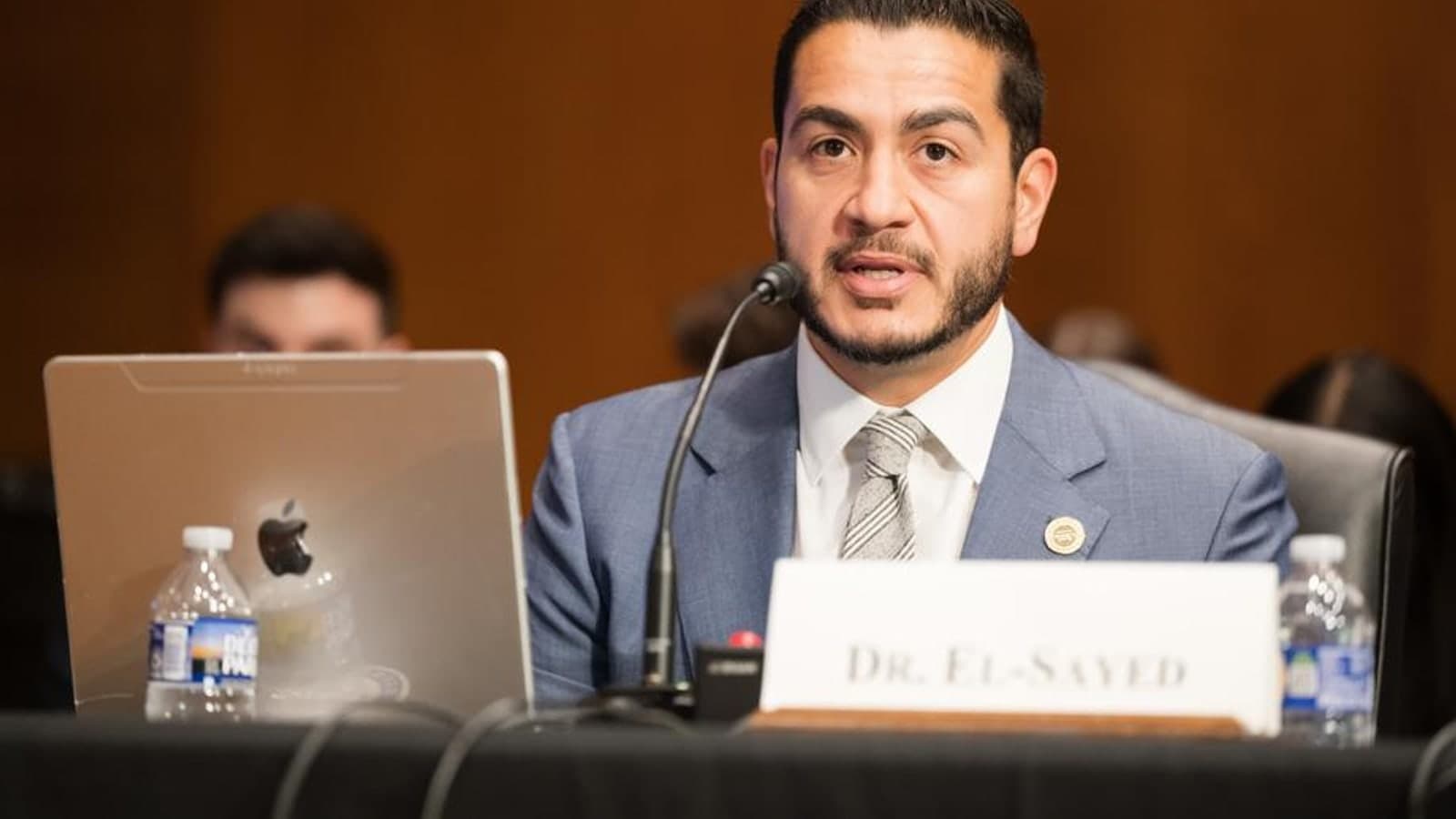
Image: El-Sayed testifying before the U.S. Senate HELP Committee in 2024, not during these campaign exchanges. Public-domain U.S. Senate photograph via Wikimedia Commons (opens in a new tab), cropped by Dispute Index.
In his August 25 livestream (opens in a new tab), Hasan Piker challenged the idea that Sharia posed an imminent threat while faulting El-Sayed for leading with the canon-law analogy. Todd Aglialoro’s August 27 Catholic Answers essay (opens in a new tab) disputed the analogy from the other direction, arguing that canon law is confined to internal church governance in ways Sharia may not be. These are attributed interpretations, not findings about El-Sayed’s intentions.
Claims
Claims separate what was said from what is contested. Follow each source for the original wording and context.
What was said
Attributed statement
El-Sayed supports Sharia law and treats opposition to it as white supremacy.
- Speaker
- JD Vance
- Date
Sources
- JD Vance criticizes El-Sayed’s Sharia-law position in Middletown — full speechFull 34:32 speech; El-Sayed passage between discussion of the Democratic Party and Sherrod Brown; matching Factba.se transcript 21:16–21:58
- Factba.se transcript of JD Vance’s August 21 Middletown speechJD Vance, 00:21:16–00:21:58
What's disputed
Disputed claim
El-Sayed’s comparison between Sharia and Christian canon law is misleading because their relationships to civil government differ.
- Who made the claim
- Andrew Kolvet
- Date
Sources
- Andrew Kolvet disputes El-Sayed’s comparison of Sharia and canon law - Andrew KolvetOriginal X post, paragraphs contrasting canon law with Sharia and subsequent broader claims about Muslims
- Jesse Watters interviews Abdul El-Sayed — full August 24 interviewFull 25:25 interview; Sharia/canon-law exchange immediately after Iran’s nuclear program and before the Second Amendment
Arguments
Documented position
Andrew Kolvet and Dana Loesch, separate August 24 X posts responding to the interview.
A religious-freedom analogy may overlook civil authority
The critics distinguish voluntary observance from religious rules that claim authority over public life. On that account, comparing Sharia with church rules does not resolve the concern about what courts or governments might enforce.
Related claim
El-Sayed’s comparison between Sharia and Christian canon law is misleading because their relationships to civil government differ.
Limit of this argument
This criticism of an analogy does not establish that El-Sayed proposes imposing religious government; his explicit rejection of imposing faith must remain visible.
Sources
- Andrew Kolvet disputes El-Sayed’s comparison of Sharia and canon law - Andrew KolvetOriginal X post, paragraphs contrasting canon law with Sharia and subsequent broader claims about Muslims
- Dana Loesch challenges El-Sayed’s description of Sharia as religious practice - Dana LoeschFinal paragraph of original post; preceding Texas examples and follow-up links
- Jesse Watters interviews Abdul El-Sayed — full August 24 interviewFull 25:25 interview; Sharia/canon-law exchange immediately after Iran’s nuclear program and before the Second Amendment
Documented position
Abdul El-Sayed, August 24 Jesse Watters Primetime interview.
Opposing a religious ban is not the same as imposing religion
El-Sayed frames the issue as equal treatment of personal religious observance. He rejects imposing his faith on others and argues that preemptive restrictions single out Muslims, just as singling out another faith’s practices would burden that community.
Related claim
El-Sayed supports Sharia law and treats opposition to it as white supremacy.
Limit of this argument
His broad denial that anyone is trying to impose Sharia invites a separate factual and policy challenge. The religious-freedom argument does not by itself settle every question about civil enforcement.
Sources
- Jesse Watters interviews Abdul El-Sayed — full August 24 interviewFull 25:25 interview; Sharia/canon-law exchange immediately after Iran’s nuclear program and before the Second Amendment
- The Detroit News reports the El-Sayed–Watters interview and religious-freedom exchangeSection “Muslims pushing sharia law?” and opening identification of Monday’s 25-minute interview
Subject's response
Response from Abdul El-Sayed
Abdul El-Sayed
El-Sayed rejected the implication that defending Muslim religious practice meant seeking to impose it. He described preemptive bans as targeting a minority and invoked Christians’ freedom to observe their own religious rules.
Read the statement and sourcesJesse Watters
Watters challenged El-Sayed to explain why he linked Sharia bans to white supremacy and disputed treating the controversy simply as a threat to personal religious practice.
Read the statement and sources JD VanceVance portrayed El-Sayed’s position as advocacy for Sharia and condemnation of its critics, placing it within a broader attack on the Democratic Party.
"not only should we have Sharia law, but if you criticize it, you’re a White supremacist."
Context, editorial note, and sources
Responding to
El-Sayed supports Sharia law and treats opposition to it as white supremacy.
Vance portrayed El-Sayed’s position as advocacy for Sharia and condemnation of its critics, placing it within a broader attack on the Democratic Party.
Why we used this label
He used the attributed position to criticize El-Sayed’s political values rather than describe them neutrally.
Before the statement
Vance was contrasting contemporary Democrats with the party his grandfather supported and discussing representation of working people.
After the statement
He moved to criticism of Sherrod Brown and other Democrats. The attribution about El-Sayed is disputed by El-Sayed’s explanation of his position, not independently established by Vance’s speech.
Response record
Other responses
8 latest responses. Dates: August 21, 2026 to August 27, 2026
Choose any combination. Selected filters stay active until you remove them or choose All responses.
6 responses on this page
Editorial labelChallenged the characterizationTodd AglialoroAglialoro rejected El-Sayed’s analogy, arguing that Catholic canon law primarily regulates the Church’s internal affairs, whereas Sharia can extend into civil and criminal government. He presented this difference as a reason the analogy did not answer concerns about religious law’s public role. "Canon law is inherently ecclesial and thus inherently limited."
Context, editorial note, and sources
Responding to
El-Sayed’s comparison between Sharia and Christian canon law is misleading because their relationships to civil government differ.
Aglialoro rejected El-Sayed’s analogy, arguing that Catholic canon law primarily regulates the Church’s internal affairs, whereas Sharia can extend into civil and criminal government. He presented this difference as a reason the analogy did not answer concerns about religious law’s public role.
Why we used this label
The signed essay directly challenges the comparison used in El-Sayed’s defense. It does not establish that El-Sayed himself proposes imposing religious law.
Before the statement
After addressing a different exchange in the same interview, Aglialoro quoted El-Sayed’s canon-law analogy and rejection of imposing religion.
After the statement
He elaborated on church organization and jurisdiction, then accused El-Sayed of using a misleading comparison. The article’s broader assertions about Sharia and its judgments about El-Sayed are attributed to the author rather than adopted by DI.
Canon Law Is Not Christian ShariaSecond half of essay, from the replayed canon-law comparison through the concluding contrast between ecclesial and civil jurisdictionEditorial labelChallenged the characterizationHasan PikerPiker challenged the premise that El-Sayed’s defense of Muslim religious practice represented a threat of imposed religious government. He described the controversy as an attack on Muslims, while arguing that El-Sayed should have led with the absence of the alleged threat rather than the canon-law analogy. "Like you think there's a real threat of Sharia law?"
Context, editorial note, and sources
Responding to
El-Sayed supports Sharia law and treats opposition to it as white supremacy.
Piker challenged the premise that El-Sayed’s defense of Muslim religious practice represented a threat of imposed religious government. He described the controversy as an attack on Muslims, while arguing that El-Sayed should have led with the absence of the alleged threat rather than the canon-law analogy.
Why we used this label
Piker explicitly disputes the threat characterization. His reservation concerns the presentation of El-Sayed’s defense, not endorsement of the accusation or a finding that religious government should be imposed.
Before the statement
Piker paused the replay as El-Sayed began invoking canon law and suggested challenging whether an actual threat of Sharia imposition existed in America.
After the statement
He endorsed El-Sayed’s later argument that preemptive bans target a small community. Piker then agreed with a viewer’s interpretation about excluding Muslims from public life and compared the questioning with hypothetical treatment of a Jewish candidate. Those motive judgments are Piker’s, not independently established findings.
HasanAbi’s August 25 reaction to El-Sayed and Watters — long-form stream archiveSharia/canon-law exchange during the Watters interview reaction; corresponding original livestream transcript 04:19:50–04:25:45Archived transcript of HasanAbi’s August 25 livestream on the El-Sayed–Watters interview04:20:33–04:20:50; 04:22:11–04:22:16; 04:23:08–04:25:45Editorial labelChallenged the characterizationDana LoeschLoesch rejected El-Sayed’s treatment of Sharia as merely personal religious practice, arguing that it can compete with civil law. "it’s Islamic jurisprudence used to supplant western jurisprudence."
Context, editorial note, and sources
Responding to
Response to the case
Loesch rejected El-Sayed’s treatment of Sharia as merely personal religious practice, arguing that it can compete with civil law.
Why we used this label
She explicitly disputes the characterization underlying his defense rather than merely reporting the interview.
Before the statement
Loesch invoked a Texas criminal case, threats against a local official and an Islamic tribunal as examples supporting her view.
After the statement
She supplied links in a follow-up reply. Recording the argument does not establish that those examples demonstrate El-Sayed’s own intentions or policy proposals.
Dana Loesch challenges El-Sayed’s description of Sharia as religious practice - Dana LoeschFinal paragraph of original post; preceding Texas examples and follow-up linksEditorial labelChallenged the characterization  Andrew KolvetKolvet argued that El-Sayed’s analogy overlooked differences between religious rules confined to church affairs and rules that can govern state affairs.
"draws a false equivalency to Christian Canon law."
Context, editorial note, and sources
Responding to
El-Sayed’s comparison between Sharia and Christian canon law is misleading because their relationships to civil government differ.
Kolvet argued that El-Sayed’s analogy overlooked differences between religious rules confined to church affairs and rules that can govern state affairs.
Why we used this label
His central response directly disputes the canon-law analogy offered in El-Sayed’s defense.
Before the statement
The post identifies Watters’s interview and the replayed 2022 remarks as its subject.
After the statement
Kolvet went beyond the comparison to generalize about Muslims concealing political goals until gaining power. Those broader assertions are his own and are not adopted as facts by this dossier.
Andrew Kolvet disputes El-Sayed’s comparison of Sharia and canon law - Andrew KolvetOriginal X post, paragraphs contrasting canon law with Sharia and subsequent broader claims about MuslimsEditorial labelChallenged the characterization  Abdul El-SayedEl-Sayed rejected the implication that defending Muslim religious practice meant seeking to impose it. He described preemptive bans as targeting a minority and invoked Christians’ freedom to observe their own religious rules.
"Nobody is trying to push Sharia law on anyone else."
Context, editorial note, and sources
Responding to
El-Sayed supports Sharia law and treats opposition to it as white supremacy.
El-Sayed rejected the implication that defending Muslim religious practice meant seeking to impose it. He described preemptive bans as targeting a minority and invoked Christians’ freedom to observe their own religious rules.
Why we used this label
He challenged the meaning attached to his position while continuing to defend opposition to the bans. This is not an endorsement of compulsory religious government.
Before the statement
Watters replayed an earlier speech and asked why El-Sayed associated Sharia bans with white supremacy.
After the statement
El-Sayed expressly said he would not impose his religion on others, then redirected the discussion to household costs and health care. That redirect is context, not coded as an explicit refusal to answer.
Jesse Watters interviews Abdul El-Sayed — full August 24 interviewFull 25:25 interview; Sharia/canon-law exchange immediately after Iran’s nuclear program and before the Second AmendmentThe Detroit News reports the El-Sayed–Watters interview and religious-freedom exchangeSection “Muslims pushing sharia law?” and opening identification of Monday’s 25-minute interviewEditorial labelChallenged the characterizationJesse WattersWatters challenged El-Sayed to explain why he linked Sharia bans to white supremacy and disputed treating the controversy simply as a threat to personal religious practice. "You said getting rid of Sharia law was white supremacy."
Context, editorial note, and sources
Responding to
Response to the case
Watters challenged El-Sayed to explain why he linked Sharia bans to white supremacy and disputed treating the controversy simply as a threat to personal religious practice.
Why we used this label
The exchange directly contests El-Sayed’s characterization of anti-Sharia measures, without requiring an inference about Watters’s position on every religious-freedom question.
Before the statement
Watters shifted from Iran policy to a replay of El-Sayed’s older speech, then asked for an explanation.
After the statement
El-Sayed invoked canon law and religious freedom. Watters distinguished criticism of Sharia from wanting El-Sayed to abandon his religion; the interview continued into economic issues.
Jesse Watters interviews Abdul El-Sayed — full August 24 interviewFull 25:25 interview; Sharia/canon-law exchange immediately after Iran’s nuclear program and before the Second AmendmentThe Detroit News reports the El-Sayed–Watters interview and religious-freedom exchangeSection “Muslims pushing sharia law?” and opening identification of Monday’s 25-minute interview
Timeline
3 timeline entries on this page. Dates: August 21, 2026 to August 25, 2026
- Reaction
Kolvet and Loesch challenge the interview’s explanation
In separate posts on the evening of August 24 in Michigan, the commentators argue that the explanation understates Sharia’s implications for civil authority.
Sources
Andrew Kolvet disputes El-Sayed’s comparison of Sharia and canon law - Andrew KolvetOriginal X post, paragraphs contrasting canon law with Sharia and subsequent broader claims about MuslimsDana Loesch challenges El-Sayed’s description of Sharia as religious practice - Dana LoeschFinal paragraph of original post; preceding Texas examples and follow-up links - Reaction
El-Sayed and Watters debate the religious-freedom defense
The full television interview includes a replay of older remarks, El-Sayed’s canon-law analogy and his rejection of imposing religious beliefs.
Sources
Jesse Watters interviews Abdul El-Sayed — full August 24 interviewFull 25:25 interview; Sharia/canon-law exchange immediately after Iran’s nuclear program and before the Second AmendmentThe Detroit News reports the El-Sayed–Watters interview and religious-freedom exchangeSection “Muslims pushing sharia law?” and opening identification of Monday’s 25-minute interview - Claim
Vance attributes support for Sharia to El-Sayed
During his Middletown speech, Vance presents El-Sayed’s position as support for Sharia and condemnation of its critics.
Sources
JD Vance criticizes El-Sayed’s Sharia-law position in Middletown — full speechFull 34:32 speech; El-Sayed passage between discussion of the Democratic Party and Sherrod Brown; matching Factba.se transcript 21:16–21:58Factba.se transcript of JD Vance’s August 21 Middletown speechJD Vance, 00:21:16–00:21:58
Sources
JD Vance criticizes El-Sayed’s Sharia-law position in Middletown — full speech
Original video
JD Vance criticizes El-Sayed’s Sharia-law position in Middletown — full speech
Relevant passage: Full 34:32 speech; El-Sayed passage between discussion of the Democratic Party and Sherrod Brown; matching Factba.se transcript 21:16–21:58
About this source
Complete August 21, 2026 economic speech in Middletown, Ohio. The transcribed passage was checked against the full recording’s extracted captions and the separately accessible Factba.se transcript. Vance attributes support for Sharia and hostility to its critics to El-Sayed; that attribution is the disputed position, not a finding by DI.
Source details
- Author
- Right Side Broadcasting Network; speaker: JD Vance
- Published
- Accessed
Reuters examines the 2022 Sharia clip and records a campaign decline to comment
Reporting
Reuters examines the 2022 Sharia clip and records a campaign decline to comment
Relevant passage: Final substantive paragraph before the correction notice and verdict; preceding account of the original 2022 speech
About this source
Original Reuters reporting on the resurfaced October 2022 CAIR-Oklahoma speech. The report explicitly says El-Sayed's campaign team declined to comment. It does not identify an individual spokesperson or the date of the request/decline. The source publication timestamp is verified from Reuters metadata, not the unknown time of the campaign's decline. A September 8 notice corrects Nancy Mace's title in Reuters's article; that is not a DI correction or a newly issued campaign response. The archived Mace post and complete 2022 video have not been independently checked for this addition.
Source details
- Author
- Reuters Fact Check
- Published
- Accessed
Archived transcript of HasanAbi’s August 25 livestream on the El-Sayed–Watters interview
Archived source
Archived transcript of HasanAbi’s August 25 livestream on the El-Sayed–Watters interview
Relevant passage: 04:20:33–04:20:50; 04:22:11–04:22:16; 04:23:08–04:25:45
About this source
Full 6:49 livestream transcript identifies the broadcast as August 25, 2026. The original Twitch VOD is unavailable, but the relevant passage is also preserved in a long-form YouTube fan archive. Automated transcription has spelling and cross-talk errors; the short selected quotation agrees across both caption records. Piker first criticizes the choice of a canon-law analogy, endorses the argument against targeting a small religious community, and then characterizes the controversy as anti-Muslim. Broadcast date is known; no exact clock time is asserted.
Source details
- Author
- Twitch.tv Transcripts; speaker: Hasan Piker
- Published
- Accessed
Canon Law Is Not Christian Sharia
Analysis
Canon Law Is Not Christian Sharia
Relevant passage: Second half of essay, from the replayed canon-law comparison through the concluding contrast between ecclesial and civil jurisdiction
About this source
Complete signed original opinion essay, dated August 27, 2026, read with its author’s official biography. Aglialoro argues that Catholic canon law governs church affairs while Sharia can have broader civil functions. That distinction is his argument against El-Sayed’s analogy, not a DI conclusion about every form of religious law or El-Sayed’s intentions. The opening discussion of a separate medical-policy exchange is outside this reaction’s scope. No personal social account was verified; Catholic Answers’ organizational accounts are not attributed to the author.
Source details
- Author
- Todd Aglialoro / Catholic Answers Magazine
- Published
- Accessed
HasanAbi’s August 25 reaction to El-Sayed and Watters — long-form stream archive
Archived source
HasanAbi’s August 25 reaction to El-Sayed and Watters — long-form stream archive
Relevant passage: Sharia/canon-law exchange during the Watters interview reaction; corresponding original livestream transcript 04:19:50–04:25:45
About this source
The uploader explicitly identifies this as a fan-made, edited archive, not Piker’s official channel. The 4:54:38 recording preserves an extended reaction to the interview, including Piker’s interjections before and after the Sharia exchange. Its extracted captions were compared with the separately preserved transcript of the August 25, 6:49 livestream (Twitch VOD 2856256518). The original Twitch VOD is currently unavailable. The listed original-stream timestamps must not be used as offsets in this edited YouTube archive. El-Sayed’s and Watters’s replayed words are distinguished from Piker’s commentary.
Source details
- Author
- Hasan Piker; fan archive published by HasanAbi Archive
- Published
- Accessed
Andrew Kolvet disputes El-Sayed’s comparison of Sharia and canon lawAndrew Kolvet
Original post
Andrew Kolvet disputes El-Sayed’s comparison of Sharia and canon law
About this source
Original post and full surrounding text retrieved. The timestamp is August 24 in Michigan. Kolvet disputes the analogy and then makes broader claims about Muslim political behavior; both are his assertions. The record does not endorse those generalizations or treat replies as additional attributable evidence.
Source details
- Author
- Andrew Kolvet
- Published
- Accessed
Dana Loesch challenges El-Sayed’s description of Sharia as religious practiceDana Loesch
Original post
Dana Loesch challenges El-Sayed’s description of Sharia as religious practice
About this source
Original post and linked-reply context retrieved. Loesch invokes events and an Islamic tribunal in Texas to argue that Sharia concerns civil authority as well as private belief. This dossier records her interpretation, not an independent determination of those examples. The timestamp is August 24 in Michigan.
Source details
- Author
- Dana Loesch
- Published
- Accessed
The Detroit News reports the El-Sayed–Watters interview and religious-freedom exchange
Reporting
The Detroit News reports the El-Sayed–Watters interview and religious-freedom exchange
Relevant passage: Section “Muslims pushing sharia law?” and opening identification of Monday’s 25-minute interview
About this source
Independent reporting corroborates the broadcast date and El-Sayed’s explanation that religious observance should not be imposed on others. Other interview subjects are outside this dossier.
Source details
- Author
- Melissa Nann Burke / The Detroit News
- Published
- Accessed
Factba.se transcript of JD Vance’s August 21 Middletown speech
Original text
Factba.se transcript of JD Vance’s August 21 Middletown speech
Relevant passage: JD Vance, 00:21:16–00:21:58
About this source
Full speech transcript supplies a reproducible locator for Vance’s characterization of El-Sayed. The passage is also present in RSBN’s complete video. Transcript timing is specific to Factba.se and is not asserted to be an exact offset in another upload.
Source details
- Author
- Factba.se / Roll Call; speaker: JD Vance
- Published
- Accessed
Jesse Watters interviews Abdul El-Sayed — full August 24 interview
Interview
Jesse Watters interviews Abdul El-Sayed — full August 24 interview
Relevant passage: Full 25:25 interview; Sharia/canon-law exchange immediately after Iran’s nuclear program and before the Second Amendment
About this source
Fox’s complete upload of the August 24 evening broadcast, published August 25 UTC. Full extracted captions were reviewed around the exchange; surrounding cross-talk is imperfectly transcribed, so quotations use only clearly corroborated passages. The interview includes El-Sayed’s rejection of imposing his religion, Watters’s distinction between religion and Sharia, and El-Sayed’s redirect to household costs. August 24 is the event date.
Source details
- Author
- Fox News; Jesse Watters and Abdul El-Sayed
- Published
- Accessed
Corrections
(0)
Corrections address errors in our reporting or labels. When a speaker changes their position, we add a separate statement and link it to the earlier one.
No corrections on this page.