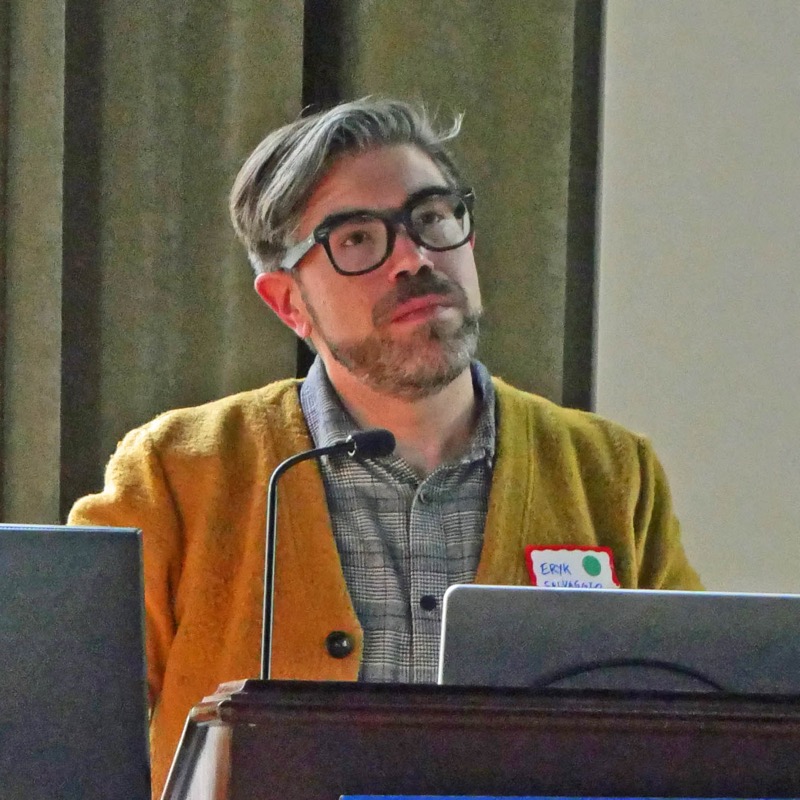
Jim.henderson, via Wikimedia Commons, CC BY 4.0SourceCC BY 4.0Cropped and resized from the Commons original.
Researcher and artist who makes films with and about artificial intelligence and writes about AI and culture. He is a Gates Scholar in digital humanities at the University of Cambridge, an affiliated researcher with the Max Planck Institute's Machine Visual Culture Research Group, and a contributor to Tech Policy Press.
We have documented 1 statement by Eryk Salvaggio, in 1 case. Each statement below gives the quotation, its original source and a link to the full case.
Case updates
Follow the debate Jacob Coxon started over Anthropic and the AI race
We'll email you when Anthropic, OpenAI, former staff or lawmakers respond to Coxon's warning, or if the outside evaluations the labs announced get underway.
Important updates only. Free. Confirm your email to start. Unsubscribe anytime. How we handle your email.
Role at the time: Researcher and artist who writes about AI, in an essay for Tech Policy Press
Challenged the characterization
Statement summary
Salvaggio wrote that gains on coding and math tasks with automatically checkable answers do not show that AI models are advancing in the other ways they would need to improve themselves, and that he is unconvinced by forecasts built on trendlines unrelated to the abilities being promised.
“if the models are showing stronger capacities for these kinds of tasks, it does not follow that the models are advancing in other ways needed to facilitate their own exponential improvement. ... I am unconvinced when I hear predictions of future capacities based on following trendlines unrelated to the capacities being promised.”
Salvaggio argues that benchmark gains in coding do not show models can drive their own exponential improvement, which disputes the premise that recursive self-improvement is near, so we labeled it as challenging the characterization.
After leaving Anthropic, Jacob Coxon said Anthropic and OpenAI were irresponsibly racing toward self-improving superintelligence, while praising Anthropic's current practices. Responses dispute catastrophic-risk forecasts, working inside AI labs, and whether governments should pause or regulate development.