
Explainer
What powers let a U.S. president impose tariffs?
The Constitution gives Congress the power to impose duties, but Congress has passed laws letting the executive branch impose tariffs in set cases, such as national-security threats (Section 232), unfair foreign practices (Section 301) and discrimination against U.S. commerce (Section 338). Each sets its own conditions.
Congress's power and the laws that delegate it
The Constitution gives Congress, not the president, the power to lay and collect duties and to regulate commerce with foreign nations.12 In the 2026 case over tariffs imposed under the International Emergency Economic Powers Act (IEEPA), the government conceded that the president has no inherent authority to impose tariffs in peacetime. Chief Justice John Roberts, in a part of his opinion joined only by Justices Neil Gorsuch and Amy Coney Barrett, wrote that when Congress has delegated its tariff powers, it has done so in explicit terms and subject to strict limits, citing a 50 percent cap under Section 338, a 15 percent cap and 150-day limit under Section 122, and a 50 percent cap with a phasedown under Section 201.2 The Congressional Research Service notes that the Court has not struck down a law under its "intelligible principle" test for delegations since 1935, while some current justices have signaled willingness to reconsider the nondelegation doctrine.3
The Budget Lab at Yale put the average statutory U.S. tariff rate at 11.0 percent in August 2026.4 For fiscal year 2026, the Treasury reported gross customs receipts of $317.8 billion, refunds of $144.6 billion and net customs receipts of $173.2 billion.5
Section 232: national security
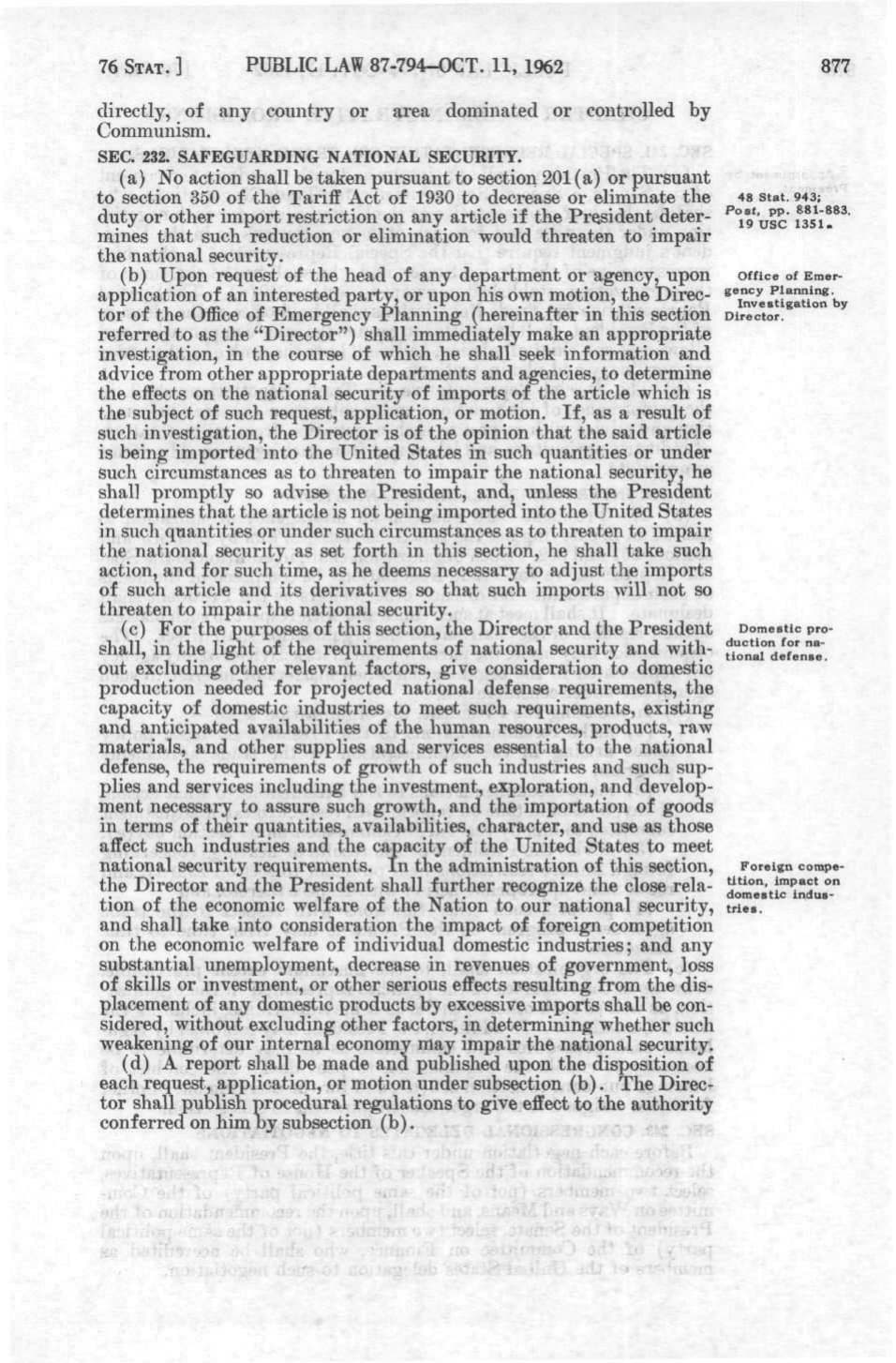
Section 232 of the Trade Expansion Act of 1962 lets the Commerce Department investigate whether imports threaten national security. Commerce has 270 days to report its findings to the president, and if it finds a threat, the president has 90 days to decide whether to concur and what action to take to adjust imports.6 The Congressional Research Service says the law sets no limit on the amount or duration of tariffs.3 In Federal Energy Administration v. Algonquin in 1976, the Supreme Court held that Section 232 is not an improper delegation because it sets clear preconditions for presidential action, and that it allows duties and license fees as well as quotas.7 In 2026 the Court said that ruling did not help the IEEPA tariffs, because Section 232 contains sweeping, discretion-conferring language that IEEPA lacks.2
President Trump has imposed Section 232 tariffs on steel, aluminum, vehicles and parts, copper, timber and lumber, trucks and buses, semiconductors and pharmaceuticals. As of September 2, 2026, his second administration had launched 13 Section 232 investigations and concluded nine, all finding a national-security threat. Some groups argue that the administration reads national security too broadly; supporters of a flexible definition say it lets the United States respond quickly to evolving threats.8 In June 2025 the president raised the steel and aluminum tariffs from 25 percent to 50 percent.9
Section 301: unfair foreign practices
Section 301 of the Trade Act of 1974 lets the U.S. Trade Representative, subject to any specific direction from the president, act against a foreign practice that is unreasonable or discriminatory and burdens or restricts U.S. commerce, including by imposing duties on the country's goods.10 Section 301 actions end after four years unless the Trade Representative receives a request to continue them and reviews the case. Beginning in 2018, the office imposed four rounds of tariffs of 7.5 to 25 percent on about $370 billion of imports from China.11 The Federal Circuit upheld the later rounds as a permissible modification of the original action in HMTX Industries,3 and the Supreme Court declined to review that ruling on June 15, 2026.12
On July 23, 2026, after investigations begun in March, the Trade Representative imposed Section 301 tariffs on 60 economies over their failure to impose and enforce bans on imports made with forced labor. The rate is 10 percent for economies that ban such imports, have committed to do so in a trade agreement or have a partial ban, and 12.5 percent for the others, with special treatment for some partners.13 The Trade Representative says it determined that the practices of each of the 60 economies were unreasonable and burdened or restricted U.S. commerce.13 Challengers in the court cases over those tariffs do not dispute that Section 301 allows tariffs; they argue the Trade Representative used it as a pretext to reimpose near-worldwide tariffs without the country-by-country findings the law requires.14 The Court of International Trade heard argument on September 30, 2026 and ordered further briefing.15
Safeguards and balance of payments
Section 201 of the Trade Act lets the president act after the International Trade Commission finds that rising imports are a substantial cause of serious injury, or the threat of it, to a domestic industry.16 Such actions may last up to four years, and may be extended for up to four more after further commission findings. Recent administrations have used Section 201 on solar cells and modules and on residential washing machines.3 The 2018 solar safeguard raised duties for four years, with annual reductions.17
Section 122 allows a temporary import surcharge of up to 15 percent for no more than 150 days unless Congress extends it.18 Congress enacted it on terms similar to President Nixon's 1971 surcharge, and the February 2026 surcharge was the first time a president used it.19 On February 20, 2026, the day of the Supreme Court's IEEPA ruling, the president imposed a 10 percent surcharge from February 24 through July 24.20 On May 7, a divided panel of the Court of International Trade held the proclamation invalid, finding that it did not identify balance-of-payments deficits as the 1974 law used that term, and entered a permanent injunction only for the importers that sued. Judge Timothy Stanceu dissented.21 The ruling was appealed to the Federal Circuit.14 The surcharge expired on July 24 and was replaced with tariffs under Section 301, the Budget Lab at Yale says.4
Section 338: discrimination against U.S. commerce
Section 338 of the Tariff Act of 1930 directs the president, when he finds as a fact that a country discriminates against U.S. commerce and that the public interest will be served, to proclaim additional duties on its goods that he determines will offset the burden, up to 50 percent, collected 30 days after the proclamation. If the country maintains or increases the discrimination, the president may exclude its products from the United States.22 In March 2026 the Congressional Research Service reported that the United States had never imposed tariffs under it.3
On July 20, 2026, the president announced 50 percent Section 338 tariffs on certain Canadian goods, citing Canadian measures on alcoholic beverages, dairy and motor vehicles. The Congressional Research Service describes this as the first time a president expressly cited the law to impose tariffs.23 The dairy proclamation, for example, found that Canada discriminates against U.S. cheese by letting retailers use its European Union quota but not its USMCA quota.24 After a short suspension for negotiations, the tariffs took effect on August 22. Canada imposed retaliatory tariffs on C$27.6 billion of U.S. goods from September 8, the day the administration announced Section 338 import bans and changes to the product lists. Some members of Congress have proposed repealing Section 338 or requiring congressional approval for such tariffs.23
On October 20, 2026, Gellert Global Group sued in the Court of International Trade. It argues that Section 338 has been impliedly repealed or is controlled by Section 301, that the duties do not offset any measured burden because each proclamation uses the 50 percent maximum, that duties on products added in September were collected after seven days instead of 30, and that reading the law to allow the tariffs would raise major-questions and nondelegation problems. It asks the court to declare the tariffs unlawful, block their collection, order refunds with interest and certify a class of importers.14
IEEPA and who can challenge tariffs
On February 20, 2026, in Learning Resources v. Trump, the Supreme Court held 6 to 3 that IEEPA does not authorize the president to impose tariffs. Chief Justice John Roberts wrote the core holding. Only Justices Neil Gorsuch and Amy Coney Barrett joined his section on the major questions doctrine, and Justice Elena Kagan, joined by Justices Sonia Sotomayor and Ketanji Brown Jackson, agreed without relying on that doctrine. Justice Brett Kavanaugh, dissenting with Justices Clarence Thomas and Samuel Alito, wrote that other laws, including Sections 232, 122, 201, 301 and 338, might justify most of the tariffs.2 An estimate cited by the Court of International Trade put the IEEPA duties at about $166 billion, assessed on entries by about 330,000 importers, as of March 2026. By October 2 about $126 billion in duties and interest had been refunded, and on October 8 the court certified a class of importers seeking refunds.25
The Supreme Court confirmed that the Court of International Trade has exclusive jurisdiction over suits arising from laws providing for tariffs.2 Parties claiming a president exceeded a tariff law sometimes have standing to sue in the trade court, whose decisions are appealed to the Federal Circuit. Section 301 actions, which the law commits to the Trade Representative, are reviewed under the Administrative Procedure Act.3 For presidential actions, the trade court looks for a clear misconstruction of the statute, a significant procedural violation or action outside delegated authority, as the Gellert complaint describes the standard.14
History
- 1930
The Tariff Act includes Section 338, on duties against countries that discriminate against U.S. commerce.22
- October 11, 1962
The Trade Expansion Act, including Section 232, becomes law.6
- 1975
Congress enacts Section 122 of the Trade Act of 1974, on terms similar to President Nixon's 1971 surcharge.19
- June 17, 1976
Federal Energy Administration v. Algonquin upholds Section 232 against a nondelegation challenge.7
- 2018 and 2019
The Trade Representative imposes four rounds of Section 301 tariffs on about $370 billion of imports from China.11
- June 2025
Section 232 tariffs on steel and aluminum rise from 25 percent to 50 percent.9
- February 20, 2026
- May 7, 2026
The Court of International Trade holds the Section 122 surcharge invalid.21
- June 15, 2026
The Supreme Court declines to review the Federal Circuit's ruling upholding the later China tariffs.12
- July 20, 2026
The president announces Section 338 tariffs on certain Canadian goods.23
- July 23, 2026
Section 301 forced-labor tariffs are imposed on 60 economies.13
- August 22, 2026
The Section 338 tariffs on Canadian goods take effect.23
- October 8, 2026
The Court of International Trade certifies a class of importers seeking IEEPA refunds.25
- October 20, 2026
Gellert Global Group sues over the Section 338 tariffs.14
What is disputed
Whether the Trade Representative made the country-by-country findings Section 301 requires before imposing the July 2026 forced-labor tariffs, or used the law as a pretext to restore global tariffs.
See the case: Are Trump's Section 301 "forced labor" tariffs a lawful remedy, or a pretext to revive struck-down global tariffs?Whether Section 338 of the Tariff Act of 1930 authorizes the 50 percent tariffs on Canadian goods, or later trade laws and the statute's own limits make them unlawful.
See the case: Trump's Section 338 Canada tariffs face Gellert Global Group's legal challengeWhether importers that have not sued should obtain IEEPA tariff refunds through a class action rather than each importer separately.
See the case: Should IEEPA tariff refunds be secured through Freestyle World's importer class action?
Cases on the Dispute Index
Trump's Section 338 Canada tariffs face Gellert Global Group's legal challenge
Gellert Global Group challenges Trump's Section 338 tariffs on Canadian goods. The administration calls the duties a response to discrimination. The importer argues that later trade laws and Section 338's own limits make them unlawful.
Should IEEPA tariff refunds be secured through Freestyle World's importer class action?
Freestyle World wants an importer class action to secure IEEPA tariff refunds. The government opposed certification. The court certified a class on October 8, but that ruling did not itself order immediate refunds.
Are Trump's Section 301 "forced labor" tariffs a lawful remedy, or a pretext to revive struck-down global tariffs?
Businesses and 25 states say Trump's 10% and 12.5% Section 301 tariffs on 60 economies are a pretext to revive struck-down global tariffs. The administration says they lawfully answer forced-labor import failures. As of September 30, 2026, no court has ruled.
Sources
- The Constitution of the United States: A Transcription (National Archives), Article I, Section 8 (opens in a new tab) · Saved copy (opens in a new tab)
- Learning Resources, Inc. v. Trump (Supreme Court of the United States, Nos. 24-1287 and 25-250), slip opinion (opens in a new tab) · Saved copy (opens in a new tab)
- Congressional and Presidential Authority to Impose Import Tariffs, CRS Report R48435 (updated March 19, 2026) (opens in a new tab)
- The State of U.S. Tariffs (updated August 24, 2026) (opens in a new tab) · Saved copy (opens in a new tab)
- Final Monthly Treasury Statement, Fiscal Year 2026 Through September 30, 2026 (opens in a new tab) · Saved copy (opens in a new tab)
- 19 U.S. Code § 1862 - Safeguarding national security (Section 232 of the Trade Expansion Act of 1962) (opens in a new tab) · Saved copy (opens in a new tab)
- Federal Energy Administration v. Algonquin SNG, Inc., 426 U.S. 548 (1976) (opens in a new tab) · Saved copy (opens in a new tab)
- Section 232 of the Trade Expansion Act of 1962, CRS In Focus IF13006 (updated September 2, 2026) (opens in a new tab)
- Proclamation 10947: Adjusting Imports of Aluminum and Steel Into the United States, 90 FR 24199 (June 9, 2025) (opens in a new tab) · Saved copy (opens in a new tab)
- 19 U.S. Code Section 2411: Actions by United States Trade Representative (Section 301 of the Trade Act of 1974) (opens in a new tab) · Saved copy (opens in a new tab)
- Section 301 of the Trade Act of 1974, CRS In Focus IF11346 (updated July 2, 2026) (opens in a new tab)
- HMTX Industries, LLC v. United States, No. 25-1012 (U.S.), docket (opens in a new tab) · Saved copy (opens in a new tab)
- USTR Takes Action in Forced Labor Section 301 Investigations (press release, July 23, 2026) (opens in a new tab) · Saved copy (opens in a new tab)
- Gellert Global Group v. Trump: complaint challenging Section 338 tariffs (opens in a new tab)
- In re Section 301 Forced Labor Cases, Court of International Trade 1:26-cv-03555: docket (CourtListener) (opens in a new tab)
- 19 U.S. Code § 2251 - Action to facilitate positive adjustment to import competition (Section 201 of the Trade Act of 1974) (opens in a new tab) · Saved copy (opens in a new tab)
- Proclamation 9693: To Facilitate Positive Adjustment to Competition From Imports of Certain Crystalline Silicon Photovoltaic Cells, 83 FR 3541 (Jan. 25, 2018) (opens in a new tab) · Saved copy (opens in a new tab)
- 19 U.S. Code § 2132 - Balance-of-payments authority (Section 122 of the Trade Act of 1974) (opens in a new tab) · Saved copy (opens in a new tab)
- Section 122 of the Trade Act of 1974, CRS In Focus IF13199 (April 9, 2026) (opens in a new tab)
- Imposing a Temporary Import Surcharge to Address Fundamental International Payments Problems (Proclamation 11012, February 20, 2026) (opens in a new tab) · Saved copy (opens in a new tab)
- Oregon v. United States and Burlap and Barrel, Inc. v. United States, Slip Op. 26-47 (Court of International Trade, May 7, 2026): opinion and order on the Section 122 tariffs (opens in a new tab) · Saved copy (opens in a new tab)
- 19 U.S. Code § 1338 - Discrimination by foreign countries (Section 338 of the Tariff Act of 1930) (opens in a new tab) · Saved copy (opens in a new tab)
- U.S. Tariffs on Canadian Imports: Section 338 of the Tariff Act of 1930, CRS Report R49349 (September 14, 2026) (opens in a new tab)
- Proclamation 11047: additional duties responding to Canadian dairy discrimination (opens in a new tab)
- Court of International Trade certifies the Freestyle World importer class (opens in a new tab) · Saved copy (opens in a new tab)
Last reviewed October 30, 2026. We review this explainer when a case that uses it changes. Report an error