
Explainer
What is IEEPA?
The International Emergency Economic Powers Act (IEEPA) is a 1977 law that lets the president block assets and bar transactions with foreign countries, groups and people after declaring a national emergency. It is central to U.S. sanctions. In February 2026 the Supreme Court ruled that it does not authorize tariffs.
What the law allows
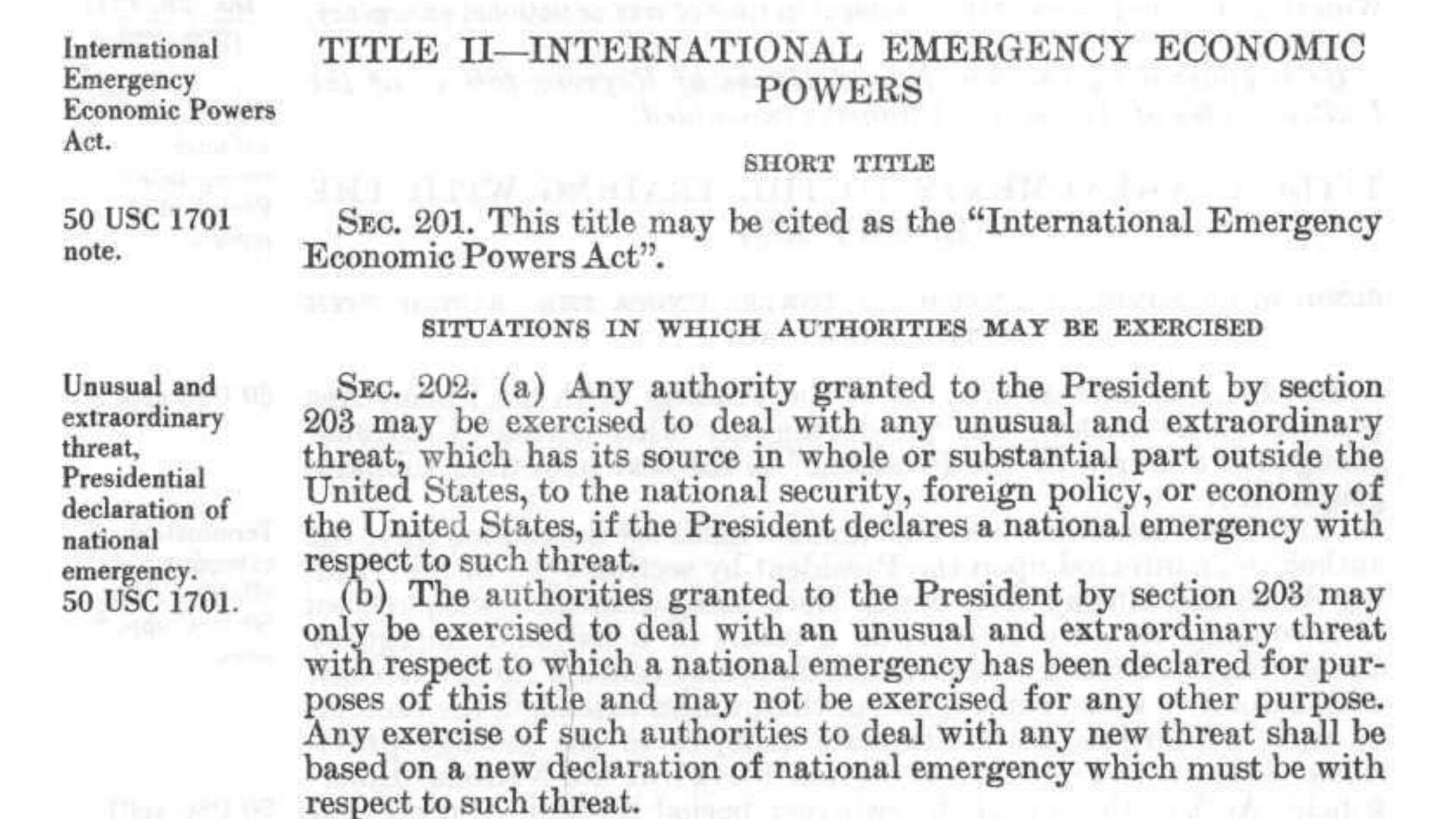
IEEPA lets a president act against an "unusual and extraordinary threat" to the national security, foreign policy or economy of the United States that has its source "in whole or substantial part" outside the country. The president must first declare a national emergency with respect to that threat. The powers may be used only for that threat, and a new threat needs a new declaration.1
Once an emergency is declared, the president may "investigate, block during the pendency of an investigation, regulate, direct and compel, nullify, void, prevent or prohibit" dealings in any property in which a foreign country or foreign national has an interest, when the property or the person is subject to U.S. jurisdiction. The president may also regulate foreign-exchange transactions, bank transfers involving foreign interests, and the import or export of currency and securities.2 Willful violations can bring a fine of up to $1 million and, for an individual, up to 20 years in prison.3
The law also sets limits. It does not reach personal communications that transfer nothing of value; donations of food, clothing and medicine meant to relieve human suffering, unless the president makes certain findings; the import or export of information and informational materials such as publications, films, artworks and news wire feeds, apart from some export controls; or transactions ordinarily incident to travel.2
From a wartime law to the sanctions law
IEEPA grew out of the Trading with the Enemy Act, which Congress passed in 1917 to regulate transactions with enemy powers after the United States entered the First World War. In the 1930s Congress expanded that law to let presidents declare emergencies in peacetime, and from 1945 to the early 1970s presidents used it as the main tool of Cold War sanctions: blocking financial transactions, seizing foreign-owned assets and restricting exports, according to the Congressional Research Service.4 After congressional committees found that the country had been in a state of emergency for more than 40 years, Congress passed the National Emergencies Act in 1976 and IEEPA in 1977 to put new limits on those powers. IEEPA became law on December 28, 1977, as Title II of Public Law 95-223.45
President Jimmy Carter declared the first IEEPA emergency on November 14, 1979, after Americans were taken hostage at the U.S. Embassy in Tehran, blocking Iranian government property in the United States.46 In Dames & Moore v. Regan in 1981, the Supreme Court held that IEEPA authorized the orders, issued to carry out the agreement that freed the hostages, that nullified court attachments on Iranian assets and directed their transfer. It upheld the suspension of Americans' claims against Iran on other grounds.6
As of September 2025, that 1979 emergency was still in effect. As of September 1, 2025, presidents had declared 77 national emergencies invoking IEEPA, 46 of them ongoing, and IEEPA emergencies had lasted more than nine years on average. Presidents first aimed the act at foreign governments and have increasingly used it against groups and individuals, such as terrorists, people engaged in malicious cyber activity and certain people involved with the International Criminal Court.4
How a sanctions program works
A typical IEEPA sanctions program has layers. The president issues an executive order that cites IEEPA, describes the threat, declares a national emergency and blocks the property of people it names or that officials later designate. The Treasury Department's Office of Foreign Assets Control (OFAC) writes regulations to carry out the order and issues licenses that allow dealings the rules would otherwise bar.789
The Russia program shows the layers. President Joe Biden's Executive Order 14024 of April 15, 2021, found that specified harmful foreign activities of the Russian government were an unusual and extraordinary threat and declared a national emergency.7 OFAC's Russian Harmful Foreign Activities Sanctions Regulations carry out that order.8 On October 9, 2026, OFAC's General License 135 authorized, until 12:01 a.m. eastern daylight time on April 7, 2027, transactions barred by those rules and a second set of Russia rules when they relate to the sale, delivery, offloading or importation of Russian-origin diesel fuel.9
The International Criminal Court program follows the same pattern. President Donald Trump's Executive Order 14203 of February 6, 2025, cites IEEPA and says the court "has engaged in illegitimate and baseless actions targeting America and our close ally Israel."10 On October 9, 2026, OFAC added the court itself to its sanctions list and issued general licenses for specified dealings with it.11
The tariff case
Before 2025, no president had used IEEPA to impose tariffs.4 Beginning in February 2025, President Trump declared national emergencies over the flow of illegal drugs from Canada, Mexico and China and over "large and persistent" trade deficits, and used IEEPA to impose duties: 25% on most Canadian and Mexican goods, 10% on most Chinese goods, and at least 10% on imports from all trading partners, with higher rates for dozens of countries. He later raised and lowered the rates several times, and the total rate on most Chinese goods reached 145%.12
Small businesses and 12 states sued. On February 20, 2026, in Learning Resources v. Trump, the Supreme Court held that IEEPA does not authorize the president to impose tariffs. Writing for six justices, Chief Justice John Roberts said the act's long list of powers never mentions tariffs or duties, and that the power to "regulate . . . importation" does not include the power to tax, which the Constitution gives to Congress. Justice Brett Kavanaugh, joined by Justices Clarence Thomas and Samuel Alito, dissented. He argued that the power to regulate importation includes tariffs, pointing to President Richard Nixon's 1971 tariffs, which an appeals court upheld under the Trading with the Enemy Act. Justice Elena Kagan, concurring, noted that Nixon had cited two trade laws and that the Trading with the Enemy Act was an after-the-fact defense raised in court.12
The same day, the president proclaimed a temporary 10% surcharge on most imported goods for 150 days under Section 122 of the Trade Act of 1974, effective February 24, and the U.S. Trade Representative said it would open investigations under Section 301 of the same act.1314 The Court of International Trade ordered U.S. Customs and Border Protection to recalculate duties on affected imports without the IEEPA tariffs, which produces refunds. By the court's account, about $166 billion in IEEPA duties was estimated in March 2026 to have been collected on 53 million entries from roughly 330,000 importers, and about $126 billion in duties plus interest had been refunded as of October 2, 2026. On June 3, 2026, the government appealed the part of the order requiring reliquidation of all affected entries; the appeal was pending as of October 8.15
Checks from Congress and the courts
Under the National Emergencies Act, an emergency ends when the president proclaims its end, when a joint resolution ending it becomes law, or on its anniversary unless the president publishes a notice continuing it. Each chamber of Congress is to meet every six months to consider a vote on ending it.16 The act first let Congress end an emergency with a concurrent resolution. After the Supreme Court held that kind of legislative veto unconstitutional in INS v. Chadha in 1983, Congress changed the act in 1985 to require a joint resolution, which the Congressional Research Service says made ending an emergency significantly harder.4
As of September 2025, the Congressional Research Service reported that no emergency declared under the National Emergencies Act had been ended without the president's assent. In 2023, five bills to end IEEPA emergencies failed to pass the House. On April 2, 2025, the Senate passed a resolution to end the emergency behind the Canada tariffs; as of September 2025 it was still pending in the House.4
Courts have also limited particular uses. Besides the tariff ruling, Judge Jesse Furman of the Southern District of New York ruled on July 30, 2025, that Executive Order 14203 violated the First Amendment rights of two law professors who sued, because it regulated their speech-based work by its content. He barred enforcement of IEEPA's penalties against them for that work.17
History
- 1917
Congress passes the Trading with the Enemy Act after the United States enters the First World War.4
- September 14, 1976
The National Emergencies Act becomes law.4
- December 28, 1977
IEEPA becomes law as Title II of Public Law 95-223.5
- November 14, 1979
- July 2, 1981
The Supreme Court upholds the orders carrying out the hostage-release agreement in Dames & Moore v. Regan.6
- August 16, 1985
After INS v. Chadha, Congress requires a joint resolution to end a national emergency.4
- 1988 and 1994
Amendments protect information and informational materials from IEEPA controls.4
- April 15, 2021
Executive Order 14024 declares a national emergency over Russian government activities.7
- February 2025
President Trump begins imposing tariffs under IEEPA.4
- February 6, 2025
Executive Order 14203 authorizes sanctions over the International Criminal Court.10
- July 30, 2025
A federal judge rules that the ICC order violates the First Amendment rights of two law professors who sued.17
- February 20, 2026
The Supreme Court rules in Learning Resources v. Trump that IEEPA does not authorize tariffs.12
- October 9, 2026
What is disputed
Whether importers who have not sued, including those whose entries were finally liquidated, should get IEEPA tariff refunds through a class action.
See the case: Should IEEPA tariff refunds be secured through Freestyle World's importer class action?Whether the Section 301 tariffs imposed in July 2026 are a lawful remedy or a pretext to revive the tariffs IEEPA could not support.
See the case: Are Trump's Section 301 "forced labor" tariffs a lawful remedy, or a pretext to revive struck-down global tariffs?Whether sanctioning the International Criminal Court as an institution is justified.
See the case: Was the United States right to sanction the ICC as an institution?Whether easing sanctions on Russian diesel to bring down fuel prices is justified.
See the case: Should the U.S. lift sanctions on Russian diesel to bring down fuel prices?Whether Congress should narrow IEEPA or make national emergencies easier to end.
Cases on the Dispute Index
Was the United States right to sanction the ICC as an institution?
Rubio defends sanctions against the ICC itself as protection for Americans. The Court and human-rights groups reject the pressure, while Treasury licenses permit specified dealings to continue under stated conditions.
Should the U.S. lift sanctions on Russian diesel to bring down fuel prices?
Trump said Russia would supply millions of tons of diesel after a call with Putin, and Treasury authorized Russian diesel imports until April 2027. Zelenskyy and lawmakers in both parties objected.
Should IEEPA tariff refunds be secured through Freestyle World's importer class action?
Freestyle World wants an importer class action to secure IEEPA tariff refunds. The government opposed certification. The court certified a class on October 8, but that ruling did not itself order immediate refunds.
Are Trump's Section 301 "forced labor" tariffs a lawful remedy, or a pretext to revive struck-down global tariffs?
Businesses and 25 states say Trump's 10% and 12.5% Section 301 tariffs on 60 economies are a pretext to revive struck-down global tariffs. The administration says they lawfully answer forced-labor import failures. As of September 30, 2026, no court has ruled.
Sources
- 50 U.S. Code § 1701: Unusual and extraordinary threat; declaration of national emergency; exercise of Presidential authorities (Legal Information Institute) (opens in a new tab) · Saved copy (opens in a new tab)
- 50 U.S. Code § 1702: Presidential authorities (Legal Information Institute) (opens in a new tab)
- 50 U.S. Code § 1705: Penalties (Legal Information Institute) (opens in a new tab) · Saved copy (opens in a new tab)
- The International Emergency Economic Powers Act: Origins, Evolution, and Use, CRS Report R45618 (updated September 1, 2025) (opens in a new tab)
- Public Law 95-223, 91 Stat. 1625 (December 28, 1977), Title II: International Emergency Economic Powers Act (opens in a new tab) · Saved copy (opens in a new tab)
- Dames & Moore v. Regan, 453 U.S. 654 (1981) (Legal Information Institute) (opens in a new tab) · Saved copy (opens in a new tab)
- Executive Order 14024: Blocking Property With Respect To Specified Harmful Foreign Activities of the Government of the Russian Federation (April 15, 2021) (opens in a new tab) · Saved copy (opens in a new tab)
- 31 CFR part 587: Russian Harmful Foreign Activities Sanctions Regulations (Electronic Code of Federal Regulations) (opens in a new tab) · Saved copy (opens in a new tab)
- Russia-related General License 135: Authorizing Transactions Related to the Sale, Delivery, Offloading, and Importation of Diesel Fuel of Russian Federation Origin (opens in a new tab)
- Executive Order 14203: Imposing Sanctions on the International Criminal Court (February 6, 2025) (opens in a new tab) · Saved copy (opens in a new tab)
- OFAC designates the International Criminal Court (opens in a new tab) · Saved copy (opens in a new tab)
- Learning Resources, Inc. v. Trump (Supreme Court of the United States, Nos. 24-1287 and 25-250), slip opinion (opens in a new tab) · Saved copy (opens in a new tab)
- Imposing a Temporary Import Surcharge to Address Fundamental International Payments Problems (Proclamation 11012, February 20, 2026) (opens in a new tab) · Saved copy (opens in a new tab)
- Ambassador Greer Issues Statement on Supreme Court IEEPA Decision (USTR, February 20, 2026) (opens in a new tab) · Saved copy (opens in a new tab)
- Court of International Trade certifies the Freestyle World importer class (opens in a new tab) · Saved copy (opens in a new tab)
- 50 U.S. Code § 1622: National emergencies (Legal Information Institute) (opens in a new tab) · Saved copy (opens in a new tab)
- Rona v. Trump, No. 25-cv-3114 (S.D.N.Y. July 30, 2025): Opinion and Order (ECF No. 70) (opens in a new tab) · Saved copy (opens in a new tab)
Last reviewed October 13, 2026. We review this explainer when a case that uses it changes. Report an error