
Explainer
What conflict-of-interest rules apply to federal officials?
A federal criminal law bars executive branch officials from taking part in government matters that affect their own finances or those of close family. Senior officials must also publicly report their assets and trades. The President and Vice President are exempt from that law but must still file the reports.
What the conflict-of-interest law bars
The main federal conflict-of-interest law, 18 U.S.C. 208, is a criminal statute. It bars an officer or employee of the executive branch or of an independent agency, including a special government employee, from participating personally and substantially in a particular matter in which, to the official's knowledge, the official has a financial interest. Participation can be a decision, approval, recommendation, advice or investigation, and particular matters include proceedings, applications, requests for rulings, contracts, claims and arrests.1
The law also counts interests held by others as the official's own: those of a spouse, a minor child or a general partner, of an organization in which the official is an officer, director, trustee, general partner or employee, and of anyone with whom the official is negotiating for, or has arranged, future employment.1 Under Office of Government Ethics (OGE) regulations, the bar applies only when the matter would have a direct and predictable effect on the interest. The Congressional Research Service (CRS) says recusal is not required when an official considers or adopts a broad policy position affecting the interests of a large, diverse group of people.2
A violation is punishable by up to one year in prison, or up to five years if willful, a fine, or both. The Attorney General can also sue for a civil penalty of up to $50,000 per violation or the amount the person received or was offered for the conduct, whichever is greater.3
Other ethics rules that apply
OGE's Standards of Ethical Conduct reach some situations the statute does not. An employee who knows that a matter involving specific parties is likely to affect the finances of a member of their household, or that a person with whom they have a covered relationship is a party, should not take part if a reasonable person who knew the facts would question their impartiality, unless an agency designee approves.4 CRS notes that this impartiality rule, like section 208, does not apply to the President and Vice President.2 Employees also may not make financial transactions using nonpublic information, or allow such information to be used improperly to further their own interests or anyone else's.5
The STOCK Act of 2012 directed OGE to make clear that executive branch employees may not use nonpublic information from their jobs to make a private profit. It also affirmed that, for the purposes of insider trading law, they owe the government and the public a duty of trust and confidence over material nonpublic information gained in their work.6 Agencies may add their own rules on employee conduct and financial holdings, which they publish in their own chapter of title 5 of the Code of Federal Regulations.7
Recusal, waivers and exemptions
The usual way to comply is recusal: the official steps aside from the matter. The statute allows exceptions. An official may take part if the official responsible for their appointment is told the facts in advance and decides in writing that the interest is not so substantial as to be deemed likely to affect the integrity of the official's services.1 OGE may also exempt, by regulation, interests it considers too remote or too inconsequential to affect an official's work.1
OGE's exemptions cover interests held through diversified mutual funds.8 They also cover small holdings of publicly traded securities: up to $15,000 in companies that are parties to a matter, up to $25,000 across all affected companies, parties included, when a matter involving specific parties also affects companies that are not parties, and, for rules and other matters of general applicability, up to $25,000 in any one affected company and $50,000 across all of them. The holdings of the official, their spouse and their minor children are counted together.9
Financial disclosure
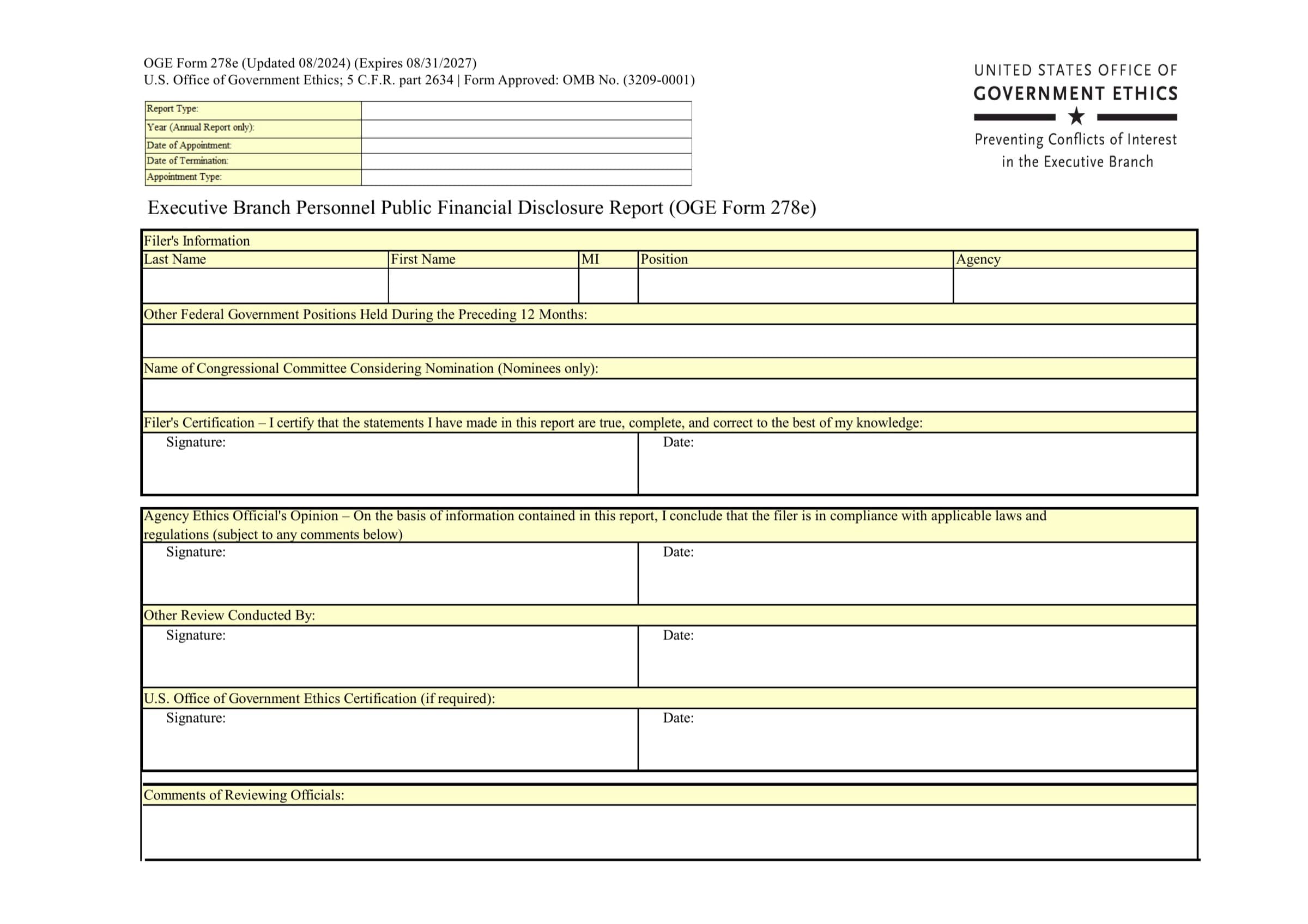
The Ethics in Government Act of 1978 requires senior officials to report their finances. Filers include the President, the Vice President, and executive branch officers and employees, special government employees among them, in positions above the GS-15 pay grade, along with certain other officials.10 A nominee for a Senate-confirmed post must file within five days after the President sends the nomination to the Senate, a new official within 30 days of taking the job, and by May 15 of each year after that.10 Executive branch filers use OGE Form 278e, which is also due within 30 days of leaving the job.11
Reports list income, assets, liabilities, outside positions and agreements with other employers, and annual reports add gifts and transactions.12 Assets, debts and transactions are reported in value ranges rather than exact amounts, from not more than $15,000 up to greater than $50,000,000.13 The STOCK Act added periodic transaction reports.6 Senior officials, the President and Vice President included, must report each purchase, sale or exchange of securities worth more than $1,000 within 30 days of being notified of it and no later than 45 days after the trade.1413
According to CRS, the reports of the President, the Vice President and appointees and nominees in the two most senior levels of executive pay are posted online, while other filers' reports are available on request.12 A report filed more than 30 days late carries a $200 fee.11 The Attorney General can seek a civil penalty of up to $50,000 against anyone who knowingly and willfully falsifies a report or fails to file one, and knowing and willful falsification can bring up to a year in prison.15
Ethics agreements, divestiture and blind trusts
A nominee for a Senate-confirmed post prepares a financial disclosure report and an ethics agreement with their agency's ethics officials and OGE. OGE sends both to the Senate and posts the agreement on its website.16 An ethics agreement is a promise to take specific steps to resolve an actual or apparent conflict, such as recusal, selling a holding, resigning an outside position, obtaining a waiver or setting up a qualified blind or diversified trust.17 The steps must generally be completed within three months of the agreement or of Senate confirmation.17 OGE's guide for nominees says outside positions must be given up before government service begins, that most other steps, including required sales, must be completed within 90 days of confirmation, and that the official must then certify compliance.16
When ethics officials require an official to sell an asset, the President or the OGE director can issue a certificate of divestiture. If the official reinvests the proceeds in U.S. government obligations or diversified funds within 60 days, the capital gains tax is deferred.18 OGE says the certificate must be obtained before the sale.16
A qualified blind trust is run by an independent trustee, such as a financial institution, lawyer, accountant, broker or investment adviser, who has no ties to the official or the official's family. The trustee may not consult or notify the official about managing the assets, the official receives only limited reports, such as the total cash value of their interest, and the official's supervising ethics office must approve the trust.13
Special government employees and advisers
A special government employee is someone retained, with or without pay, to perform temporary duties for no more than 130 days in any 365-day period.19 The conflict-of-interest statute applies to special government employees.1 According to a Justice Department summary of the rules for its own special government employees, a special government employee paid above the GS-15 rate and expected to serve more than 60 days files a public financial disclosure report, while one paid at or below that rate files a confidential report if their decisions could affect a non-federal entity.20
Whether an unpaid adviser counts as a government employee depends on the role. A 1977 opinion of the Justice Department's Office of Legal Counsel distinguished informal advice to the President from the performance of government functions, and concluded that one informal adviser who had called and chaired meetings of agency employees on an administration priority should be designated a special government employee for that work.21
The President and Vice President
Since 1989, the definitions that apply to the statute, in 18 U.S.C. 202(c), have excluded the President, the Vice President, members of Congress and federal judges.19 CRS says the exclusion is consistent with a 1974 Justice Department opinion, written during Nelson Rockefeller's confirmation as Vice President, which said serious doubts about constitutionality argued against reading the law to cover the President. In a 1983 letter, OGE agreed that the two officials are not legally bound by the conflict-of-interest laws but said they should act as if they were. CRS noted in 2019 that no court had ruled on whether the rule could constitutionally be applied to them.2
The President and Vice President must still file public disclosure reports, including periodic transaction reports.1014 CRS describes disclosure as the main rule governing conflicts between their finances and their offices, leaving voters to judge any conflicts.12 CRS also notes that the STOCK Act requires officials who file public reports, the President and Vice President included, to recuse themselves when they negotiate for future employment or compensation and there is a conflict or the appearance of one.2 In 2017, OGE Director Walter Shaub said that every President from Jimmy Carter through Barack Obama had either set up a blind trust or limited their investments to assets that did not raise conflicts, such as diversified mutual funds.22
The Constitution adds two Emoluments Clauses. The Foreign Emoluments Clause bars anyone holding an office of profit or trust under the United States from accepting any present, emolument, office or title from a foreign state without the consent of Congress. The Domestic Emoluments Clause bars the President from receiving any emolument from the federal government or the states beyond a fixed salary. Scholars disagree about whether the foreign clause reaches the President, and about what counts as an emolument. The Justice Department's Office of Legal Counsel has presumed that the clause applies to the President.23 On January 25, 2021, the Supreme Court ordered two emoluments suits against President Trump dismissed as moot because he had left office, and vacated the appeals court rulings in them.24
Who enforces the rules
OGE was created by the Ethics in Government Act of 1978 and is led by a director whom the President appoints with the Senate's consent for a five-year term.25 It sets ethics policy for the executive branch and reviews agency ethics programs, but it does not investigate or prosecute individual violations. Inspectors general investigate, and the Justice Department prosecutes.26 Each agency head and the agency's designated ethics official run that agency's ethics program.7 The President, agency heads and others may also take personnel action against an official who fails to file a disclosure report or falsifies one.15
OGE posted on February 10, 2025 that President Trump was removing its director, David Huitema.27 A series of acting directors followed. In May 2026, seven Democratic senators wrote that the office had no director, even an acting one, and that its last acting director, Eric Ueland, had left in December 2025.28 In June 2026, Trump nominated Michael Chamberlain, director of the watchdog group Protect the Public's Trust, which E&E News describes as conservative-leaning, to lead the office.29 The Senate Homeland Security and Governmental Affairs Committee listed the nomination for a hearing on November 19, 2026.30
History
- October 23, 1962
Public Law 87-849 enacts the modern conflict-of-interest statute, 18 U.S.C. 208.1
- 1974
During Nelson Rockefeller's confirmation as Vice President, Acting Attorney General Laurence Silberman concludes that the statute should not be read to cover the President.2
- October 26, 1978
- 1983
OGE advises that the President and Vice President are not legally bound by the conflict-of-interest laws but should act as if they were.2
- November 30, 1989
Public Law 101-194 writes the exclusion of the President, Vice President, members of Congress and federal judges into the definitions that apply to section 208, now 18 U.S.C. 202(c).19
- April 4, 2012
The STOCK Act becomes law, adding periodic transaction reports and affirming that federal employees may not profit from nonpublic information gained in their jobs.6
- January 11, 2017
OGE Director Walter Shaub says President-elect Trump's plan to place his businesses in a trust while his sons run them falls short of the standards Presidents had met for four decades; Trump's lawyer said operating businesses cannot be put in a blind trust.22
- January 25, 2021
The Supreme Court orders two emoluments suits against Trump dismissed as moot because he has left office.24
- February 2025
The White House says Elon Musk is serving as a special government employee.31
- February 10, 2025
President Trump removes OGE Director David Huitema, whom the Senate had confirmed in December 2024 for a five-year term.27
- June 2026
Trump nominates Michael Chamberlain to lead OGE.29
What is disputed
Whether Jared Kushner's unpaid diplomatic work requires him to file a public financial disclosure, as CREW argues, and whether his diplomacy conflicts with his leadership of Affinity Partners, as congressional Democrats contend; the White House says he works as a volunteer.
See the case: Does Jared Kushner's Affinity Partners conflict with his role in Middle East negotiations, as congressional Democrats and ethics groups say?Whether Pete Hegseth's broker sought to buy into a defense-industry fund weeks before the 2026 strikes on Iran, as the Financial Times reported and stands by; five Democratic senators asked whether he shared information about pending military action, and Hegseth and the Pentagon call the report false.
See the case: Financial Times reports Hegseth's broker sought a defense-fund investment before the Iran war; Hegseth calls the story falseWhether Elon Musk took part in government matters affecting his companies' federal contracts while he served as a special government employee, as House Democrats who have discussed investigating him allege; Musk responded that he would come for whoever is pulling the strings.
See the case: Democrats say Elon Musk's conflicts and DOGE work warrant investigation if they win Congress; Musk vows to 'come for' those behind itWhether Stephen Miller's financial disclosures understate his family's August 2025 stock sales, as Public Citizen's analysis says; the White House says he complies with all ethics requirements.
See the case: Public Citizen says Stephen Miller's disclosures misreport his family's 2025 stock sales; the White House says he complies with ethics rulesWhether Doug Burgum's retained interests in Arthur Ventures, including AI holdings, should keep him out of decisions on data centers on public lands, as former Bush White House ethics lawyer Richard Painter says; other ethics lawyers told ProPublica the holdings appear acceptable under the criminal law, and the Interior Department says any suggestion his decisions are driven by his investments is false.
See the case: ProPublica reports Burgum holds up to $64.4 million in AI companies while pushing data centers on public lands; Interior calls suggestions of a conflict falseWhether President Trump stands to profit from his administration's decisions on Nvidia chip sales to China, as Democratic lawmakers say, and who directs his accounts' Nvidia trades; the White House says independent managers handle his portfolio without his input.
See the case: Washington Post estimates Trump held up to $62 million in Nvidia stock as his administration eased China chip limits; the White House says outside managers handle his portfolio
Cases on the Dispute Index
Washington Post estimates Trump held up to $62 million in Nvidia stock as his administration eased China chip limits; the White House says outside managers handle his portfolio
The Washington Post estimates Trump held $13 million to $62 million in Nvidia stock by August 2026 as his administration eased limits on chip sales to China. Democrats call it a conflict of interest; the White House says independent managers handle his portfolio.
ProPublica reports Burgum holds up to $64.4 million in AI companies while pushing data centers on public lands; Interior calls suggestions of a conflict false
ProPublica and Save Our Parks report that Interior Secretary Doug Burgum holds up to $64.4 million in AI companies through Arthur Ventures while promoting data centers on public lands. Interior says suggestions his decisions follow his investments are false.
Public Citizen says Stephen Miller's disclosures misreport his family's 2025 stock sales; the White House says he complies with ethics rules
Public Citizen says Stephen Miller's disclosures understate at least 10 of 27 stock sales his family made in August 2025 and leave about $1.4 million unexplained. The White House says Miller complies with all ethics requirements.
Democrats say Elon Musk's conflicts and DOGE work warrant investigation if they win Congress; Musk vows to 'come for' those behind it
Democrats quoted by Politico say Elon Musk's DOGE work, federal contracts and possible role in a Ukraine internet disruption warrant investigation if they win Congress. Musk responded on X that he would come for whoever is pulling the strings.
Financial Times reports Hegseth's broker sought a defense-fund investment before the Iran war; Hegseth calls the story false
The FT says Hegseth's broker asked BlackRock about a defense-industry fund weeks before the Iran war. The Pentagon and Hegseth call the report false. Democratic senators say it would be a serious conflict of interest if accurate.
Does Jared Kushner's Affinity Partners conflict with his role in Middle East negotiations, as congressional Democrats and ethics groups say?
Congressional Democrats and ethics groups say Jared Kushner's investment firm, Affinity Partners, conflicts with his role in Middle East negotiations. Kushner, his lawyers and the White House dispute that. CNN found no indication his diplomacy directly affected the investments it reviewed.
Sources
- 18 U.S.C. 208, Acts affecting a personal financial interest (opens in a new tab) · Saved copy (opens in a new tab)
- CRS Legal Sidebar LSB10250: Executive Branch Ethics and Financial Conflicts of Interest: Disqualification (opens in a new tab) · Saved copy (opens in a new tab)
- 18 U.S.C. 216: Penalties and injunctions (federal conflict-of-interest laws) (opens in a new tab) · Saved copy (opens in a new tab)
- 5 C.F.R. 2635.502: Personal and business relationships (impartiality rule) (opens in a new tab) · Saved copy (opens in a new tab)
- 5 C.F.R. 2635.703: Use of nonpublic information (opens in a new tab) · Saved copy (opens in a new tab)
- Stop Trading on Congressional Knowledge Act of 2012 (STOCK Act), Public Law 112-105 (opens in a new tab) · Saved copy (opens in a new tab)
- Mission, Authority, and Key Players, U.S. Office of Government Ethics (opens in a new tab) · Saved copy (opens in a new tab)
- 5 C.F.R. 2640.201: Exemptions for interests in mutual funds and other investment funds (opens in a new tab) · Saved copy (opens in a new tab)
- 5 C.F.R. 2640.202: De minimis exemptions under 18 U.S.C. 208 (opens in a new tab) · Saved copy (opens in a new tab)
- 5 U.S.C. 13103: Persons required to file financial disclosure reports (opens in a new tab) · Saved copy (opens in a new tab)
- OGE Form 278e: Executive Branch Personnel Public Financial Disclosure Report (updated August 2024) (opens in a new tab) · Saved copy (opens in a new tab)
- CRS Legal Sidebar LSB10238: Executive Branch Ethics and Financial Conflicts of Interest: Disclosure (opens in a new tab) · Saved copy (opens in a new tab)
- 5 U.S.C. 13104: Contents of financial disclosure reports (opens in a new tab) · Saved copy (opens in a new tab)
- 5 U.S.C. 13105: Filing of reports (periodic transaction reports) (opens in a new tab) · Saved copy (opens in a new tab)
- 5 U.S.C. 13106: Failure to file or filing false reports (opens in a new tab) · Saved copy (opens in a new tab)
- The Nominee Guide (2024), U.S. Office of Government Ethics (opens in a new tab) · Saved copy (opens in a new tab)
- 5 C.F.R. 2634.802: Ethics agreements (opens in a new tab) · Saved copy (opens in a new tab)
- 26 U.S.C. 1043: Sale of property to comply with conflict-of-interest requirements (opens in a new tab) · Saved copy (opens in a new tab)
- 18 U.S.C. 202: Definitions (federal conflict-of-interest laws) (opens in a new tab) · Saved copy (opens in a new tab)
- Summary of Government Ethics Rules for Special Government Employees, U.S. Department of Justice (opens in a new tab) · Saved copy (opens in a new tab)
- Office of Legal Counsel, Opinion 77-9: Conflict of Interest, Status of an Informal Presidential Advisor as a 'Special Government Employee' (February 24, 1977) (opens in a new tab) · Saved copy (opens in a new tab)
- Remarks of Walter M. Shaub, Jr., Director, U.S. Office of Government Ethics, at the Brookings Institution (opens in a new tab) · Saved copy (opens in a new tab)
- CRS Report R45992: The Emoluments Clauses and the Presidency: Background and Recent Developments (opens in a new tab) · Saved copy (opens in a new tab)
- Supreme Court tosses Trump emoluments cases (opens in a new tab) · Saved copy (opens in a new tab)
- 5 U.S.C. 13121: Establishment of the Office of Government Ethics (opens in a new tab) · Saved copy (opens in a new tab)
- OGE Oversees the Executive Branch Ethics Program in a Variety of Ways (opens in a new tab) · Saved copy (opens in a new tab)
- Trump fires top government ethics, whistleblower officials (opens in a new tab) · Saved copy (opens in a new tab)
- Sen. Schiff and Colleagues Press White House on Critical Office of Government Ethics Vacancy (opens in a new tab) · Saved copy (opens in a new tab)
- Trump picks conservative watchdog to head ethics office (opens in a new tab) · Saved copy (opens in a new tab)
- Nominations hearing, November 19, 2026, Senate Committee on Homeland Security and Governmental Affairs (opens in a new tab) · Saved copy (opens in a new tab)
- Elon Musk is serving as a 'special government employee,' White House says (opens in a new tab) · Saved copy (opens in a new tab)
Last reviewed November 19, 2026. We review this explainer when a case that uses it changes. Report an error