
Explainer
What is the Supremacy Clause?
The Supremacy Clause in Article VI of the Constitution makes federal law the supreme law of the land. Courts read it to bar states from regulating the federal government directly or discriminating against it, though states may refuse to help enforce federal law.
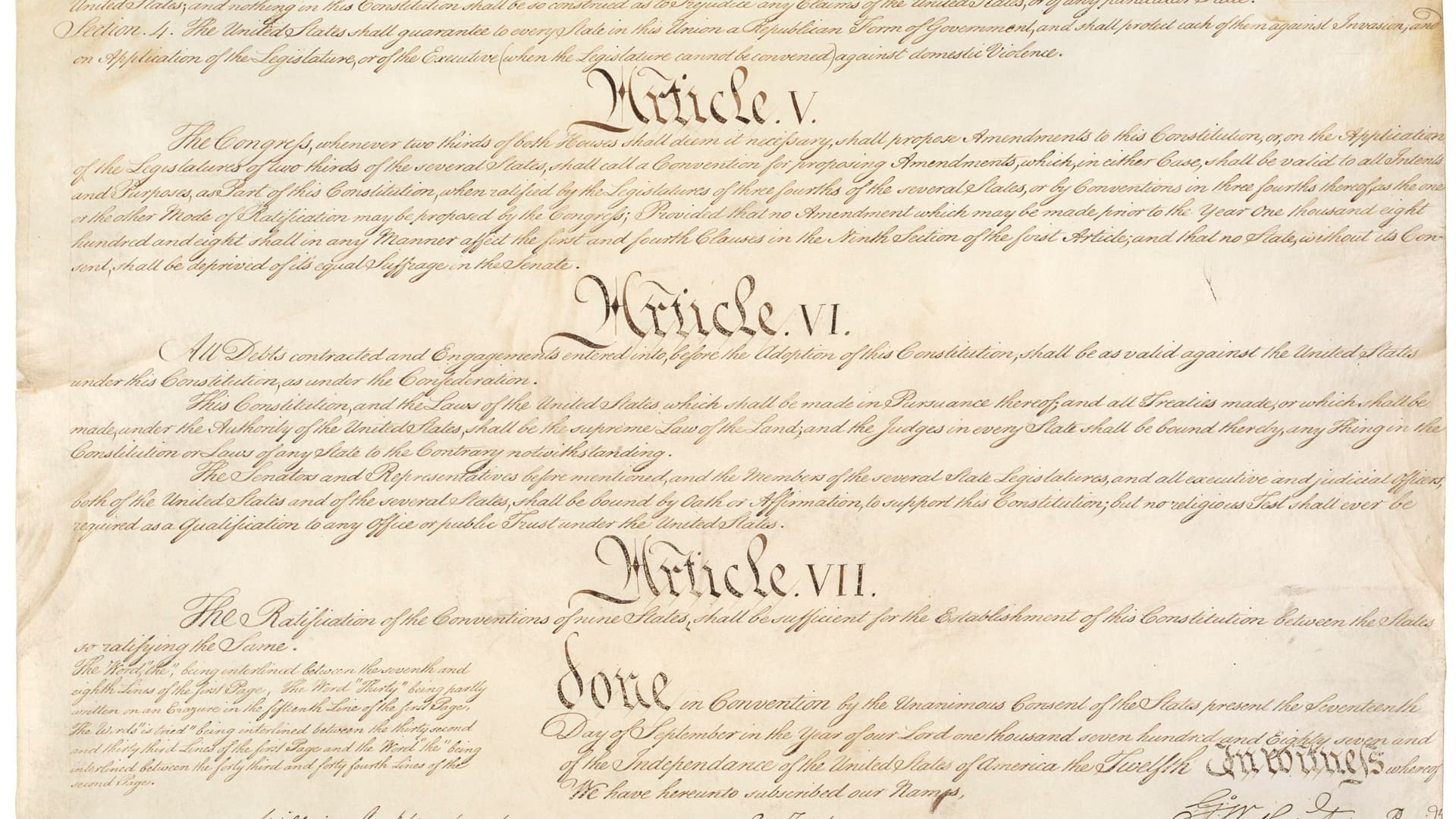
What the clause says
The second paragraph of Article VI of the Constitution reads: "This Constitution, and the Laws of the United States which shall be made in Pursuance thereof; and all Treaties made, or which shall be made, under the Authority of the United States, shall be the supreme Law of the Land; and the Judges in every State shall be bound thereby, any Thing in the Constitution or Laws of any State to the Contrary notwithstanding."1 The next paragraph requires state and federal officers alike to swear an oath to support the Constitution.1
The clause does not list what states may or may not do. Courts have built several doctrines on it. Preemption decides when a federal law displaces a state law. Intergovernmental immunity protects the federal government itself from state laws that regulate it directly or discriminate against it.2 A related immunity can shield federal officers from state prosecution for acts within their duties. A separate rule runs the other way: the federal government "may not compel the States to implement, by legislation or executive action, federal regulatory programs," in the words of the Supreme Court's 1997 decision in Printz v. United States.3
Preemption
When a valid federal law and a state law collide, the federal law controls. Congress can say in a statute that it displaces state law. Courts also treat a state law as preempted when it conflicts with federal law, which the Supreme Court has described as cases where "compliance with both federal and state regulations is a physical impossibility" and those where the state law "stands as an obstacle to the accomplishment and execution of the full purposes and objectives of Congress."3
Courts apply the obstacle test with caution. The Ninth Circuit, quoting the Supreme Court, wrote in 2019 that implied preemption analysis does not justify a "freewheeling judicial inquiry into whether a state statute is in tension with federal objectives."3
Federal immunity from state laws
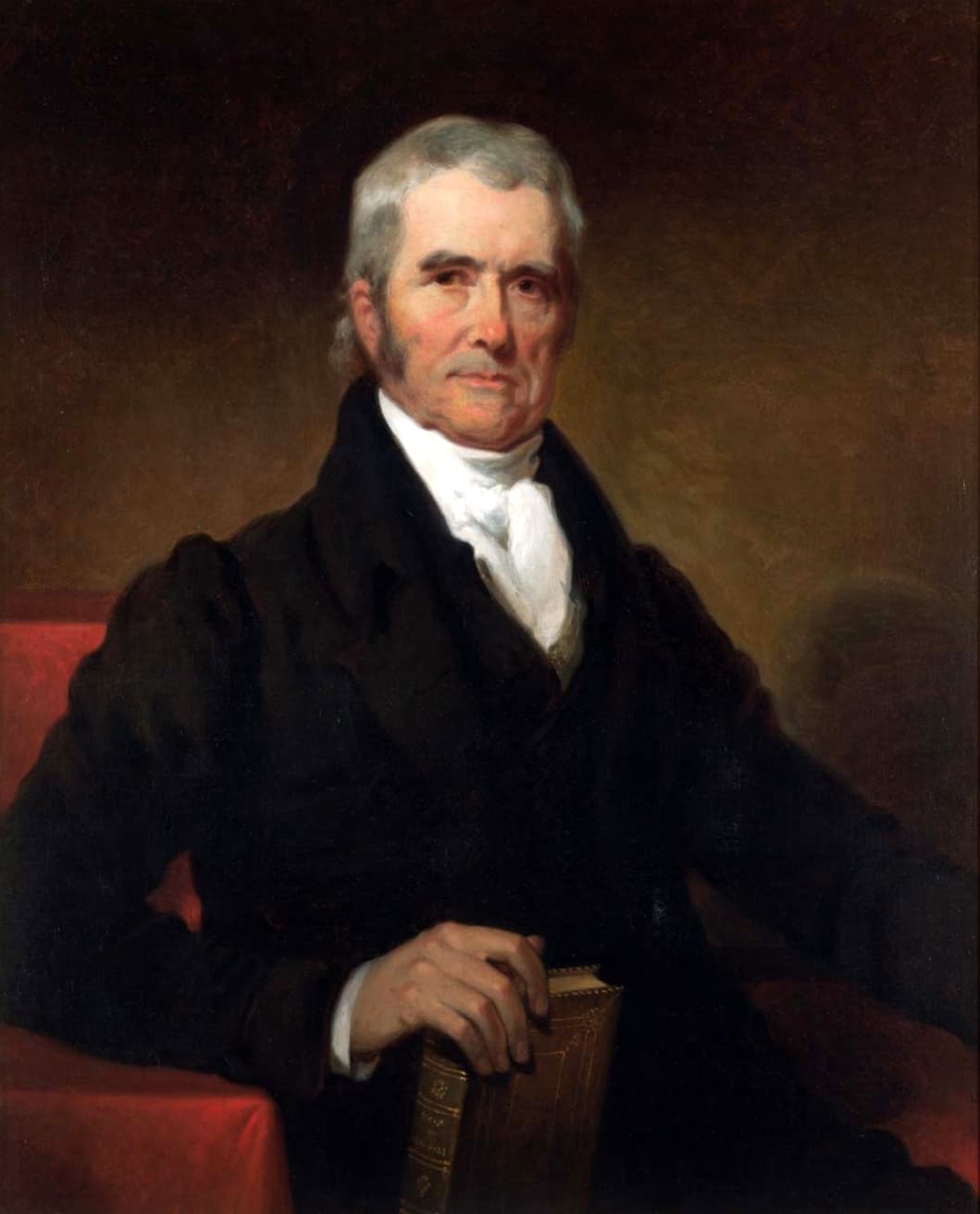
Intergovernmental immunity dates to McCulloch v. Maryland in 1819, when the Supreme Court struck down Maryland's tax on the Bank of the United States. Maryland imposed no comparable tax on other banks in the state. Chief Justice John Marshall wrote that under the Supremacy Clause, "the States have no power, by taxation or otherwise, to retard, impede, burden, or in any manner control" the operation of federal laws.2
The Supreme Court has since narrowed the rule. It once read the doctrine to bar any state law that raised the federal government's costs. It now bars state laws that "regulat[e] the United States directly or discriminat[e] against the Federal Government or those with whom it deals," such as contractors. A law discriminates if it singles out the federal government or its contractors for less favorable treatment. In United States v. Washington (2022), a unanimous Court used that test to strike down a Washington workers' compensation law that made claims easier only for federal contract workers at the Hanford nuclear site. Congress can waive the immunity, the Court said, but it had not done so for that law.2 The Ninth Circuit held in 2019 that there is no exception for small burdens: any economic burden a state imposes on the federal government in a discriminatory way is unlawful.3
Mask and identification laws
Laws that bar police from covering their faces, or require them to show identification, have tested both halves of the rule. In February 2026, a federal district court barred California from enforcing its face-covering ban, the No Secret Police Act, against federal officers because the law exempted California's own state officers. The court found the United States had not shown that the mask law or a companion identification law directly regulated the federal government, and it declined to block the identification law.4 In April 2026, the Ninth Circuit took a different view of the identification law. In an order blocking it as to federal officers while the appeal proceeds, the court wrote that the law "attempts to directly regulate the United States in its performance of governmental functions."5 On September 29, 2026, California extended its face-covering rules to state officers.6
Bridget Lavender, a staff attorney at the University of Wisconsin Law School's State Democracy Research Initiative, wrote in State Court Report that lawmakers in at least 30 other states had introduced or considered similar bills, that most of them cover every level of law enforcement, and that the open question is whether such a ban directly regulates federal officers or only affects them incidentally.7 In Connecticut, federal officials and Republican state legislators have cited the Supremacy Clause against a state mask law that the Department of Homeland Security has sued to block. State Senate President Pro Tempore Martin Looney, a Democrat, said lawmakers took care not to subject federal officers to anything the state does not require of its own officers.8
What states may refuse to do
The Supremacy Clause makes valid federal law binding in every state, but it does not require states to help enforce it. Under the anticommandeering rule, which courts draw from the Tenth Amendment, Congress cannot order states to carry out federal programs.3
In 2019, the Ninth Circuit applied that rule to SB 54, California's law limiting cooperation between state and local police and federal immigration authorities. The United States argued that the law obstructed immigration enforcement. The court disagreed: "whatever the wisdom of the underlying policy adopted by California, that frustration is permissible, because California has the right, pursuant to the anticommandeering rule, to refrain from assisting with federal efforts." It quoted the district court's reasoning: "refusing to help is not the same as impeding."3 In the same ruling, the court held that a provision of another California law, AB 103, requiring state inspections of immigration detention facilities to examine how detainees were arrested and transferred, discriminated against the federal government.3
When states prosecute federal agents
States can charge federal officers with state crimes. "The law is clear that there is no absolute immunity for federal officers from state law," Alicia Bannon, editor of the Brennan Center's State Court Report, wrote in January 2026. She said Vice President JD Vance and other administration officials had suggested otherwise.9
What federal officers can claim is Supremacy Clause immunity, which traces to In re Neagle (1890). David Neagle, a deputy U.S. marshal assigned to protect Supreme Court Justice Stephen Field, shot and killed David Terry, a former chief justice of California, when Terry attacked Field, and local authorities arrested Neagle. The Supreme Court held him immune from state prosecution because he was carrying out his federal duties and did "no more than what was necessary and proper for him to do."9 Under the framework Bannon describes, a state prosecution can go forward if the state shows the officer acted outside federal duties or acted unreasonably or unlawfully, and an officer who claims the immunity can move the case to federal court. In 2001, the Ninth Circuit allowed an Idaho county prosecutor to pursue a manslaughter case against an FBI sniper who had killed an unarmed woman during a raid on a cabin near Ruby Ridge, Idaho.9
History
- September 17, 1787
Delegates sign the Constitution, with the Supremacy Clause in Article VI.1
- 1819
In McCulloch v. Maryland, the Supreme Court strikes down Maryland's tax on the Bank of the United States.2
- 1890
In In re Neagle, the Supreme Court holds a deputy U.S. marshal who killed a man while guarding Justice Stephen Field immune from state prosecution.9
- 1997
In Printz v. United States, the Supreme Court holds that the federal government may not compel states to carry out federal regulatory programs.3
- 2001
The Ninth Circuit lets an Idaho county prosecutor pursue a manslaughter case against the FBI sniper from the Ruby Ridge raid.9
- April 18, 2019
The Ninth Circuit leaves in place California's limits on police cooperation with federal immigration authorities.3
- June 21, 2022
In United States v. Washington, a unanimous Supreme Court strikes down a state law that singled out federal contract workers.2
- February 9, 2026
A federal district court bars California from enforcing its mask ban against federal officers because the ban exempted state officers.4
- April 22, 2026
The Ninth Circuit blocks California's identification requirement for federal officers while the appeal proceeds.5
- September 29, 2026
California extends its face-covering rules to state officers.6
What is disputed
Whether a state law that bans a device or practice for all police, federal and state alike, directly regulates federal agents or only affects them incidentally. California's ban on electric shock gloves tests that line.
See the case: Can California ban ICE and other federal agents from using electric shock gloves, as AB 2760 does?Whether Connecticut can enforce its rules for federal immigration agents, including its mask ban and its judicial-warrant requirement for protected spaces such as courthouses.
See the case: Did ICE's conduct at the Meriden, Connecticut, courthouse violate the state's TRUST Act?Whether Supremacy Clause immunity bars Minnesota's prosecution of ICE officer Christian Castro over the shooting of Julio Cesar Sosa-Celis. The Department of Homeland Security says only federal authorities have jurisdiction.
See the case: Was ICE Officer Christian Castro Justified in Shooting Julio Cesar Sosa-Celis?Whether local prosecutors can review a shooting by a federal immigration agent under state law when the agent's own department leads the investigation.
See the case: Should DHS lead the investigation of the ICE shooting of a delivery driver in Austin?
Cases on the Dispute Index
Can California ban ICE and other federal agents from using electric shock gloves, as AB 2760 does?
California's AB 2760 bars all law enforcement, including federal agents, from using electric shock gloves. Newsom and the author defend the ban. DHS and a federal prosecutor reject California's authority over federal agents. As of October 1, 2026, no court has ruled.
Did ICE's conduct at the Meriden, Connecticut, courthouse violate the state's TRUST Act?
ICE agents arrested a man inside a Meriden, Connecticut, courthouse while activists demanded to know why masked agents were violating the TRUST Act. State officials called it improper; ICE called the arrest appropriate and said marshals impeded it.
Was ICE Officer Christian Castro Justified in Shooting Julio Cesar Sosa-Celis?
ICE officer Christian Castro shot Julio Cesar Sosa-Celis in Minneapolis in January 2026. DHS initially called it self-defense against an armed ambush; ICE later said officers' sworn testimony appeared untruthful. Castro faces state assault and federal false-statement charges.
Should DHS lead the investigation of the ICE shooting of a delivery driver in Austin?
DHS says it will lead the investigation of an ICE officer's shooting of Wilber Rafael Garces Perez in Austin. Read its statement, calls for an independent inquiry and the subsequent charge.
Sources
- The Constitution of the United States: A Transcription (National Archives), Article VI (opens in a new tab) · Saved copy (opens in a new tab)
- United States v. Washington, 596 U.S. 832 (2022), No. 21-404, opinion of the Court (opens in a new tab) · Saved copy (opens in a new tab)
- United States v. State of California, 921 F.3d 865, No. 18-16496 (9th Cir. Apr. 18, 2019), opinion on AB 450, AB 103 and SB 54 (opens in a new tab) · Saved copy (opens in a new tab)
- United States v. State of California, No. 2:25-cv-10999-CAS-AJRx (C.D. Cal.), order on motion for preliminary injunction, Document 63 (opens in a new tab) · Saved copy (opens in a new tab)
- United States v. State of California, No. 26-926 (9th Cir. Apr. 22, 2026), opinion granting an injunction pending appeal (opens in a new tab)
- SB 1004 (Wiener), Chapter 757, Statutes of 2026: Law enforcement: masks (chaptered text) (opens in a new tab)
- State Court Report (Brennan Center), April 20, 2026: Can States Ban Federal Officers from Wearing Masks? (opens in a new tab) · Saved copy (opens in a new tab)
- CT law limits federal ICE agents. Debate is over whether it can it be enforced or needs to change (opens in a new tab)
- State Court Report (Brennan Center), January 27, 2026: When Can States Prosecute Federal Agents? (opens in a new tab) · Saved copy (opens in a new tab)
Last reviewed October 6, 2026. We review this explainer when a case that uses it changes. Report an error