
Explainer
What are the Epstein files?
The Epstein files are the Justice Department's and FBI's records on Jeffrey Epstein and Ghislaine Maxwell. A 2025 law ordered them released, with exceptions such as victims' privacy. The department says it complied; some lawmakers say it over-redacted, and a judge ordered it to review records it had set aside.
What the term covers
"The Epstein files" is the common name for the federal government's records on Jeffrey Epstein, and above all the Justice Department and FBI records that a 2025 law ordered released. Epstein pleaded guilty in a Florida state court in 2008 to a felony charge of procurement of minors to engage in prostitution. On July 2, 2019, a federal grand jury in Manhattan indicted him on sex trafficking charges. He died in federal custody in August 2019; New York City's chief medical examiner determined the cause of death was hanging and the manner of death suicide.1
Ghislaine Maxwell was found guilty by a federal jury on December 29, 2021, and sentenced on June 28, 2022, to 240 months in prison.2
The Justice Department told Congress in January 2026 that the records it gathered came from five main sources: the Florida and New York cases against Epstein, the New York case against Maxwell, the New York investigations of Epstein's death, a Florida case involving a former Epstein butler, and several FBI investigations, along with the inspector general's review.3 A July 2025 Justice Department and FBI memo said the FBI's searches had turned up more than 300 gigabytes of data and physical evidence, and that much of the material was under court-ordered seal.4
Grand jury records
Some of the records are grand jury material, which is secret by default. Federal Rule of Criminal Procedure 6(e) bars grand jurors, government lawyers, court reporters and others present from disclosing grand jury matters, with narrow exceptions, as Judge Paul Engelmayer explained.5
In July 2025 the Justice Department asked federal courts in Florida and New York to unseal Epstein grand jury transcripts. On July 23, U.S. District Judge Robin Rosenberg in Florida denied the request, writing that 11th Circuit law did not permit her to grant it, NPR reported.6 On August 11, Engelmayer denied the request in Maxwell's case, writing that the materials would not reveal new information of any consequence.5 On August 20, Judge Richard Berman denied it in Epstein's 2019 case, describing 70 pages of transcripts from two sessions in which no victim testified and the only witness was an FBI agent.7
After the 2025 law passed, the department asked again, and the courts granted the requests. In Florida, Judge Rodney Smith granted it on December 5.89 Engelmayer granted it on December 9, noting that the law does not mention grand jury materials but holding that its text covers them.10 Berman granted it on December 10, writing that Section 2(a) of the law "clearly includes" the Epstein grand jury materials.9
Releases before the law
Courts and Congress had already made some records public. Records from Virginia Giuffre's 2015 lawsuit against Maxwell, which settled in 2017, have been unsealed in stages: about 2,000 pages in 2019, more in 2020, 2021 and 2022, and a further batch of about 250 records that a federal court in New York began releasing in January 2024. U.S. District Judge Loretta Preska said she was releasing that batch because much of the information was already public, the Associated Press reported.11
The House Oversight Committee subpoenaed the Justice Department on August 5, 2025, and released 33,295 pages of the records it received on September 2.12 It released records from Epstein's estate, obtained under an August 25 subpoena, on September 8,13 and another 20,000 pages of estate documents on November 12, 2025.14
The July 2025 memo
In July 2025 the Justice Department and the FBI issued a memo on their review of the Epstein investigation. It said the review found no incriminating "client list" and no credible evidence that Epstein blackmailed prominent people, and no evidence that could justify investigating uncharged third parties. It said no further disclosure would be "appropriate or warranted." It also said FBI investigators had concluded that Epstein died by suicide in his cell on August 10, 2019, and that jail video showed no one entering any tier of the unit from about 10:40 p.m. the night before until about 6:30 a.m.4
The memo drew criticism from some of President Trump's supporters. The AP reported that the two-page memo was not signed by any individual, that Attorney General Pam Bondi had suggested in February 2025 that a client list was on her desk before saying she meant the overall case file, and that commentators including Laura Loomer and Glenn Beck called on Bondi to resign. Trump defended Bondi.15
The Epstein Files Transparency Act
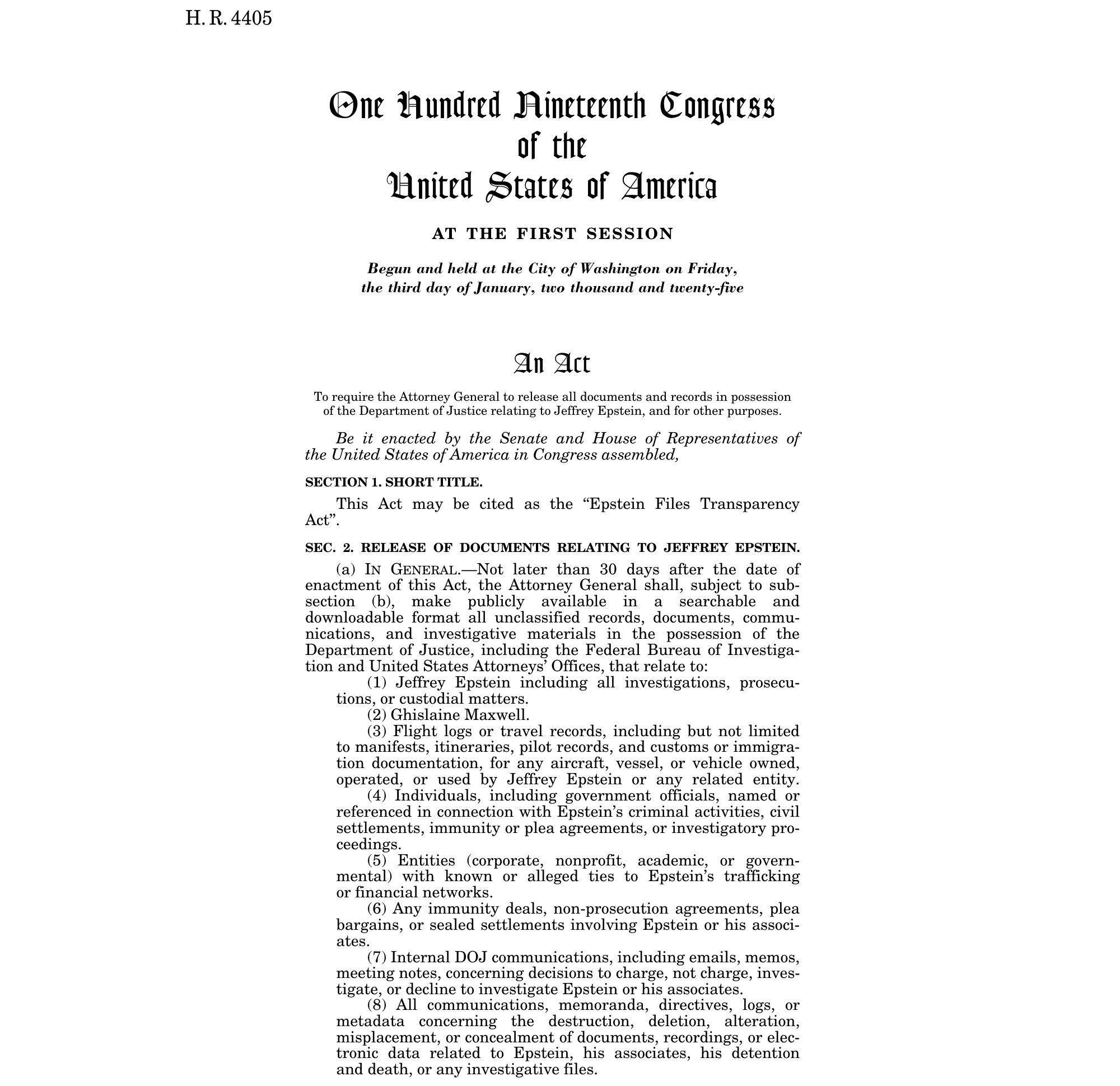
On September 10, 2025, the Senate voted 51 to 49 to table an amendment to a Senate bill, S. 2296, that would have directed the attorney general to release Epstein documents.16 In the House, Reps. Thomas Massie and Ro Khanna had filed a resolution, H.Res. 581, on July 15 to bring the act's text to the floor,17 and on September 2 Massie filed a discharge petition to force a vote on it. The House Clerk's record shows the 218th signature on November 12.18 On November 18 the House passed the act, H.R. 4405, under suspension of the rules, by 427 to 1, with 5 not voting.19 The Senate passed it on November 19, and it was approved that day as Public Law 119-38.20
The law gave the attorney general 30 days to publish, in a searchable and downloadable format, all unclassified Justice Department records that relate to Epstein, including those held by the FBI and U.S. attorneys' offices. The covered records include all investigations, prosecutions and custodial matters involving Epstein; records relating to Maxwell; flight logs and travel records; records naming individuals in connection with Epstein's criminal activities, civil settlements, plea agreements or investigations; immunity deals and non-prosecution agreements; internal Justice Department communications about decisions to charge or not charge; and records of Epstein's detention and death.20
The law says no record may be withheld, delayed or redacted "on the basis of embarrassment, reputational harm, or political sensitivity," including to any government official, public figure or foreign dignitary. It allows the attorney general to withhold or redact victims' identifying information and personal and medical files whose disclosure would be a clearly unwarranted invasion of privacy, child sexual abuse material, material that would jeopardize an active federal investigation or prosecution (only in a narrowly tailored and temporary way), images of death, physical abuse or injury, and properly classified information. Every redaction must come with a written justification published in the Federal Register and sent to Congress. Within 15 days of finishing the release, the attorney general must give the House and Senate Judiciary Committees a report that includes a list of all government officials and politically exposed persons named or referenced in the released materials.20
How the department carried it out
On December 19, 2025, the department told Congress it was producing hundreds of thousands of pages that day, was still reviewing other documents, and had withheld or redacted some information under the deliberative-process, work-product and attorney-client privileges.21 Massie, a lead sponsor, said the release grossly failed to comply with the law, PBS reported.22
On January 30, 2026, the department told Congress that its production that day marked its compliance with the law's production requirements. It said it had identified more than 6 million potentially responsive pages, that about 200,000 pages had been redacted or withheld on privilege grounds, that no files were withheld on national defense or foreign policy grounds, and that redactions were likely applied inconsistently given the volume of material.3 It said its releases totaled nearly 3.5 million pages, including more than 2,000 videos and 180,000 images, and that notable individuals and politicians were not redacted in any released file.23 According to a later court opinion, the department's letter said foreign-language materials had not been reviewed or produced because it was not practicable for first-level reviewers to judge their responsiveness.24
Khanna and Massie wrote the same day that the department had redacted some material wholesale while leaving some victims' names unredacted.25 In February 2026 the department sent Congress its list of politically exposed persons named in the files. CNN reported that the list does not say what contact, if any, each person had with Epstein, that no one on it other than Epstein and Maxwell has been charged in connection with his crimes, and that the department listed reasons for redactions that go beyond what the law requires.26 On August 27, 2026, the department published in the Federal Register its report to Congress on the records it released and withheld.27 On November 10, 2026, the House Oversight Committee's majority released a staff report saying the department failed to communicate adequately about its releases and failed to sufficiently protect survivors.28
Court fights and new bills in 2026
Journalist Katie Phang sued to enforce the law. On June 25, 2026, U.S. District Judge Emmet Sullivan granted her a preliminary injunction, writing that the attorney general, by not contesting her arguments on the merits, had conceded he was in violation of the law; the government argued that the law gives private individuals no right to sue.24 Sullivan's order required the department to begin reviewing and producing foreign-language materials that may be covered.29 On October 28 the U.S. Court of Appeals for the D.C. Circuit refused to pause that order, and on November 2 the department told the court it had begun the review.30
On July 15, 2026, Massie, Khanna and Rep. Leger Fernandez introduced the Epstein Files Transparency Act II. It would let state attorneys general and other state officers, victims and members of Congress sue the U.S. attorney general over withheld or redacted records, give members of Congress unredacted access within seven days of a request, bar the department from invoking common-law privileges such as the deliberative process privilege, and give victims their own records unredacted on request.31 The sponsors also filed a resolution, H.Res. 1430, to bring its text to the floor.32 Massie filed a discharge petition on that resolution on August 31; the House Clerk's record lists a 218th signature dated November 11, 2026.33 On October 15, 2026, Sen. Elizabeth Warren and Rep. Robert Garcia introduced the Epstein Wall Street Records Act, which would require the Federal Reserve, FDIC, OCC and SEC to disclose supervisory records related to Epstein and his associates.34
History
- 2008
Epstein pleads guilty in a Florida state court to procurement of minors to engage in prostitution.1
- July 2, 2019
A federal grand jury in Manhattan indicts Epstein on sex trafficking charges.1
- August 10, 2019
Epstein dies in his cell at the Metropolitan Correctional Center in New York.4
- December 29, 2021
A federal jury finds Ghislaine Maxwell guilty.2
- January 2024
A federal court begins releasing a further batch of sealed records from Giuffre v. Maxwell.11
- July 2025
A Justice Department and FBI memo says no further disclosure is warranted.4
- September 2, 2025
The House Oversight Committee releases 33,295 pages of Justice Department records.12
- September 10, 2025
The Senate tables an amendment directing release of Epstein documents, 51 to 49.16
- November 18, 2025
The House passes the Epstein Files Transparency Act, 427 to 1.19
- November 19, 2025
The Senate passes the act and it becomes Public Law 119-38.20
- December 2025
- December 19, 2025
The department makes its first release under the law.21
- January 30, 2026
The department tells Congress it has complied with the law's production requirements.3
- June 25, 2026
Judge Emmet Sullivan grants Katie Phang a preliminary injunction.24
- August 27, 2026
The department publishes its report to Congress in the Federal Register.27
- October 28, 2026
The D.C. Circuit refuses to pause the order to review foreign-language records.30
- November 11, 2026
What is disputed
Whether the Justice Department has released every record the Epstein Files Transparency Act requires, as it says, or is still withholding or over-redacting covered records, as the sponsors of a second bill say.
See the case: Massie says a second Epstein files bill will get the 218 signatures needed to force a House vote; the Justice Department says it complied with the first lawWhether the Epstein Files Transparency Act requires the Justice Department to review and release the foreign-language records it set aside, and whether a private person such as Katie Phang can sue to enforce the law.
See the case: Katie Phang sues Todd Blanche over the Epstein files; courts order the Justice Department to start reviewing foreign-language records, and DOJ says she cannot sueWhether federal financial regulators have failed to investigate banks tied to Epstein, as Sen. Elizabeth Warren says, and whether their supervisory records should be made public, as the Epstein Wall Street Records Act would require.
See the case: Warren and Garcia bill would force regulators to investigate banks tied to Epstein; the Fed and OCC say they cannot comment on investigationsWhether Sen. Jon Husted's September 2025 vote to table an amendment directing release of the Epstein records amounts to a vote to keep the files secret, as Sherrod Brown's campaign says, or is misleading given that the Senate later passed the Epstein Files Transparency Act, as Husted's campaign says.
See the case: Sherrod Brown's campaign says Husted voted to keep the Epstein files secret; Husted's campaign disputes that accountWhether Sen. Roger Marshall's September 2025 vote to table an amendment directing release of the Epstein records supports the claim that he voted to keep the files sealed, given that the Senate later passed the Epstein Files Transparency Act.
See the case: Super PAC ads accuse Roger Marshall and Adam Hamilton of protecting pedophiles in the Kansas Senate race; FactCheck.org calls both attacks misleading or unsupportedWhether the House Oversight Committee's subpoenas to Leon Black in its Epstein investigation were within its authority, as the committee says, or exceeded it, as Black's lawyers argue.
See the case: Was the House justified in holding Leon Black in contempt of Congress over the Epstein inquiry?
Cases on the Dispute Index
Massie says a second Epstein files bill will get the 218 signatures needed to force a House vote; the Justice Department says it complied with the first law
Massie says a discharge petition for a second Epstein files bill will reach the 218 signatures needed to force a House vote; the clerk lists 216. The bill would let states and survivors sue the Justice Department, which says it complied.
Katie Phang sues Todd Blanche over the Epstein files; courts order the Justice Department to start reviewing foreign-language records, and DOJ says she cannot sue
Katie Phang says the Justice Department broke the Epstein Files Transparency Act by not reviewing foreign-language records. A judge ordered the review, and an appeals court refused to pause it on Oct. 28. DOJ says she cannot sue.
Super PAC ads accuse Roger Marshall and Adam Hamilton of protecting pedophiles in the Kansas Senate race; FactCheck.org calls both attacks misleading or unsupported
A WinSenate ad says Sen. Roger Marshall voted to keep the Epstein files sealed and protected pedophiles. A Senate Leadership Fund ad says Adam Hamilton protected a pedophile at his church camp. FactCheck.org calls both attacks misleading or unsupported.
Sherrod Brown's campaign says Husted voted to keep the Epstein files secret; Husted's campaign disputes that account
Brown's campaign says Husted voted to keep the Epstein files secret. Husted's campaign points to the context of the September 2025 amendment vote and the later standalone disclosure law. The dispute concerns how those different Senate actions should be described.
Warren and Garcia bill would force regulators to investigate banks tied to Epstein; the Fed and OCC say they cannot comment on investigations
Warren and Garcia's bill would force bank regulators to release Epstein-related records and investigate banks and executives tied to him. Warren says regulators failed to act; the Fed and OCC say they cannot comment on investigations.
Was the House justified in holding Leon Black in contempt of Congress over the Epstein inquiry?
The House agreed on September 16 to hold Leon Black in contempt over two Oversight Committee subpoenas in the Epstein inquiry. Comer and Garcia say he defied them; Black's lawyers call the action retaliation and dispute the subpoenas' validity.
Sources
- Investigation and Review of the Federal Bureau of Prisons' Custody, Care, and Supervision of Jeffrey Epstein at the Metropolitan Correctional Center in New York, New York (Report 23-085) (opens in a new tab) · Saved copy (opens in a new tab)
- Ghislaine Maxwell Sentenced To 20 Years In Prison For Conspiring With Jeffrey Epstein To Sexually Abuse Minors (opens in a new tab)
- Letter from Attorney General Pamela Bondi and Deputy Attorney General Todd Blanche to Congress: Epstein Files Transparency Act, Production of Department Materials (opens in a new tab)
- Justice Department and FBI memorandum on the review of the Jeffrey Epstein investigative holdings (opens in a new tab) · Saved copy (opens in a new tab)
- United States v. Maxwell, No. 20 Cr. 330 (PAE): Opinion & Order denying the government's motion to unseal grand jury materials (ECF No. 809) (opens in a new tab) · Saved copy (opens in a new tab)
- Judge denies release of Jeffrey Epstein transcripts in Florida (opens in a new tab) · Saved copy (opens in a new tab)
- United States v. Epstein, No. 19 Cr. 490 (RMB): Decision & Order denying the government's motions to unseal grand jury transcripts and exhibits (ECF No. 77) (opens in a new tab) · Saved copy (opens in a new tab)
- Judge orders unsealing of grand jury transcripts from Epstein case in Florida (opens in a new tab) · Saved copy (opens in a new tab)
- United States v. Epstein, No. 19 Cr. 490 (RMB): Decision & Order granting the government's motion under the Epstein Files Transparency Act (ECF No. 92) (opens in a new tab) · Saved copy (opens in a new tab)
- United States v. Maxwell, No. 20 Cr. 330 (PAE): Opinion & Order granting DOJ's motion to unseal grand jury materials under the Epstein Files Transparency Act (ECF No. 820) (opens in a new tab) · Saved copy (opens in a new tab)
- What we know so far about the Jeffrey Epstein documents (opens in a new tab) · Saved copy (opens in a new tab)
- Oversight Committee Releases Epstein Records Provided by the Department of Justice (opens in a new tab) · Saved copy (opens in a new tab)
- Oversight Committee Releases Records Provided by the Epstein Estate, Chairman Comer Provides Statement (opens in a new tab) · Saved copy (opens in a new tab)
- Oversight Committee Releases Additional Epstein Estate Documents (opens in a new tab) · Saved copy (opens in a new tab)
- What to know about the MAGA faithful's anger over Trump and the Epstein case (opens in a new tab) · Saved copy (opens in a new tab)
- Senate roll call 512 on tabling Schumer Amendment 3849 (opens in a new tab) · Saved copy (opens in a new tab)
- H.Res. 581 (119th Congress), as introduced: Providing for consideration of the bill (H.R. 185) (opens in a new tab) · Saved copy (opens in a new tab)
- Discharge Petition No. 9 (119th Congress) on H.Res. 581 (opens in a new tab) · Saved copy (opens in a new tab)
- Roll Call 289, H.R. 4405: On Motion to Suspend the Rules and Pass the Epstein Files Transparency Act (opens in a new tab) · Saved copy (opens in a new tab)
- Public Law 119-38, Epstein Files Transparency Act, 139 Stat. 656 (opens in a new tab) · Saved copy (opens in a new tab)
- Letter from Deputy Attorney General Todd Blanche to Members of Congress on the Epstein Files Transparency Act production (opens in a new tab) · Saved copy (opens in a new tab)
- Justice Department's heavily redacted Epstein file release draws criticism from lawmakers (opens in a new tab) · Saved copy (opens in a new tab)
- Department of Justice Publishes 3.5 Million Responsive Pages in Compliance with the Epstein Files Transparency Act (opens in a new tab) · Saved copy (opens in a new tab)
- Memorandum Opinion granting preliminary injunction, Phang v. Blanche, No. 26-1417 (D.D.C. June 25, 2026), ECF 16 (opens in a new tab) · Saved copy (opens in a new tab)
- Letter from Reps. Ro Khanna and Thomas Massie to Deputy Attorney General Todd Blanche requesting access to unredacted Epstein files (opens in a new tab) · Saved copy (opens in a new tab)
- Justice Department lists hundreds of prominent people named in Epstein files in letter to Congress (opens in a new tab) · Saved copy (opens in a new tab)
- Report Under Public Law 119-38 (91 FR 55356, FR Doc. 2026-17533) (opens in a new tab) · Saved copy (opens in a new tab)
- House Oversight Committee Releases Report on the Federal Government's Mishandling of Epstein and Maxwell Criminal Investigations (opens in a new tab) · Saved copy (opens in a new tab)
- Memorandum Opinion and Order on the responses to the June 25 injunction, Phang v. Blanche, No. 26-1417 (D.D.C. Sept. 16, 2026), ECF 43 (opens in a new tab) · Saved copy (opens in a new tab)
- November 2 joint notice on foreign-language record review (opens in a new tab) · Saved copy (opens in a new tab)
- H.R. 9694, Epstein Files Transparency Act II, as introduced in the House (opens in a new tab) · Saved copy (opens in a new tab)
- H.Res. 1430 (119th Congress), as introduced: Providing for consideration of the bill (H.R. 185), with the Epstein Files Transparency Act II as a substitute (opens in a new tab) · Saved copy (opens in a new tab)
- Discharge Petition No. 27 (119th Congress) on H.Res. 1430, with member signatures (opens in a new tab) · Saved copy (opens in a new tab)
- Ranking Members Warren and Garcia Lead Bipartisan Lawmakers in Introducing Bill to Hold Bankers Who Financed Epstein Accountable (opens in a new tab) · Saved copy (opens in a new tab)
Last reviewed November 13, 2026. We review this explainer when a case that uses it changes. Report an error