
Josh Udall backs deeper EU trade but says closer alignment means giving up sovereignty
Host of The Elevate Report, a Canadian politics podcast and Substack, speaking on his own programme
“Sure, I think deeper trade EU is great. If we can expand trade with them, awesome. … But to culturally get closer to them, that's what makes me nervous. This whole digital trade agreement, seeing what we've been seeing in the EU and the laws they've been trying to pass, no thank you. … There's nothing he said there that I disagree with. It's spot on. … So what does an associate membership really mean? Because it looks like you keep wanting to get closer to them. You're going to have to give up some type of sovereignty if you want to do it the way that you seem to want to be doing it.”
Source and context
Analysis
About this source
Episode of The Elevate Report, a Canadian politics podcast and Substack, published to its YouTube channel on the morning of September 16, 2026, running 46:52. Host Josh Udall, identified as the publication's author on elevatereport.ca, opens with an extended sarcastic passage treating the associate-membership offer as another empty announcement from Mark Carney before setting out his own view. Much of the episode consists of him reading and reacting to other material, including a Financial Times report, a Sam Cooper post and Pierre Poilievre's statement of red lines; those passages are the other speakers' words, not Udall's. Quotations attributed to him here were transcribed from the episode audio, and the auto-generated captions render "Carney" as "Curry" throughout.
Before the quotation
Udall opened the episode ironically — "We are a associate member of the EU. We're so back, baby" — listing recent Carney announcements he regards as achieving nothing for Canadians, and arguing there has been no focus on interprovincial trade barriers or Canadian identity. Before the quoted passage he said the EU side of the story showed deeper trade was the real content of the offer.
After the quotation
Udall read a post by journalist Sam Cooper asking whether special access could be obtained without giving up pieces of sovereignty, and cited a Financial Times report that in his account showed the EU was not enthusiastic about the idea. He closed by inviting listeners to send him social-media posts defending Carney's handling of the offer. The passages in which he reads Poilievre, Cooper and the Financial Times are those sources' words rather than his own.
How this statement is classified
Case context: Should Canada become an associate member of the European Union?
The label describes this statement’s response within the context above.
Why this label?
This dossier's fixed reference point is the proposition that Canada should become an associate member of the European Union. Udall combines materially different positions on it: he endorses deeper trade with the EU without qualification, while rejecting the regulatory and cultural convergence he believes the arrangement would entail and asserting it would cost sovereignty. That is the same shape as Pierre Poilievre (945), whose red lines Udall expressly adopts, and both are classified mixed_or_conditional. The closest competing label is condemns, used here for Andrew Scheer (950), who rejects associate membership outright as a sovereignty question; it loses because Udall's "no thank you" is directed at cultural and legal alignment specifically, immediately after he calls expanded trade "great" and "awesome," so he does not reject the arrangement as such.
- Recorded on
- Published here
- People and groups discussed
- Mark Carney
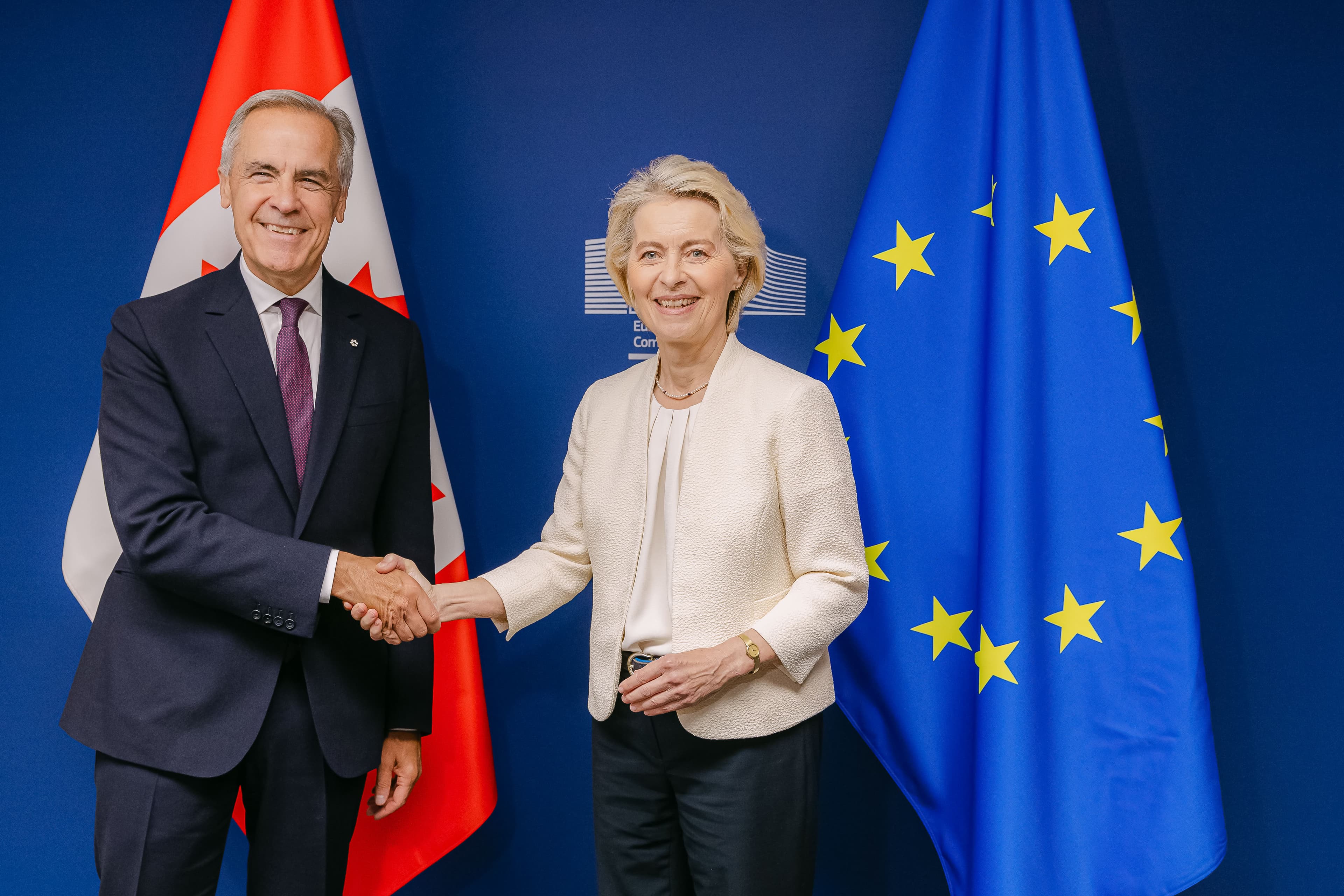
Should Canada become an associate member of the European Union?
Explore the case context, sources and public responses.
More from this case
Read the full case“This alliance is a positive process, that's my response to the American president. Canadians are united that nobody is going to tell us what language we speak, no-one is going to dictate our culture, or with whom we can strike agreements internationally.”Read statement
“Yesterday, President von der Leyen spoke of moving beyond CETA to an alliance for the future – opening the door to Canada becoming the European Union’s first associate member. Canada welcomes this ambition – polling shows an overwhelming majority of Canadians support much closer ties with Europe.” … “I want to be precise about what I am not proposing. I am not proposing a third bloc in order to become a great-power rival – only with better manners.” … “We are pursuing resilience so that no one can control our open markets, impair our sovereignty, threaten our territorial integrity, or undermine our freedoms, our democracies, our rule of law.”Read statement
“Madame von der Leyen did what we may call a friendly exaggeration. … So it's an exaggeration, but it's a friendly one, because it shows how much she's willing to have close links with us. … Canada doesn't want to transfer sovereignty, whether federal or provincial, to Brussels. That's something that will not happen. And the EU cannot give to Canada all the advantages of the EU without the constraints, because the EU members would say it's unfair for us. … Maybe she did not choose the right words, but it's a good wake-up call for everyone.”Read statement