
Meta's description of Muse credential handling
Meta, in its public description of Muse's security model
“Muse "has no visibility into people's passwords or payment methods," and credentials a user shares "go into secure storage, so Muse can use them without seeing them, including passwords a person types into the browser themselves."”
Source and context
Reporting
About this source
GeekWire report that Amazon blocked Meta's Muse personal AI agent from shopping on Amazon.com, with Amazon's stated reasons (no advance notice, no self-identification, credential handling), the text of the popup shown to users, Meta's response about credential storage, and the companies' prior contacts before the block.
Before the quotation
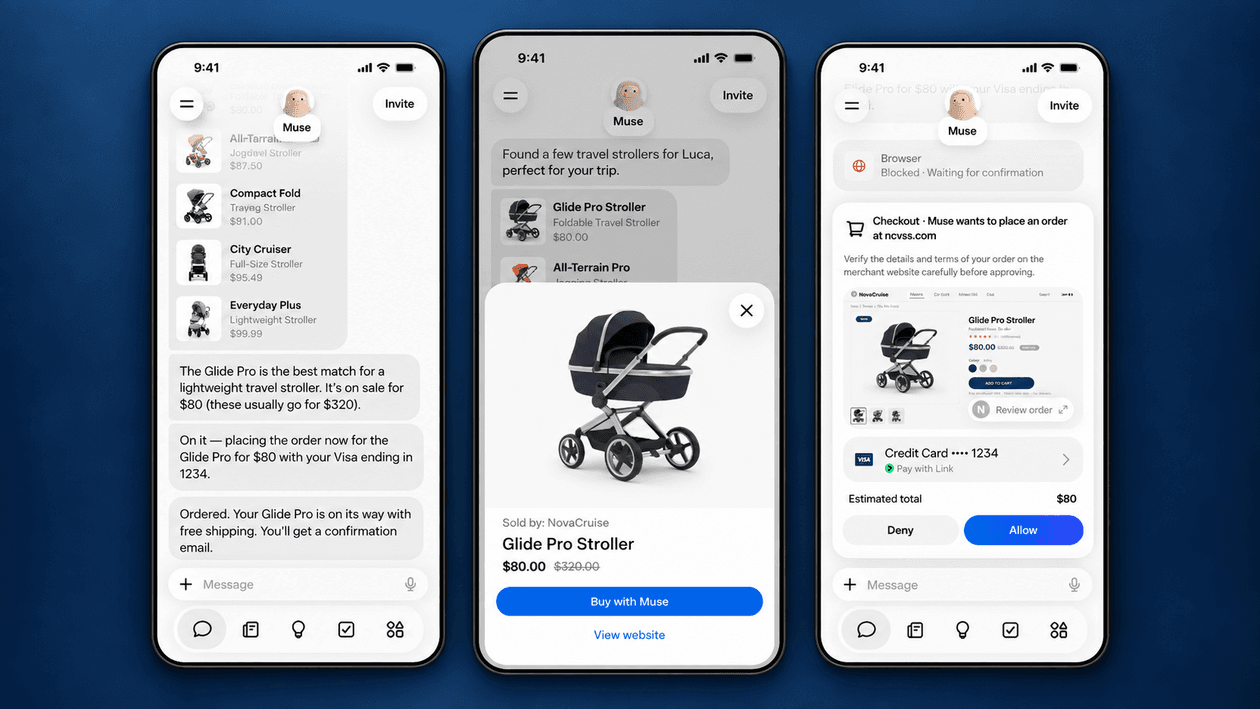
Amazon told reporters that Muse appears to capture and store customer login credentials and does not identify itself as an automated agent. Meta's statement about credential handling predates the block; GeekWire republished it in coverage of the dispute.
After the quotation
As of September 28, 2026, we could not locate a detailed public statement from Meta addressing the block itself. Meta announced a partnership with Shopify for some of Muse's shopping features.
How this statement is classified
Case context: Should Amazon be allowed to block Meta's Muse agent from shopping on its site?
The label describes this statement’s response within the context above.
Why this label?
Amazon's stated reasons include an apparent capture and storage of customer credentials; Meta's statement directly denies that characterization of how Muse works.
- Recorded on
- Published here
- People and groups discussed
- Amazon
Should Amazon be allowed to block Meta's Muse agent from shopping on its site?
Explore the case context, sources and public responses.
More from this case
Read the full case“This is bigger than a dispute over bot detection or website access. We are moving toward a world where agents will increasingly act as our representatives online. The companies that control the rules of access will have enormous influence over whether those agents actually work for the consumer.”Read statement
“It is only a matter of time before there is an Apple and Google version of Muse and possibly TikTok, in addition to the frontier LLM agents. Every app that is a services, marketplace or commerce app will need to existentially decide to open [Application Programming Interfaces] for consumer agents to interact. Smaller players have no choice. Either the consumer benefits or distribution aggregators will demand a higher transaction fare.”Read statement
Amazon
“We think it's fairly straightforward that third-party applications that offer to make purchases on behalf of customers from other businesses should operate openly and respect service provider decisions about whether or not to participate.”Read statement