
Explainer
What does the Fourth Amendment protect?
The Fourth Amendment protects people against unreasonable searches and seizures by the government. Courts generally require a warrant from a judge, based on probable cause, before officers search a home, with exceptions such as consent and emergencies.
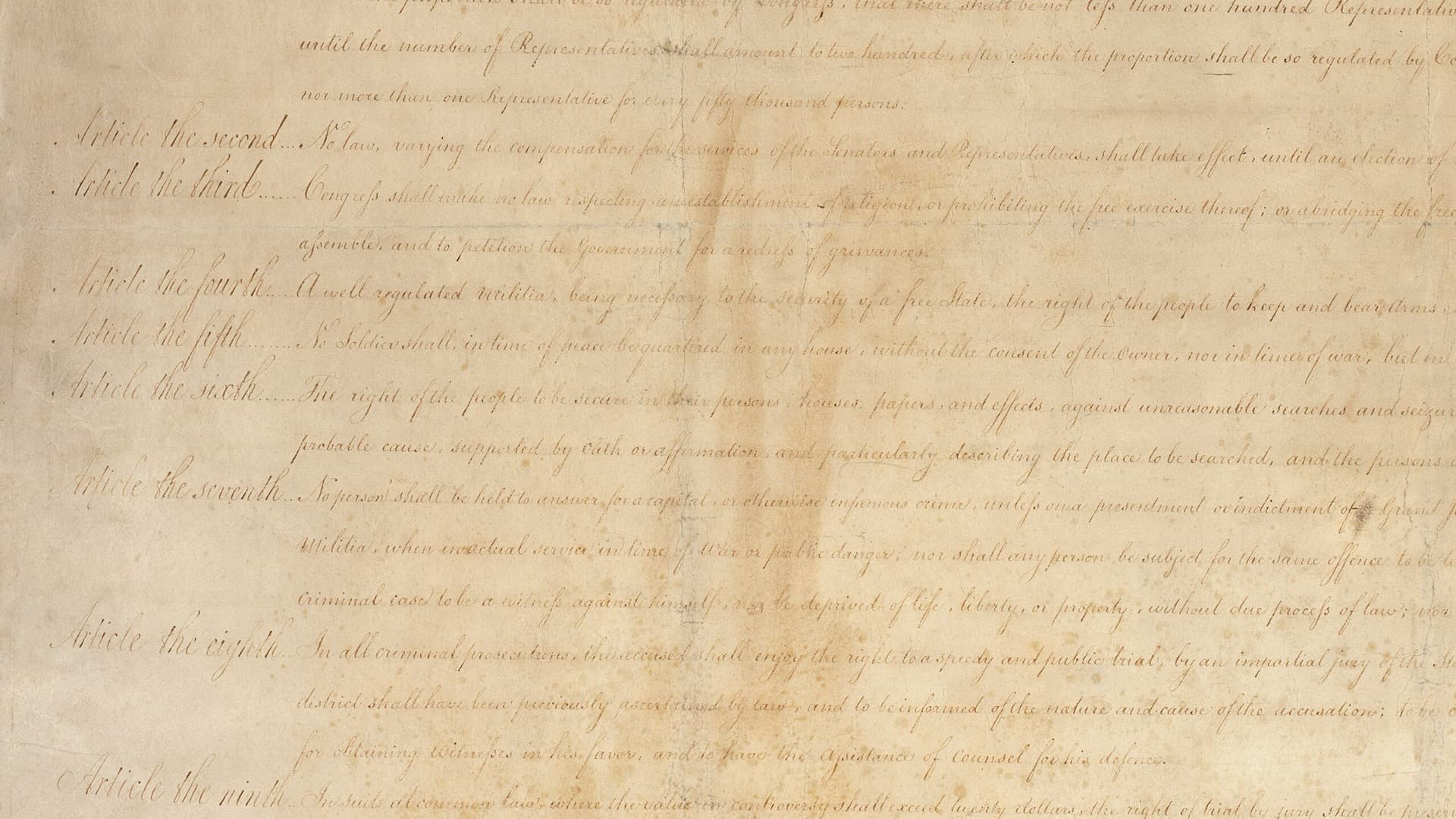
What the amendment says
The Fourth Amendment, ratified with the rest of the Bill of Rights on December 15, 1791, reads: "The right of the people to be secure in their persons, houses, papers, and effects, against unreasonable searches and seizures, shall not be violated, and no Warrants shall issue, but upon probable cause, supported by Oath or affirmation, and particularly describing the place to be searched, and the persons or things to be seized."1
It has two parts. The first bars unreasonable searches and seizures. The second sets the conditions for a warrant: probable cause, a sworn statement, and a specific description of the place and of the people or things involved.1 The Supreme Court has read the two together. In Katz v. United States (1967), it said that searches conducted without prior approval by a judge or magistrate "are per se unreasonable under the Fourth Amendment," subject only to "a few specifically established and well-delineated exceptions."2
What counts as a search
The amendment applies only to a search or a seizure, so many disputes begin with whether one happened. In Katz, FBI agents recorded a man's calls with a device attached to the outside of a public telephone booth. The Court held that this was a search, saying that "the Fourth Amendment protects people, not places." Justice John Marshall Harlan's concurrence set out the test courts still use: a person must have shown an actual expectation of privacy, and the expectation must be one "that society is prepared to recognize as 'reasonable.'"2
Information shared with a business gets less protection. In Smith v. Maryland (1979), the Court held that recording the numbers dialed from a home phone, through equipment at the phone company, was not a search, because "a person has no legitimate expectation of privacy in information he voluntarily turns over to third parties."3 Location records have tested that rule. In Carpenter v. United States (2018), the Court held that obtaining seven days of a person's cell-site location records was a search, while saying the decision did not disturb Smith.4 In Chatrie v. United States (2026), it held that police conducted a search when they acquired a person's location data from Google.5 Courts are now applying these cases to license-plate readers. Most have found no search, and a federal judge in Oklahoma ruled the other way in October 2026.6
Warrants and their exceptions
A warrant is permission from a judge. The Congressional Research Service notes that the Supreme Court "has also long held that, absent certain exceptions, the Fourth Amendment prohibits the government's nonconsensual entry into a person's home without a judicial warrant." Recognized exceptions include consent and exigent circumstances, such as a risk of harm to the public or the potential destruction of evidence, and the protection can extend to the non-public parts of a workplace.7
Those rules are being tested at job sites. In September 2026, a federal judge in Alabama, ruling in a suit by a U.S. citizen construction worker, temporarily stayed three alleged Department of Homeland Security policies, including entering private construction sites without a warrant or consent. The order quotes a DHS regulation that bars immigration officers from entering non-public areas of a business to question workers without a warrant or consent. The government argued that a construction site is like an open field that officers may enter without a warrant, and a DHS official said he knew of no such policy in his area.8
A warrant is only as sound as what the judge is told. When a California sheriff seized about 650,000 ballots under search warrants, the state Supreme Court ruled the seizure unlawful under state election law. In a concurring opinion, Justice Goodwin Liu noted that the court that issued the warrants had not been told of the county registrar's earlier explanation of the claimed ballot gap, information he called "plainly material to whether there was probable cause of criminal activity."9
Administrative warrants in immigration cases
Most immigration arrests rest on a different document. According to the Congressional Research Service, "warrants issued by ICE are purely administrative, as they are neither reviewed nor issued by a judge or magistrate, and therefore do not confer the same authority as judicially approved arrest warrants."7 ICE's Fugitive Operations Handbook, as quoted by Sen. Richard Blumenthal, says: "Neither a Warrant for Arrest of Alien (I-200) nor a Warrant of Removal (I-205) authorizes officers to enter the target's residence or anywhere else where the target has a reasonable expectation of privacy."10
A May 12, 2025 ICE memo, disclosed by whistleblowers in January 2026, takes a different view. The Associated Press reported that it says officers may forcibly enter homes to arrest people with a final order of removal using only a Form I-205, after knocking and announcing themselves. Homeland Security spokeswoman Tricia McLaughlin told the AP that everyone served with such a warrant has already had "full due process and a final order of removal" and that the issuing officers have found probable cause.11 Blumenthal called the policy "directly contrary to Fourth Amendment law."10 Some states have added rules of their own. Gov. Ned Lamont's spokeswoman said that beginning October 1, 2026, Connecticut law requires ICE agents to show a judicial warrant to enter protected spaces such as courthouses.12
When the rules are broken
The main remedy comes in criminal court. In Mapp v. Ohio (1961), the Supreme Court held that "all evidence obtained by searches and seizures in violation of the Constitution is, by that same authority, inadmissible in a state court," extending the exclusionary rule to state prosecutions.13 The Oklahoma plate-reader ruling applied it, suppressing the evidence found after the deputy's warrantless query.6
Suing federal officers for money is harder. In Egbert v. Boule (2022), the Supreme Court held that a man could not sue a Border Patrol agent for excessive force under Bivens, the 1971 decision that allowed some damages suits against federal officers.14 People can still ask a court to stop a practice going forward, as the Alabama construction worker did.8
History
- December 15, 1791
The states ratify the Bill of Rights, including the Fourth Amendment.1
- 1961
In Mapp v. Ohio, the Supreme Court bars unlawfully obtained evidence from state trials.13
- 1967
In Katz v. United States, the Supreme Court holds that recording calls from a phone booth without a warrant was a search.2
- 1979
In Smith v. Maryland, the Supreme Court holds that recording the numbers a person dials is not a search.3
- June 22, 2018
In Carpenter v. United States, the Supreme Court holds that obtaining seven days of cell-site location records is a search.4
- June 8, 2022
In Egbert v. Boule, the Supreme Court rejects a damages suit against a Border Patrol agent.14
- May 12, 2025
An ICE memo says officers may enter homes with an administrative warrant alone to arrest people with final removal orders.10
- June 29, 2026
In Chatrie v. United States, the Supreme Court holds that acquiring a person's Google location data was a search.5
- September 21, 2026
A federal judge in Alabama temporarily stays alleged DHS policies, including warrantless entry onto private construction sites.8
- October 1, 2026
A federal judge in Oklahoma suppresses evidence found after a warrantless search of a car's plate-reader history.6
What is disputed
Whether immigration officers may enter private construction sites without a warrant or consent, or whether such sites are open fields.
See the case: Did DHS violate the Fourth Amendment with warrantless immigration raids on Alabama construction sites?Whether looking up a car's stored plate-reader history is a search that requires a warrant.
See the case: Did a deputy's warrantless query of Flock license-plate data violate the Fourth Amendment, as a federal judge in Oklahoma ruled?Whether members of Congress's phone toll records, obtained from carriers by grand jury subpoena rather than a warrant, were properly collected.
See the case: Were members of Congress's phone records and text messages properly obtained in the Arctic Frost and Jack Smith investigations?Whether the warrants a California sheriff used to seize ballots rested on probable cause.
See the case: Was Riverside County Sheriff Chad Bianco's seizure of about 650,000 ballots lawful?Whether ICE must show a judicial warrant to make arrests in protected spaces such as Connecticut courthouses.
See the case: Did ICE's conduct at the Meriden, Connecticut, courthouse violate the state's TRUST Act?
Sources
- The Bill of Rights: A Transcription (National Archives), Amendment IV (opens in a new tab) · Saved copy (opens in a new tab)
- Katz v. United States, 389 U.S. 347 (1967), opinion of the Court and concurring opinions (Legal Information Institute) (opens in a new tab) · Saved copy (opens in a new tab)
- Smith v. Maryland, 442 U.S. 735 (1979), opinion of the Court (Legal Information Institute) (opens in a new tab) · Saved copy (opens in a new tab)
- Carpenter v. United States, 585 U.S. 296 (2018), No. 16-402, opinion of the Court (opens in a new tab) · Saved copy (opens in a new tab)
- Chatrie v. United States, No. 25-112 (U.S. June 29, 2026) (opens in a new tab) · Saved copy (opens in a new tab)
- United States v. Kyle, No. 4:26-cr-00189-SEH, Doc. 62 (N.D. Okla. Oct. 1, 2026) (Opinion and Order granting motion to suppress) (opens in a new tab) · Saved copy (opens in a new tab)
- Immigration Arrests in the Interior of the United States: A Primer, CRS Legal Sidebar LSB10362 (updated June 13, 2025) (opens in a new tab) · Saved copy (opens in a new tab)
- Venegas v. Homan, No. 1:25-cv-00397-JB-N (S.D. Ala. Sept. 21, 2026), order on motion for preliminary injunction (Doc. 106) (opens in a new tab) · Saved copy (opens in a new tab)
- Cervantes v. Bianco (S295866), opinion of the Court and concurring opinion of Justice Liu (opens in a new tab) · Saved copy (opens in a new tab)
- Letter from Sen. Richard Blumenthal to FLETC Director Benjamin C. Huffman on ICE's use of Form I-205 to enter homes (January 21, 2026) (opens in a new tab) · Saved copy (opens in a new tab)
- Memo tells ICE officers to enter homes without judge's warrant (Associated Press report, published by FOX 5 DC) (opens in a new tab) · Saved copy (opens in a new tab)
- CT law limits federal ICE agents. Debate is over whether it can it be enforced or needs to change (opens in a new tab)
- Mapp v. Ohio, 367 U.S. 643 (1961), opinion of the Court (Legal Information Institute) (opens in a new tab) · Saved copy (opens in a new tab)
- Egbert v. Boule, No. 21-147 (U.S. Supreme Court, June 8, 2022) (opens in a new tab)
Last reviewed October 7, 2026. We review this explainer when a case that uses it changes. Report an error