
Tinoco calls the sheriff's reading of the ballot-custody law erroneous and does not oppose the writ
Riverside County Registrar of Voters and respondent in Cervantes v. Bianco (through counsel)
“As a county election official, Respondent is required to comply with all facially valid warrants and orders issued by courts of competent jurisdiction. His compliance with such judicial process should not be construed to mean that he acted unlawfully or failed to fulfill his obligations under the Elections Code. … Consistent with his obligations as an elections official, Respondent agrees that voted ballots and related election materials should be maintained, preserved, transported, inspected, retained, and administered in accordance with the Elections Code and under procedures designed to protect ballot security, transparency, accountability, and public confidence in election administration. Respondent therefore does not oppose the relief requested in the Petition and respectfully submits that issuance of the requested writ would further those objectives by ensuring compliance with California law governing the custody and handling of election materials. … Sheriff Bianco contends that section 15551 does not impose an absolute custodial requirement because courts must harmonize the Elections Code with the Penal Code by permitting seizure of voted ballots pursuant to a valid judicial warrant. … Respectfully, that interpretation is erroneous, as it cannot be reconciled with the text and structure of section 15551. … There is no evidence of suspected criminal wrongdoing by personnel within the Riverside County Registrar of Voters’ office. Likewise, there is no evidence that the integrity, preservation, or security of the ballots would be jeopardized by their continued custody by the Registrar, the very official to whom California law assigns responsibility for maintaining and preserving election materials.”
Source and context
Original text
About this source
The Registrar of Voters' return in the California Supreme Court, verified by Art Tinoco. It states his position on ballot custody, on his own compliance with the warrants, and on the voters' request that the ballots be returned.
Archived copy (opens in a new tab)Original text
About this source
The California Supreme Court's unanimous opinion on the voters' petition. It holds that Sheriff Bianco's seizure of the ballots violated Elections Code section 15551(d), orders the ballots returned to the Riverside County Registrar of Voters, and summarizes the facts and the warrants.
Archived copy (opens in a new tab)Before the quotation
The voters sued Tinoco alongside Bianco, alleging that the registrar failed to uphold his duty to keep custody of the ballots when he acquiesced to the seizure.
After the quotation
Justice Liu's concurring opinion said the registrar could not be faulted for complying with a facially valid warrant issued under seal, and described his position as the same as the petitioners'.
How this statement is classified
Responding to: Elections Code section 15551(d) requires that voted ballots never be taken from the elections official's custody, so Sheriff Bianco violated it when he removed the Riverside County ballots from the Registrar of Voters, even under a search warrant.
The label describes this statement’s response within the context above.
Why this label?
The reference point is the sheriff's seizure and handling of the ballots. Tinoco says the sheriff's reading of section 15551, which would permit seizing voted ballots under a warrant, is erroneous and does not oppose the writ ordering their return, so he rejects the legal basis for the seizure. His defense of his own compliance with the warrants concerns his conduct, not the sheriff's, so condemns applies rather than mixed or conditional.
- Recorded on
- Published here
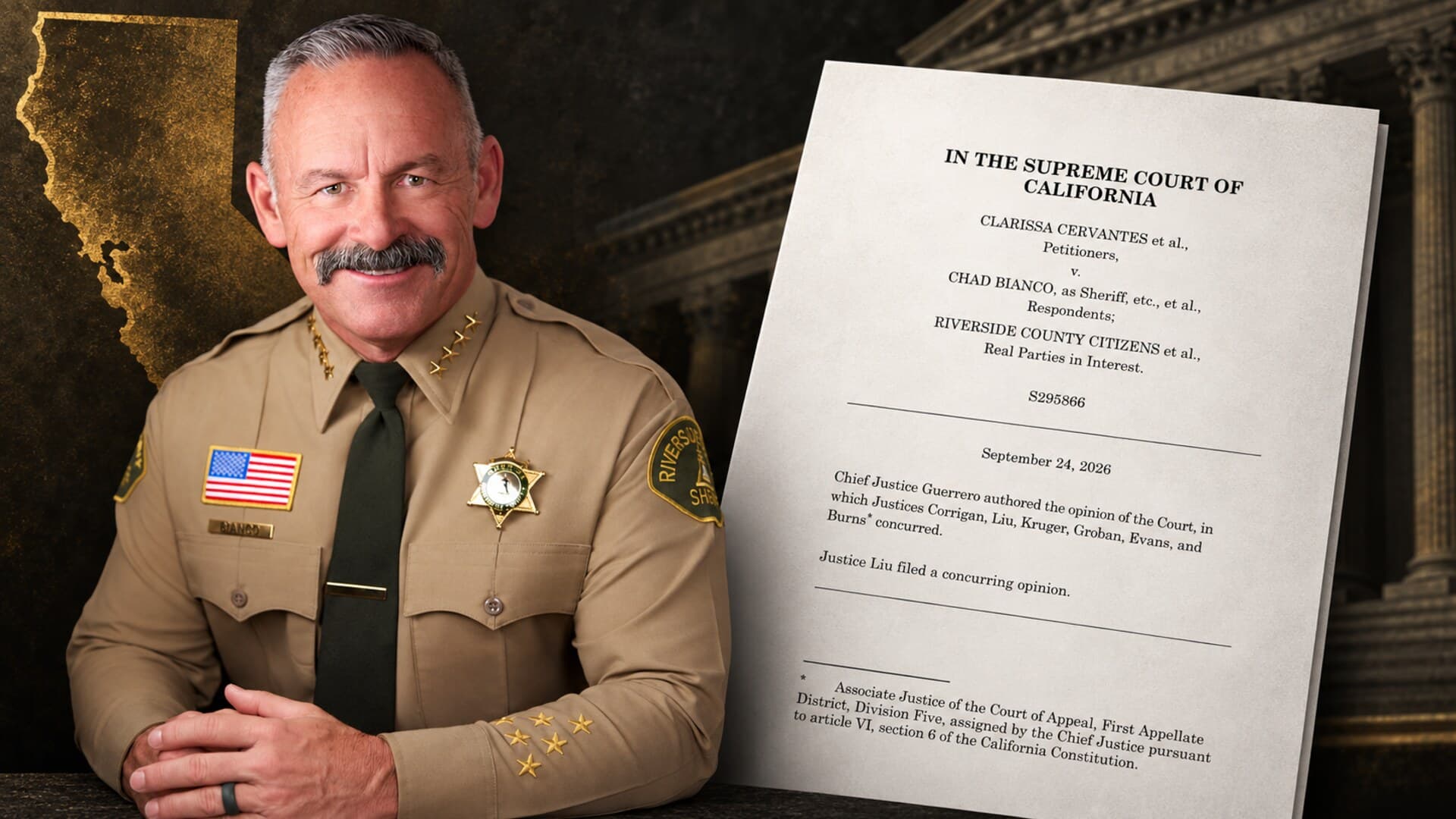
Was Riverside County Sheriff Chad Bianco's seizure of about 650,000 ballots lawful?
Explore the case context, sources and public responses.
More from this case
Read the full caseCampaign Legal Center
“Sheriff Bianco’s illegal seizure of ballots is a dangerous escalation and blatantly unlawful intrusion by law enforcement … In Riverside County and a growing number of localities across the country, actions like this risk disrupting critical chain of custody procedures, endangering sensitive voter data, sidestepping recount and contest procedures, and amplifying baseless claims, ultimately undermining the freedom to vote.”Read statement
“Governor Gavin Newsom today released the following statement in response to the California Supreme Court ruling Riverside County Sheriff Chad Bianco illegally seized hundreds of thousands of ballots from last year’s special election … Today’s ruling affirms that in California we will defend democracy — using every branch of government. And the new laws I signed just last week add new protections so attacks like this cannot happen again. People deserve to know their ballot is counted and secure, and in California we will do everything we can to protect that constitutional right — this year, and beyond.”Read statement
“Election fraud can and should be investigated. But misuse of criminal investigative tools — without any evidence that a crime was committed — needlessly undermines trust in our elections system and in law enforcement. After the Sheriff took the extraordinary step of obtaining warrants to seize control over voted ballots, I made a modest request to him: pause your investigation, preserve all evidence, and provide the information needed for my office to review the allegations. Instead, Sheriff Bianco pressed forward with the seizure of hundreds of thousands of ballots. The Court has now made clear that this kind of defiance cannot stand, that the Attorney General has the authority to intervene when sheriffs take improper action, and that voted ballots belong in the custody of elections officials.”Read statement